




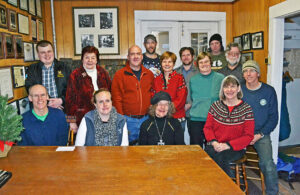
The Hardwick Gazette became a community owned nonprofit organization on January 1, 2024. Pictured in front (from left) are Vanessa Fournier, photographer; Sandy Atkins, production; Dawn Gustafson, production. The board members for the Northeast Kingdom Public Journalism Inc. in back (from left) are Elizabeth (Wiz) Dow, executive director/secretary; Jessie Upson, chair; David Kelley, treasurer; James (Skip) Duncan, director; Paul Fixx, interim editor/vice chair.
by Gazette Staff
HARDWICK — The Hardwick Gazette is beginning 2024 as a community-owned nonprofit publication.
On December 29, Ray and Kim Small donated The Gazette to Northeast Kingdom Public Journalism Inc. (NEKPJ), an organization created to manage and rebuild the finances and reach of the paper. This is just the twelfth ownership team for the paper since it was founded in 1889.
The non-profit board hopes offering the paper at no charge will bring back readers lost during the pandemic. With more readers, a mix of local donations, grants, and the return of lost advertisers, the new board envisions bringing back reporters and returning to print.
Fixx said that “board members are committed to seeing the Gazette return to covering more local news stories and filling the vital role it has served in the area for 134 years.”
For now, the Gazette will continue publishing online and be available at no charge. A new website at HardwickGazette.org will host the digital version. The archive of issues back to 2006 will soon be available there at no charge.
Starting in 2022, Ray Small, then the editor and publisher of the Gazette, started recruiting local residents to serve as directors of what was to become NEKPJ. In November of 2023, board members began meeting to plan the details of the transition in earnest. The board’s activities accelerated as the end of the year approached and it filed for 501(c)3 nonprofit status.
On December 29, Paul Fixx, vice chair and interim editor, met at the Gazette office in Greensboro with Ray Small to finalize the transfer of the newspaper’s assets. Fixx accepted the Smalls’ gift of the paper on behalf of NEKPJ, along with a cash donation to provide initial operating funds.
Hearing of the Smalls’ gift, an anonymous donor has offered to match the first $12,000 received from the community beginning with the publication of this January 10 edition. Donations can be accepted as tax-deductible pending IRS acceptance of NEKPJ’s application for nonprofit status. Donors will be notified of the outcome of the application as soon as a response is received.
The Smalls’ initial years with the Gazette went well, but the situation changed with the onset of the COVID pandemic.
Ray Small explained that “We heard about the Gazette through New York Times coverage of the essay contest to locate a new owner for the paper. We had no ties to the area, but trying to keep a local paper afloat seemed a good use of our time and energy. The first three years were good: we had five correspondents who covered the towns in our area, we started printing the front and back page in color, we launched the paper’s first website … all while closing in on financial breakeven.”
The pandemic changed that, as it did for many other companies.
Small reports that “We lost 90 percent of our ad revenue and all of our correspondents, and had to suspend the printed edition.”
Regarding his time as editor, Small added: “Despite the ups and downs, I always enjoyed putting out the Gazette and am extremely proud of what our writers and staff accomplished under very difficult circumstances. The Gazette continued its mission of providing local news to the towns in its readership area and – against the odds – survived the pandemic. I’m optimistic about the paper’s future as a community-owned nonprofit and will do what I can to help out during its transition.”
The Hardwick Gazette Began in 1889
by Elizabeth Dow
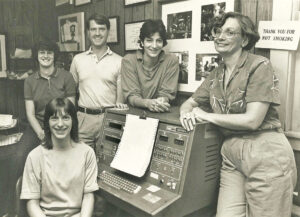
Eric Pope (second from left, back) and his wife Karen Pope (back right) owned the Gazette from 1977 to 1986. Dawn Gustafson (front) joined the paper in 1985 as a typesetter. Vanessa Fournier (back left) started working for the Gazette as the photographer in 1978. Lana Janci Bortolot (center) worked in production. The photo was taken in 1986.
HARDWICK – J. E. Harris launched the Hardwick Gazette in September of 1889. Other men in the Vermont newspaper world knew Harris and felt free to comment on his new paper, giving us some idea of what the first issue contained.
An unidentified writer for the Burlington Free Press described it as “a newsy sheet which the editor in his we-are-here statement…says [he] has come to stay and to grow.” Understanding that a local newspaper generally supported the establishment in the town it served, the writer observed that “Hardwick’s granite interests ought to be well looked after now and the townspeople will undoubtedly give the new enterprise the patronage it deserves.”
A writer in the Northfield News read the first issue and wrote, “He salutes the community in which he has cast his lot” with an introductory editorial. In it he “makes confession of some of his failings, leaving it to time and his newspaper to reveal the rest.” The writer then observed that Harris did not seem to have ‘many politics’,” and that his religious views “do not carry him beyond the annual camp meeting,” meaning he does not advocate for any particular religious point of view.
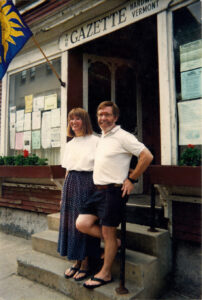
Susan Jarzyna (left) and her husband Ross Connelly (right) bought the Gazette from the Popes in 1986. Susan passed away in 2011. Ross sold the paper in 2017. Their picture was taken in 1996.
A writer for the Richford Journal and Gazette observed that “John has not lost any of his vigorous style of stating facts, and if pith and point will help to success the new paper will succeed.
The paper succeeded enough to afford another employee. In October, D. W. Jenness, of Danville, took the job of “canvassing for the Hardwick Gazette.”
The oldest available issue of the Hardwick Gazette appeared on September 13, 1890 — the second issue of its second year of publication. Printing on both sides of a single sheet of 24-inch by 35-inch paper, it folded into a four-page newspaper measuring 17.5 inches by 24 inches; it stayed that size for the next 130 years it remained in print.
Page one contained a combination of feature stories about “Life in a Big City” and news from New England, Washington, D.C., and anywhere else that grabbed Harris’ attention — most them fairly sensational accidents, murders, Russian barbarity, and missing ships. It also included a column listing the current commodity prices in Boston. The issue contained no advertising.
Page four contained more features, but none of them as sensational as those on the front page: serialized fiction, a poem, advice to farmers, advice to housewives, classified ads, and lots of advertising, nearly all of it for nationally available patent medicines.
Ray and Kim Small bought the Hardwick Gazette from Ross Connelly in 2017 and owned it until 2023. Staff and correspondents included (left to right) Jim Flint, Erica Baker, June Cook and Dawn Gustafson; middle row (left to right) Tyler Molleur, Sandy Atkins, Ray and Kim Small, Vanessa Fournier and Eric Hanson; back row (left to right) Ron Touchette, Michael Bielawski, Doug McClure and Will Walters. The photo was taken in 2017.
Pages two and three of the September 1890 edition contain local news and advertisements. In 1890, South Hardwick (now Hardwick village) had no water system, and its population had grown so dense that it needed one. The best source, the springs on the Bridgman farm above the village, remained out of reach as the “Misses Bridgman” refused to allow a reservoir on their land.
On these inside pages, people also found the train schedule for the three east-bound and west-bound trains that rolled through town every day, and a schedule for the mail delivery at post offices in the area.
Advertisers included lawyers, banks, insurance agents, and local merchants highlighting specials and new arrivals. G.H. Schoolcraft announced that he had emancipated his son, Merton J. Schoolcraft “for the rest of his minority” and that G.H. would “claim none of his earnings or pay any of his debts” beginning on September 10, 1890.
Hardwick Academy and Graded School, then both the local school for Hardwick District No. 1 and a private academy for high school students paying tuition, advertised its program and rates for the 1890-1891 school year.
The Gazette wasn’t Hardwick’s first newspaper. Between 1871 and 1873, M.T. Hatch, in East Hardwick, edited the Hardwick Reporter. Newspapers.com holds two issues, one each from 1871 and 1873. Like most local newspapers, it carried very little local news beyond advertisements, the railroad schedule, and legal notices. Instead, it filled its pages with informative or amusing clippings from other newspapers around the country. People learned local news at the store or post office or church.
By 1888, it had become clear to anyone paying attention that South Hardwick had a robustly growing granite industry, and J.E. Harris saw a business opportunity.
Born in Cabot in 1858, Harris attended the local elementary school and academy, then read the law. He passed the bar in 1879 and practiced in Danville for two years before going into the newspaper business by buying the St. Johnsbury Index. We know he left that paper and moved to Burlington, but we don’t know details about the next ten years.
He had once owned a portion of the Burlington Clipper, but in 1888 he served as its local editor and office manager. In June, 1889, he announced he would start a paper in Hardwick, provided he could get an initial subscription of 400 names from Hardwick, Walden, Greensboro, Woodbury, and Craftsbury.
By August 5, Harris had moved to East Hardwick and advertised for “A good all-around printer to take charge of a country office.” Three weeks later, W.A. Palmer moved to Hardwick “to take charge of the office of the new paper to be edited there by J.E. Harris.”
Every newspaper contains the first draft of history, and with the coming of the Hardwick Gazette, the events that make up Hardwick’s history received a great deal more scrutiny than they had.

