



VERMONT – As floodwaters swept through Vermont earlier this month, communities sought to share and receive emergency updates as quickly as possible. Some turned to town Facebook pages, some exchanged observations with neighbors at the general store, and some waited for official updates to get the information they needed to stay safe.
Clear, timely alerts “could be imperative for life safety,” said Brett LaRose, the operations and logistics chief for Vermont Emergency Management. In an emergency, he said, every second counts.
When Vermonters waste time making calls and scanning social media platforms in search of updates they can trust, they have less time to prepare for flooding events and, eventually, to recover from them, according to Jason Van Driesche, chief of staff for the communications platform Front Porch Forum.
Though a statewide alert system, Vermont Emergency Management’s VT-ALERT platform, disperses location-specific information via text, email, phone calls and a mobile app, it doesn’t have a broad reach.
Just under 64,000 people have registered for VT-ALERT, according to LaRose. “Pushing out awareness about the VT-ALERT notification system is an annual priority,” he said. “I would like to see a much larger number.”
When registering for VT-ALERT, Vermonters can select what municipalities they want to receive notifications for and what categories of notifications they want to receive including health alerts, weather warnings and more. It’s more granular than the Wireless Emergency Alert system that the state uses, which delivers urgent threat-to-life and missing person notifications to most phones without a registration process.
But many towns, specifically those in rural Vermont, don’t have enough staff to regularly send updates to state officials who run VT-ALERT, or to run a branch of the system entirely on their own. And even if they did, many of their residents aren’t subscribed to VT-ALERT.
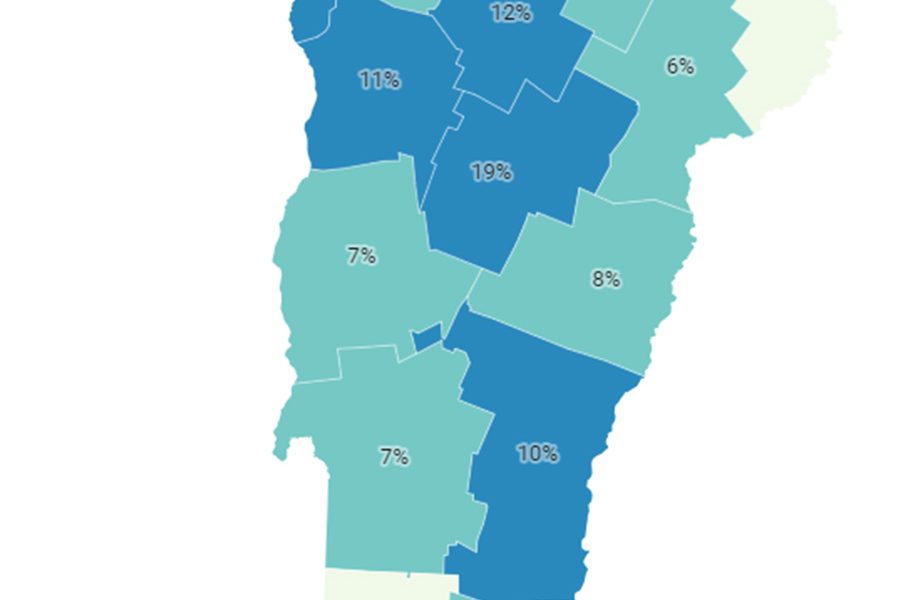
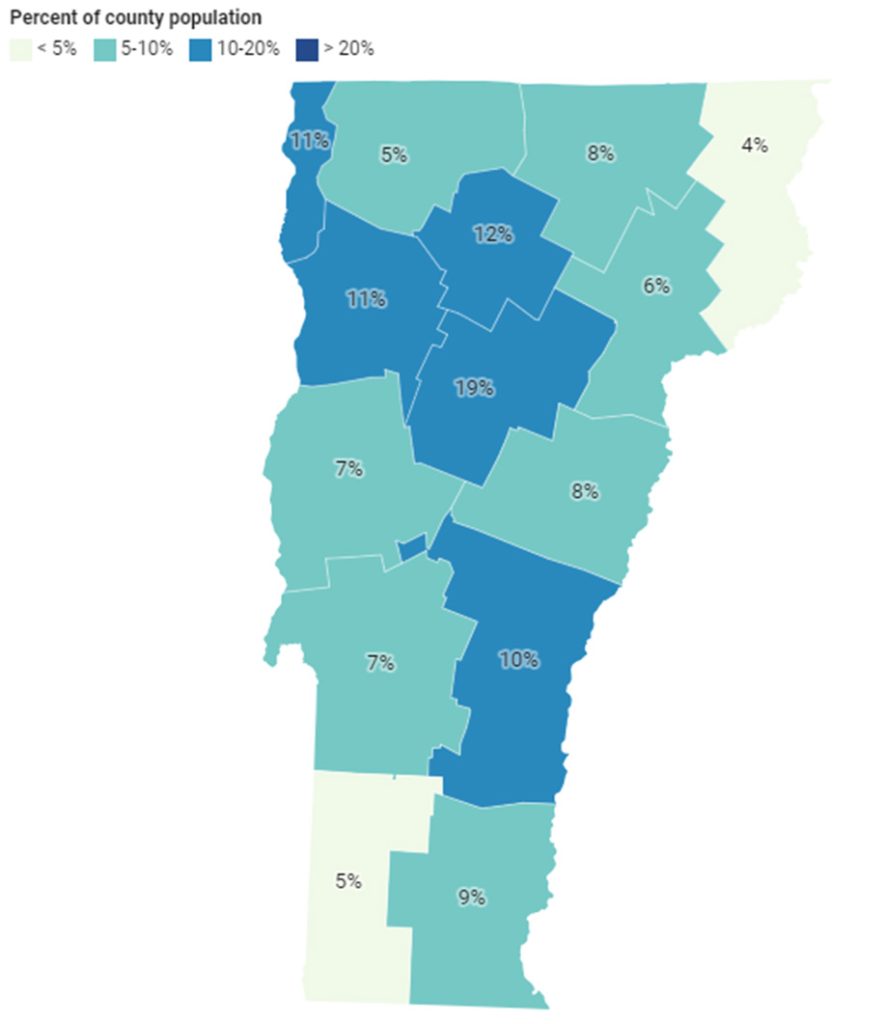
Washington County, with just 19% of residents enrolled in the VT-ALERT system, nonetheless has the highest rate of participation of any Vermont county. In rural Essex County, which has the lowest percentage of VT-ALERT subscribers, only 226 people have signed up out of around 6,000 inhabitants.
Vermont Emergency Management
Vermont-Alert subscribers by county
Town officials sometimes use other virtual platforms that have a wider reach.
Front Porch Forum has about 235,000 members in Vermont, Van Driesche said, almost four times the number of VT-ALERT subscribers. Even though crisis communications have never been “front and center” in the company’s mission, he said, announcements about road closures, emergency shelters and more have become more common as town officials use the platform as their megaphone during crises.
But even Front Porch Forum posts take time to craft and distribute to subscribers: time that town officials might not have at the height of an emergency.
In the Northeast Kingdom town of Lyndon, town officials use Facebook as their main avenue to communicate with residents, according to Assistant Town Clerk Denise Montgomery. In the wake of this month’s floods, posts have ranged from boil water notices to instructions for how to report flood damage.
Lyndon leaders don’t send updates to the state officials who run VT-ALERT, according to Montgomery. “We just don’t have the time to get on board (with VT-ALERT) right now,” she said, considering the energy and resources it takes to recover from the floods, especially in Caledonia County, which saw the most rainfall during the July 10 storm.
Sen. Ruth Hardy, D-Addison, said that she has become a source of emergency information for her constituents. During the pandemic, she began releasing updates and resources via email and Front Porch Forum. “I heard from a lot of constituents that I was really the only one that provided them with information,” she said.
“I take that really seriously, as part of my responsibilities as a state senator,” she continued, “especially in times of crisis.”
These means of communication all take time and money. At the moment, Hardy said, it feels like a public service that’s being privately funded.
Sen. Andrew Perchlik, D/P-Washington, agrees with Hardy that the model must change. He said relying on under-resourced individuals in rural communities is not a sustainable model for emergency communications, especially when volunteer emergency management directors have limited bandwidth and little professional assistance.
And while there are three regional coordinators for Vermont Emergency Management responsible for connecting local officials with the department’s resources, Perchlik said they are spread too thin to be substantially helpful on a local level. “It’s hard for that coordinator to be that much of a resource for all those little towns,” he said.
“I don’t have good answers,” Perchlik said, acknowledging the lack of funding for more professional staff in such small towns.
Montpelier’s communications coordinator, Evelyn Prim, said the city is exploring all avenues of emergency alerts, including a city-specific alert system.
“People are busy. They have lives. They don’t have time to read every newsletter,” Prim said. “So it’s all about having many systems in place so that people have options and don’t have to spend time wondering what to do when an emergency strikes.”
Prim said VT-ALERT is Montpelier’s “first line of defense” in emergency situations, largely because it has the widest reach of any of the city’s communication platforms, with about 10,000 subscribers. For hyper-local alerts, she can choose which subscribers within the region will receive messages. That comes in handy during floods, she said, when just a few feet in elevation can change how much a household is at risk.
“We have hills and waterways and low-lying areas and such a diverse landscape,” Prim said. “With (VT-ALERT) we don’t have to constantly bombard everyone with things that don’t necessarily apply to them. We can target it.”
But Prim also relies on other platforms, including Front Porch Forum, Facebook, Instagram and Notify Me, a messaging system run through the city’s website, to make sure residents can access emergency updates regardless of what technology they have access to.
Towns without communications departments have to get creative, according to Waterbury Municipal Manager Tom Leitz. When floods left many Waterbury homes and businesses underwater in July 2023, the town didn’t even have a Facebook page to communicate with its residents, he said. He started one a week later to start sharing information about flood recovery resources.
For the past year, he’s looked for an alert system that would best fit Waterbury’s needs. He said he found it in a system called TextMyGov, a platform also used by Middlebury.
“The great irony,” he said, is that he wasn’t able to schedule his training for the system until July 10, 2024, the day the rain that fueled this summer’s floods began.
He said the town will start rolling out the new system by the end of the month. Leitz opted for the system because it facilitates communication from town officials to residents, and vice versa
The platform will allow Leitz to get emergency updates to residents instantaneously, rather than hoping they find his messages in a stream of non-urgent Facebook or Front Porch Forum posts “about garage sales and missing pets.”
The system will eat into the town’s budget with its $5,000 annual operating fee and will add more to Leitz’s already overflowing plate of town responsibilities. But “it’s worth it,” he said, to keep locals informed and safe.
But some worry that informal platforms won’t always meet their needs.
For example, while public officials can use Front Porch Forum for free, they are limited in how much they can post “in order to keep the conversation centered on neighbors,” Van Driesche said. According to the company’s terms of use, Front Porch Forum can “set limits on the maximum number and/or size” of posts and “may reduce or eliminate the ability of selected categories of public officials to post on (Front Porch Forum) for a period of time before an election.”
Van Driesche said Front Porch Forum “typically exempt(s) any posting related to a significant emergency from those limits.” And Front Porch Forum staff members publish emergency alerts from town officials as soon as they come in, rather than waiting to post them in the typical evening newsletter, according to Chloe Tomlinson, the company’s community division director.
But Prim, in Montpelier, said Front Porch Forum staff didn’t consider her flood alerts this month to be related to a “significant emergency,” so she had to take steps to limit how much each city official was posting.
Hardy said that, at the moment, she can only post on Front Porch Forum twice a month: not enough to address locals’ concerns about flood recovery.
The Addison County senator chairs the Senate Government Operations Committee, and said she worked to address issues of emergency preparedness in the last legislative session. Act 143 provides for a number of improvements to emergency communications, including reviews of existing systems and expansion of their accessibility, as well as more cooperation between VT-ALERTS and the state’s Enhanced 911 Board.
That law took effect on July 1. “Obviously, they weren’t able to do anything in those 11 days (before this year’s flooding) to make any improvements,” Hardy said.
LaRose said that after the passage of Act 143, a task force was assembled to improve the state’s emergency preparedness, including its alert systems. The goal of the group, he said, is to “find solutions to be able to communicate with all people that live in the state of Vermont.”
This includes people with limited internet connection, people whose first language is not English, and people who are hard of hearing, he said.
Hardy said expanding accessibility is important but emphasized that it’s only a start. “It’s not an issue that we could solve just by passing a bill,” she said.
Some cities are taking the state’s lead and are reforming their communication systems now to prepare for the future.

Emma Malinak, VTDigger

