
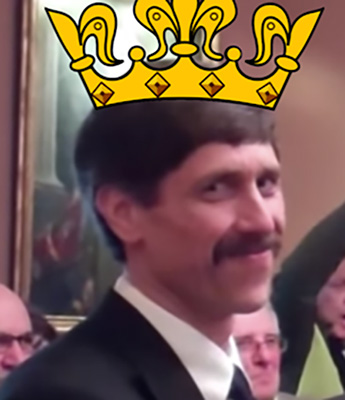

photo John Rodgers
John Rodgers is a curious sort of politician: He presents himself as a simple farmer, a rural populist who gives voice to the voiceless, meaning people who live outside the Burlington area. But John Rodgers, former Democratic state lawmaker turned Republican nominee for lieutenant governor, has seen his campaign picked up off the mat by major backing from Chittenden County elites. The Barons of Burlington, you might say.
These same people are writing batches of four-figure checks to a handful of Republican candidates for state Senate who have some chance of winning. The goal, clearly, is to kill the Democratic/Progressive super-majority in the Senate and end the truly historic string of veto overrides in the current biennium. It’s a long shot; the Republicans would need a net gain of four seats to end the super-majority. But if Rodgers wins, they’d only need three because the potential tie-breaking vote would be in their back pocket, though not for veto overrides. If there’s a tie on an override, it’s already lost.
A few months ago, this Barons of Burlington thing was kind of cute. Like, can you really expect to swing an election with a sprinkling of large donations? Now, it’s looking like a serious, coordinated effort beyond anything I’ve seen in my 12-plus years of walking this beat. I mean, all these people writing identical checks to the same handful of candidates? It’s beyond anyone’s notion of coincidence.
Rodgers got a very late start. He didn’t publicly announce his candidacy until May 24, which was less than one week before the major-party filing deadline. That late a start is usually a death sentence for a statewide campaign. Just ask Thomas Renner.
Rodgers reported zero activity in his July 1 campaign finance filing, but the floodgates opened immediately thereafter. And if you don’t think the Barons are coordinating their donations, get a load of this: On July 5 alone, Rodgers received $26,500, including one $2,000 gift, one at $500, plus 24 gifts of exactly $1,000 apiece.
It’s been onward and upward from there. Rodgers netted $44,950 in July, including only $1,450 in small donations (under $100) of the kind you’d expect a populist to get. In August, Rodgers only took in $18,660, including $1,325 in small gifts. Then, in September, the pedal hit the metal. Rodgers took in $59,324, of which only $2,374 came from small donors. In total, small donations have accounted for only 4.2% of his fundraising.
Let’s slice the cheese another way. Rodgers had raised $122,934 as of October 1. Of that total, $95,000 came in increments of $1,000 or more. That’s 77% of his total take. More than three-fourths of his money came from the Barons and their friends.
Even so, Rodgers hasn’t been able to catch up with the incumbent. Despite his gangbusters September, his $122,934 still lags far behind Zuckerman’s $188,511. (Eagle-eyed readers will notice that my dollar figures are slightly different from those cited in a recent VTDigger story. That’s because I count only financial contributions, while Digger combined cash gifts with in-kind donations. Which, I believe, is a departure from past practice.)
And where would he be without the Barons? Nowhere, that’s where. Which raises the question, if Rodgers were to win, whose interests would he really represent? Rural farmboys or city slickers?
(Rodgers’ filings include some… interesting… names. Former Vermont Democratic Party chair Jake Perkinson is one of those $1,000 donors. Environmental advocate and serial candidate for office James Ehlers has received $2,000 in consulting fees. And a certain “E Brown LLC” has pulled in $10,000 in consulting fees. E Brown is located in Waterbury, and is almost certainly Elizabeth Brown, the business-backed candidate whose challenge to incumbent Reps. Tom Stevens and Theresa Wood ended in an inglorious primary face-plant. Maybe Ehlers and Brown can advise Rodgers on how not to win an election.
Turning now to the Senate, where five Republican candidates have benefited from the Barons’ largesse: Rep. Scott Beck of Caledonia, Samuel Douglass of Orleans, Rep. Chris Mattos of Chittenden North, Rep. Patrick Brennan of Grand Isle, and Steven Heffernan of Addison. These five have put their Democratic opponents on the back foot financially, thanks to the Barons.
(There may be a sixth entry, by the way. Larry Hart, Sr. of Orange has only filed a single campaign finance account, the August 1 tally, which was submitted more than six weeks late, on September 19, which showed only $750 in fundraising. However, he has apparently boasted of having at least $30,000 in the bank for his challenge to longtime Democratic incumbent Mark MacDonald. If so, it almost certainly came from the Barons.)
Total fundraising: Brennan $65,412, Beck $60,637, Mattos $38,280, Heffernan $31,983, Douglass $30,626. Heffernan and Douglass were late additions to the Barons’ Early Christmas list.
Four-figure checks may seem almost quaint in a post-Citizens United world. But they’re big money by Vermont standards. It remains to be seen if the Barons’ investments will pay off in November; big spends on electronic media would be hugely wasteful, and how many postcards and yard signs can you effectively deploy?
The Democrats running against the Baron-backed Republicans have tried to keep pace with mixed success. Rep. Katherine Sims has more than doubled Douglass’ takings, with $60,514 in total fundraising. Democratic Sen. Andy Julow, appointed to the Grand Isle seat formerly held by the late Dick Mazza, has raised $39,360, with more than $10,000 coming from himself or his family. That’s still far short of Brennan’s total. Addison County incumbents Chris Bray ($35,288) and Ruth Hardy ($19,869) have raised a hell of a lot more than they have in the past, but that was more because of Rep. Caleb Elder’s unsuccessful primary challenge than because they were afraid of Heffernan. Bray has actually spent more than he’s raised, while Hardy has little left in the bank.
Democrat Amanda Cochrane, running for Jane Kitchel’s Caledonia seat, has raised $30,179, a boatload by Kingdom standards but far short of Beck’s ginormous haul. Chittenden North incumbent Irene Wrenner has stuck to her low-budget strategy, having raised only $13,710 compared to Mattos’ $38,280. Orange County’s MacDonald hasn’t budged from his low-dollar, minimal-effort approach to campaigning; his latest filing with the Secretary of State was a “No Activity Report.”
Aside from Wrenner and MacDonald, the Democratic candidates have tried to keep pace with the Baron-backed Republicans, and only Sims has succeeded. By the standards of any other year, the likes of Julow and Cochran would be fundraising superstars. Even Wrenner’s total would be creditable in any previous cycle.
Which makes one thing clear: If the Barons break the supermajority, they will have blown the roof off the cost of running for Senate. And that would be an unwelcome change from our traditionally human-scale approach to running for the Legislature.
John Walters is a member of the board of Northeast Kingdom Public Journalism, parent company of The Hardwick Gazette.

John Walters is the sole author of The Vermont Political Observer, readable for free (but donations cheerfully accepted) at thevpo.org. Walters has had a long career in print and broadcast journalism. He’s been an observer of Vermont politics since 2011, including a three-year stint as political columnist for Seven Days. He is on the board of NEK Public Journalism. He lives in East Montpelier with his loyal spouse, two house rabbits and two cockatiels.
