


WHITE RIVER JUNCTION – As the Vermont summer comes to an end, we want to spend a little more time thinking about beaches. Our minds might drift on warm afternoons from the state’s famous green mountains to distant, sandy shores. Yet while there is no coastline in Vermont, sandy beaches and even dunes can be found here, supporting an interesting suite of disturbance-adapted plants.
Beaches and dunes are dynamic habitats that remain open through natural disturbances, such as ice scour, wind energy, and wave action. As you may imagine, these open habitats, subject to wind and wave energy with dry sandy soils, are difficult places for plants to survive. As a result, beach plants have evolved various strategies to help them persist in these environments. These strategies include prostrate growth forms (low, creeping plants) that keep them out of the wind, hairy or succulent leaves to limit desiccation, long-term seed banking for optimal germinating conditions, and floating seeds to aid dispersal on nearby water.
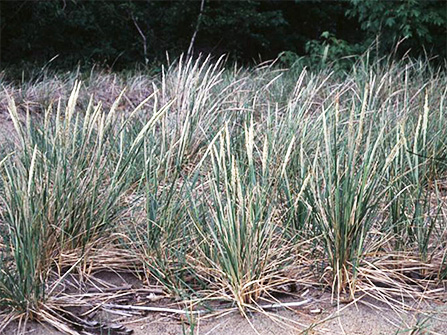
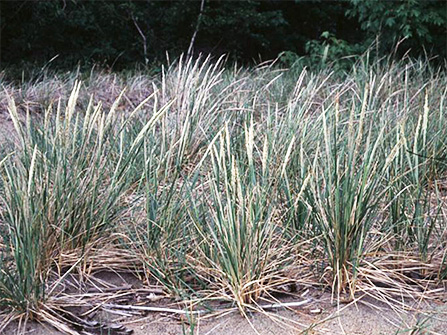
Still, these habitats are rare in Vermont, with sand dunes limited to Lake Champlain and sand beaches found primarily along Lake Champlain and bordering parts of only a handful of other large lakes in the state. Because these habitats are so limited, beach-dependent plant species are rare. A few examples are Champlain Beach Grass (Ammophila breviligulata ssp. champlainensis), Beach Wormwood (Artemisia campestris ssp. caudata), Wright’s Spikerush (Eleocharis diandra), Beach Heather (Hudsonia tomentosa), Beach Pea (Lathyrus japonicus var. maritimus), Beach Pineweed (Lechea maritima var. maritima), and Seabeach Dock (Rumex pallidus), which is only known from historical records.
The state-endangered Lake Champlain Beach Grass can only be found along the shores of Lake Champlain, Lake Ontario, and the St. Lawrence River. It is an earlier-blooming subspecies with smaller inflorescences than the widespread Beach Grass (Ammophila breviligulata ssp. breviligulata). Our local subspecies resulted from the westward expansion of breviligulata along the ancient Champlain Sea followed by isolation from other populations when land rebounded and separated Lake Champlain from the Atlantic Ocean.
Next time you visit beach habitat on one of our larger lakes, take a minute to observe some of the plants in the sand and consider the strategies they need to grow, reproduce, and disperse seeds in these difficult conditions.
Ryan Rebozo is a staff member of the Vermont Center for Ecostudies.

