



HARDWICK — On Center Road, peeking slightly through and above the trees, sits a field of atypical appearance: eighteen-foot tall poles arranged in rows are interconnected via wire and rope. Absent of vines and greenery in the winter months, stands the Whitefield Hop Yard.

by Raymonda Parchment
Kevin and Karen Broderick returned hops farming to Hardwick in 2017, after a 100-year hiatus. Since then, several developments have been in the works. Now the Broderick’s boast another addition at Whitefield Hop Yard, an animal similarly intertwined with the state’s history.
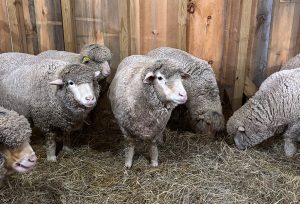
Recently, after several years of working on the logistics, the Brodericks acquired Saxon Merino ram genetics from Tasmania. Ultrasounds reveal most of their ewes are pregnant, some with twins. The Broderick’s have been raising Merino sheep in and around the hop yard for some time. This feat took time, effort, and much research on the Brodericks part.
Karen and Kevin provided background on how and why they got interested in growing hops, sheep farming, and how they connect to Vermont’s history.
“I started home-brewing my own beer and decided to grow a few hops in our garden to use for that,” Kevin said. “That went well and sometime later I noticed hop yards on an 1875 map of Hardwick that I had a copy of. That gave me the nudge to try growing hops here in Hardwick again. After discovering that there wasn’t a modern mill for pelletizing hops in Vermont, we decided to invest in a hop mill that pelletized hops with the high quality standards our craft brewers in Vermont require. Karen’s family has a strong history of farming in this area so she agreed that starting a hop farm was an interesting, if not good idea. She also has experience running and managing a small business and that knowledge and expertise has been invaluable for everything here.”
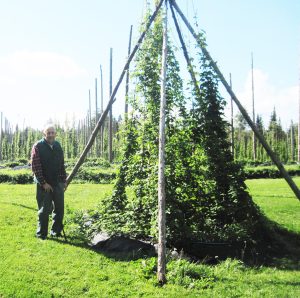
The Broderick’s grow several varieties of hops, one of which has a unique namesake and backstory. Upon finding feral hops growing in the area, the Brodericks sent off a sample to be tested against a national database. The sample came back unidentified, meaning the Brodericks had discovered a variety both unique to the area and native to Vermont.
by Raymonda Parchment
The Brodericks decided to name their discovery after Karen’s late father Leopold Dufresne. The Broderick’s reflected fondly on Dufresne’s role in the development of Whitefield Hop Yard, remembering his love for riding the tractor in and around the rows of vines.
Their interest in sheep began slightly differently.
Kevin said “While growing up in Brookfield, I had the chance to work for a nearby farm including one that had a flock of sheep. I really enjoyed working with sheep and had the idea that I would like to have my own flock. It prompted me to buy a book, way back then, about raising and caring for sheep that I still have on my shelf, all the years later. Another aspect of sheep that I find fascinating is their strong historic connections to Vermont, the Merino sheep craze started by William Jarvis in the very early 1800s, is a story every Vermont elementary school student should be familiar with.”
Kevin’s past interest in hops created a full circle moment later while attending a workshop at one of University of Vermont’s hop conferences.
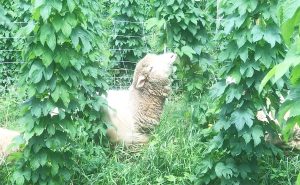
He said “I had the good fortune to hear Tom Barse talk about how he used sheep in his hop yard to weed and to prune the bottom three feet of each bone. Hops love air circulation, especially in our humid Vermont summers, so the clearing of weeds and leaves really helps them thrive. In addition to the weeding, sheep manure is a good source of fertilizer for hops. All that, plus my long-time interest in Merino sheep led us to look into raising Merino sheep in a way that could be mutually beneficial to the hops, sheep and respectful of the land.”
The Broderick’s search for Merino stock in the United States took time and effort, traveling around the country to build their flock.
Kevin said “I kept hearing the best Merino stock in the United States was known to be from three shepherds. The first, Bridget Kavannagh in Michigan. Another was Andy McMurray in Missouri. Lastly, Dr. Geof Ruppert in Pennsylvania was highly recommended. We purchased four ewes from Bridget and a super fine ram from Andy. Our other super fine ram was out of Geof and Barb Ruppert’s Merino stock. We now have nine breeding ewes. Several years ago, I learned about a line known as Saxon Merino sheep. After investigating that type of super fine Merino I put a note on a virtual bulletin board at New Zealand Sheep and Goat Association asking if anyone had Saxon Merino genetics available.”
Having waited for a long while, the Broderick’s eventually gave up on acquiring Saxon-Merino genetics.
“Months went by and I forgot about it, then I got an email reply to my post from none other than John Taylor. The Taylor family has been running the oldest pure Saxon Merino flock in Tasmania since the 1830s. After getting export and import agents, finding facilities that store frozen genetics, we had 400 doses from four of Winton’s best rams delivered to us from Australia.
“A few weeks ago, Dr. Rachael Weiss used the Winton Saxon ram genetics for the artificial insemination work on our ewes. Just last week, Dr. Geof Ruppert did ultrasounds on our ewes and seven of the nine are pregnant, several with twins. If all goes well we expect to have the lambs hit the ground the last week of April. They will be some of, if not the best Merino sheep in the United States and in the near future, available for Vermont and New England shepherds that want to improve or start their own flocks.”
by Kevin Broderick
The sheep are closely intertwined with the cultivation and maintenance of the crops at Whitefield Hop Yard. Sheep can be used to weed, prune, and control pests in hop yards. This can reduce the need for herbicides, fungicides, and commercial fertilizers. Sheep grazing can introduce organic fertilization, as well as improving soil structure.
Aside from their day job of pruning hop plants, the Broderick’s flock provides Merino wool, a soft fine yet durable fiber with similarities to cashmere. Thus far Aurora Spinnery, a mill owned by Kristen Gallagher has bought their wool fleeces this past year to make yarn.
Kingdom Fleece and Fiberworks of East Hardwick processed their wool, making beanies and gloves.
Kevin Broderick emphasized the importance of small family farms, the benefits of local production and how these practices benefit both the product and business.
by Raymonda Parchment
Broderick said “Our belief is that Vermont is best suited for small family-sized farms. The issue with small farms is they can’t really compete with large scale commercial farms on price. What our small Vermont farms can do is provide a unique product with high standards that would be impossible to achieve on a factory large scale farm operation.
“So far, people have been willing to spend a little extra for our hops because they are unique and in many ways superior to hops from the massive hop yards out west. People have also been willing to pay a premium for winter hats we sell that were made from our Merino wool. They know it is a unique Vermont product, and the softest, most luxuriously warm wool is from our animals that are ethically raised and cared for right here in the Northeast Kingdom.
“Everything we produce here on our small family farm is 100% biodegradable. We continue to learn and improve our farming practices out of deep respect for our friends, neighbors and fellow Vermonters.
Visit Whitefield Hop Yard online at whitefieldfarmvt.com

Raymonda Parchment is a Hardwick Gazette reporter. She recently graduated from Vermont State University - Castleton with a Bachelor’s Degree in English. She is a strong supporter of freedom of speech, and the right to publish information, opinions, and ideas without censorship or restraint. She is a lifelong lover of the written word, and is excited to join the team as a staff member.

I very much enjoyed this article about a local diversified family farm. I’d like to see more articles like this one.
Thanks. We hope to have more like it
I love this. I have known Kevin since he was thirteen. He and his wife are a real Vermont Power Couple. Amazing their vision, ambition, and ingenuity!
Thanks for your comment and for reading The Gazette.