




CABOT – Usually plays are turned into films but there is a certain trend of turning movies into plays, as in the case of “The Little Mermaid.” Originally a Disney animated musical which came out in 1989, based on Hans Christian Andersen’s tale, it has been adapted for the stage and was produced on May 8 through May 11 by the Cabot Community Theater in the Cabot School Performing Arts Center, combining a large cast of adult and child players.
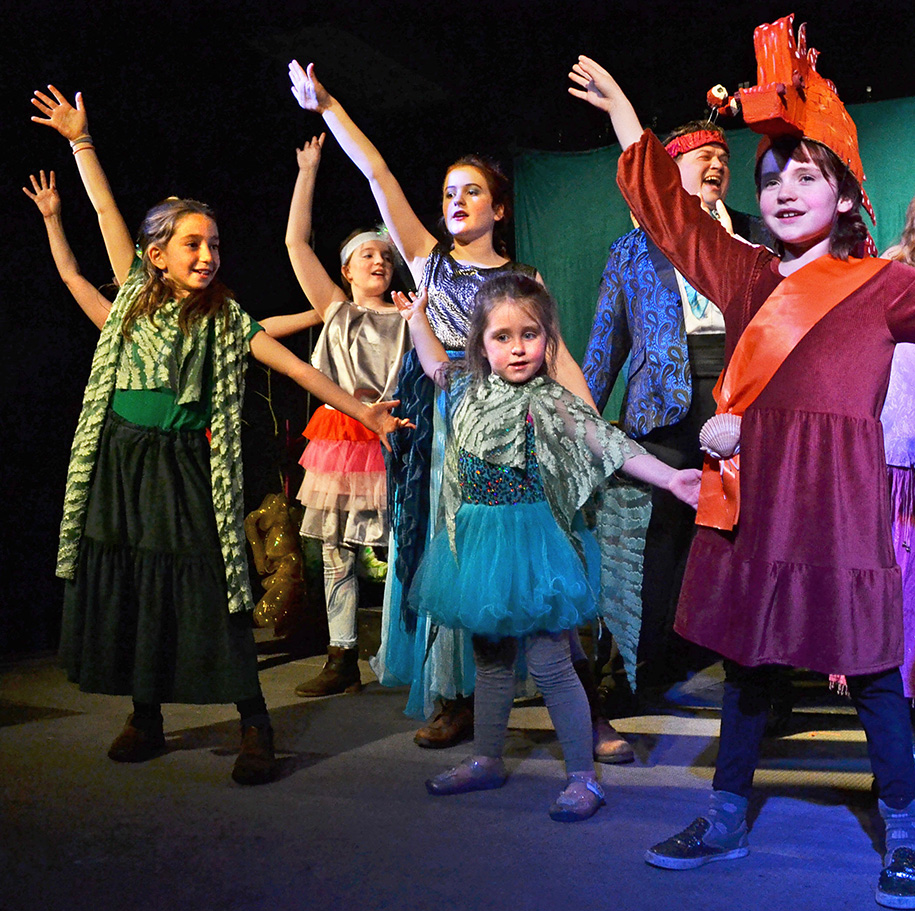
photo by Vanessa Fournier
The basic plot is fairly straightforward: a headstrong teenage mermaid (Ariel) rescues a young sailor (Eric) from a storm-wrecked ship and then falls in love with him She wants to lose her fish tail and grow legs, becoming a human being, but she gets no encouragement from her sisters and her father (Triton, King of the Ocean World). She makes a pact with the evil sister of her father (Ursula) to get a pair of legs, but with the trade off of losing her voice. After many difficulties she is finally able to marry the sailor, who turns out to be a prince. Happy ending!
Making a play from a movie illustrates something of each medium. In films, scenes change frequently, but in the theater a drama usually has a few acts with a limited number of scenes within them. In “The Little Mermaid” there were some 32 scenes, of short duration and requiring a constant moving of background props to suggest, for example, being underwater in Triton’s Kingdom, on a beach or in a Prince’s palace, in this production just a minimal suggestion of coral and seaweed, rocks and grass or tables and chairs. But to describe the numerous twists and turns of the story line would be tedious, so it might be better to focus on the characters and the overarching themes.
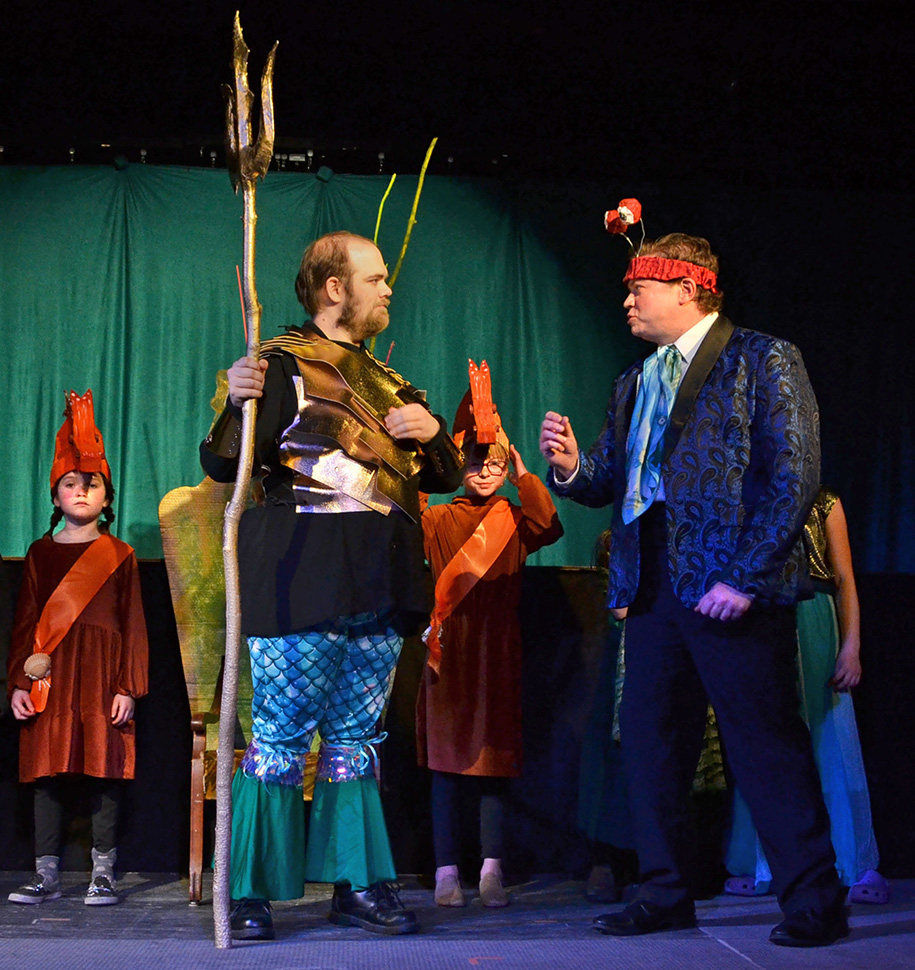
photo by Vanessa Fournier
The heroine Ariel, a mermaid who is one of the daughters of King Triton, represents defiance to authority and the triumph of love through persistence. She is an independent person, at one point saying that she has no friends and didn’t feel she belonged here in the sea. She wants to change and become a human being so she can consummate her love for the sailor Eric, whose life she saved. All children need to separate themselves from their parents psychologically at some stage of their life, usually as teenagers, hopefully without too much pain. Hence the long standing appeal of Ariel as a role model to younger people in Hans Christian Andersen’s popular story. In this performance, the role of Ariel was given to three young girls, Nora McCann, Sycada Barnes and Elliett Melen, each of whom showed impressive dramatic talent and had fine voices.
Eric, the sailor-prince, was portrayed by Mary Rogerson and Louise Swift, both of whom were convincing in their acting and sang well. He is the hero of the play but his presence is secondary to that of Ariel. Their mutual attraction is the underlying momentum of the whole plot as she changes symbolically into another person, and his love the source of her deepest happiness.
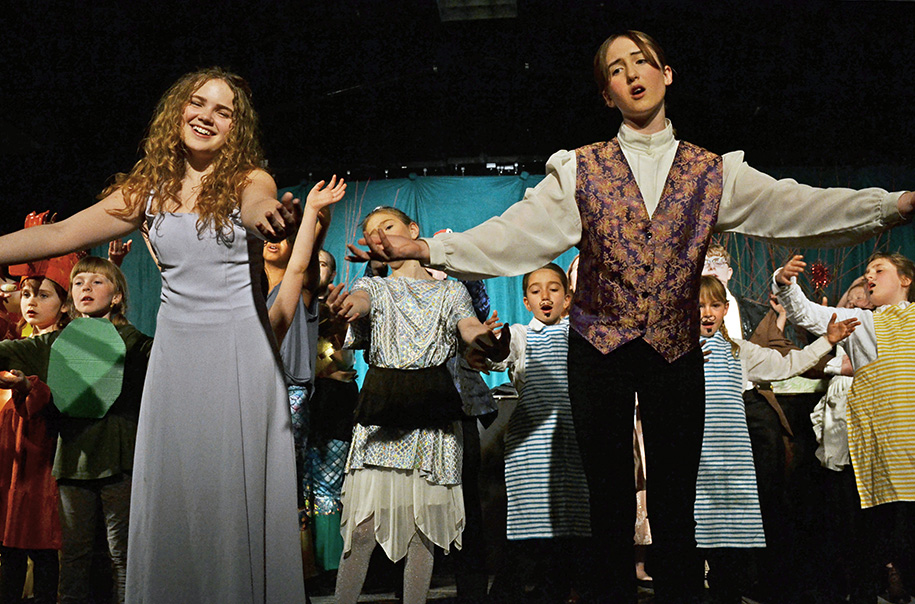
photo by Vanessa Fournier
Of the older authority figures, Seth Vandenburg as King Triton embodied the archetype of a loving father, keeping consistently in character, while Thomas Dunbar and Jesse Clayton, sharing the role of Sebastian, the music director, stood for the empathetic adults that every young person appreciates when their life is changing. Similarly, Erin Barry as Grimsby showed an admirable dignity characteristic of adults who can give wise advise and protection when it is needed, as did Clare Waterman as Scuttle. In a comic interlude in the second half of the play, Thomas Dunbar was quite humorous as Chef Louis, preparing a meal of dubious ingredients.
At the opposite end of the moral spectrum was the villainess Ursula, King Triton’s exiled, evil sister, performed with great dramatic flair by Luna Dunbar and Jessica Della Pepa-Clayton. In the fundamental choice in life whether to relate to people by love or by power, she had chosen the latter. The proverbial witch, she used black magic in her lust for power over others, but ultimately she was defeated.
The cast of younger children acting, singing and dancing in “The Little Mermaid” was extensive, as sailors, sea creatures, seagulls, maids, chefs and princesses. They included Liam Waugh, Alexander Clayton, Alice Hannan, Rue Jacobs, Gwenyth Pare, Mavis Hall, Kate McIntyre, Fern Hammond, Susannah Harman, Lila Christiansen-Pollica, Althaea Itwin, Iris Jacobs, Jojo Taylor, Simone Kulsick, Amara Hansen, Judzia Bubrouski, Hanalee Hill, Luciana Abare-Rossi, Ariabella Clayton, Lily Dunbar, Elfi Goldenrose, Enid Hammond, Ariella Helfand, Cora McIntyre, Penelope Otto, Ruthie Podolin, Nora Rader, Zelda Scrivenner, Addelyn Temple and Moriah Usinowicz. This production was an inspiring example of genuine community theater, giving children an important opportunity to discover their potential acting skills. Live theater is a wonderful world of imagination and pretending to be that is always fun to explore.
The director and producer was Karen Mueller-Harder, the music directors were Jessica Della Pepa-Clayton and Mark Violette, who was also the keyboard accompanist, the assistant director was Jesse Clayton and the choreography was by Sarah Spletzer, Stella Cusack, Althaea Irwin, Louise Swift and Karen Mueller-Harder.

David K. Rodgers
David K. Rodgers is a writer, mason and card carrying dilettante, who dabbles and babbles in art. He has lived in East Craftsbury for the past 40 years.
