


WHITE RIVER JUNCTION – It’s a sunny day in early June, and your plan is to beat the I-93 summer crowds with a hike up the Franconia Ridge in the White Mountains of New Hampshire. But as you ascend, you reach a point where the trail disappears under a monorail of packed snow. You stumble and post-hole every few steps, the microspikes you brought effectively worthless. You laugh out loud, throw in the towel, and retreat to the safety of the lower elevations and some dry socks.
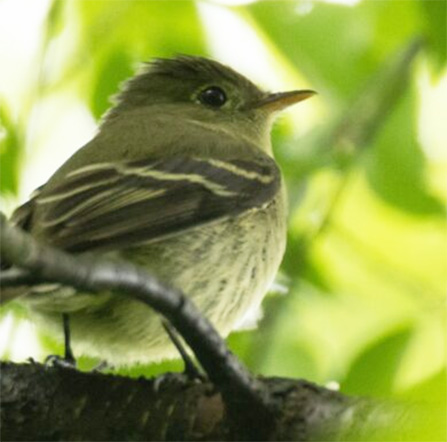
If you notice a Bicknell’s Thrush sitting quietly in the hardwood understory around the parking lot, you might think you’ve detected it on its spring migratory return up the mountain. But what if it’s already been up and come back down?
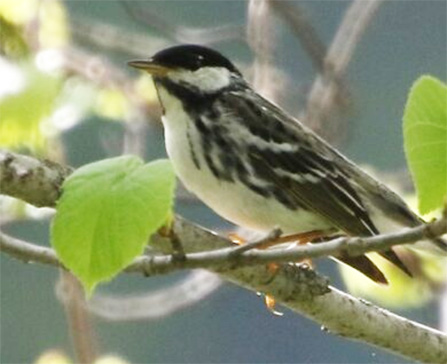
Each May, long-distance migrants like Yellow-bellied Flycatcher, Bicknell’s Thrush, and Blackpoll Warbler return to New England to breed in the spruce-fir forests that cap our highest peaks after overwintering thousands of miles away in the Caribbean and Central or South America. You might have seen one in your backyard in May.
Now, there’s growing evidence that montane birds sometimes do what we do on a weekend hike: move up and down the slopes.
While altitudinal migration is typically discussed in seasonal terms, birds heading uphill to breed and downhill to overwinter, short-term or daily elevational movements are less well known, but potentially just as important. In Hawaiʻi, where I studied montane honeycreepers, we’d gather on a volcanic outcropping at the end of the day and watch birds flying above the canopy, heading to lower forest far below. The likely reason: warmer nighttime temperatures and richer foraging, improving energy conservation and early-morning food access. A 2017 study described this behavior as essential to their survival but not without tradeoffs. At lower elevations, honeycreepers are more exposed to avian malaria carried by mosquitoes.
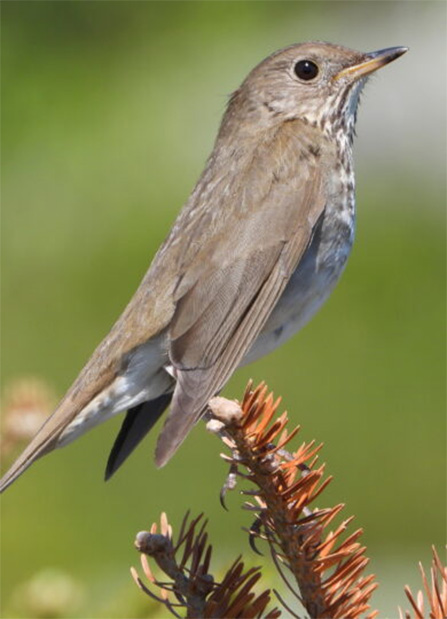
Here in Vermont, the Vermont Center for Ecostudie’s (VCE) Kent McFarland observed radio-tagged Bicknell’s Thrushes abandoning their high-elevation habitat during late spring snowstorms, retreating downslope into hardwood forests where they do not breed, likely to wait out the conditions.
Other recent research in the Alps supports this pattern, finding that Northern Wheatears equipped with pressure-sensitive tags regularly left their territories. One wheatear moved about 1,000 meters downslope from its breeding territory on multiple occasions in response to a snow storm, and all four birds in the study moved 50 to 200 meters upslope every night to roost outside of their territories, possibly to reduce predation risk or seek warmer microclimates. An earlier 2021 study, also in the Alps, found that birds adjusted elevation daily in response to snow cover, particularly early in the breeding season.
These evolutionarily adaptive movements: daily (or even just lasting hours at a time), flexible and weather-driven are likely more widespread than we realize. Yet they’ve only been formally documented in a handful of species. If montane birds rely on lower elevation refugia during poor weather or food scarcity, it could have important implications for how we conserve these species across the full elevational gradient.
So when you’re out on a hike this June, keep a lookout for birds that are far below their expected breeding grounds. A Fox Sparrow at the trailhead isn’t lost, and it’s not a late bloomer. She may already have been up to the top and back again, flexing her evolutionary muscles in response to a dynamic mountain environment.
Jason Hill is a member of the staff at the Vermont Center for Ecostudies.

