

HARDWICK – As long as there has been dairy farming in Vermont, harvesting and storing hay in the summer has been how farmers prepared for winter. Traditionally, it was the farmer’s job to make hay for the winter and the cow’s job to feed herself during the growing season, and so the farmer effectively operated two systems, one pastoral and one where the cows were confined. In the last 75 years, the dairy mainstream has mostly chosen to abandon the pastoral component and operate their winter systems year-round. Consistency in the cows’ feed and living environment, increased per-cow milk production, and economies of scale have become the fundamental commandments of the American dairy business.
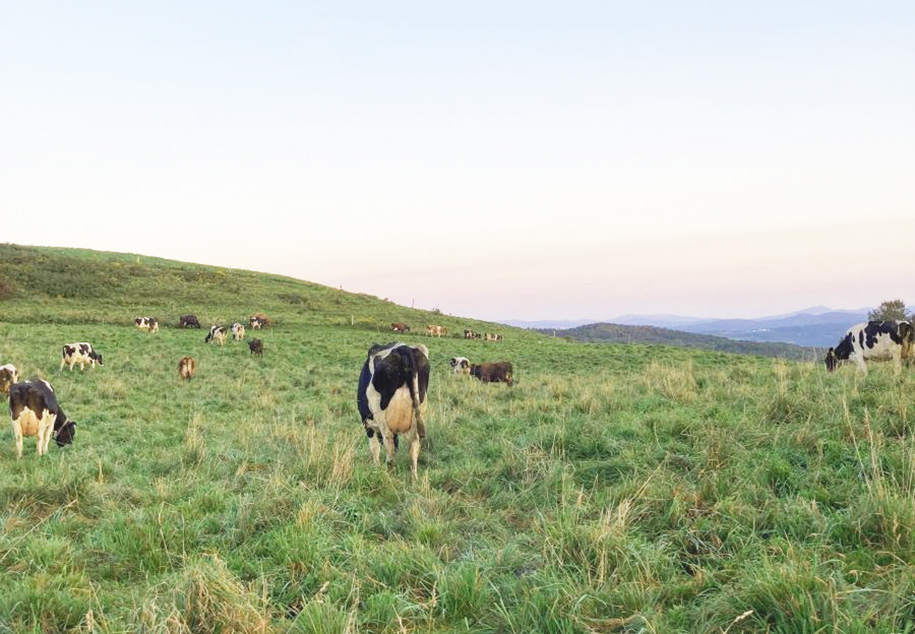
photo by Silene DeCiucies
Vermont’s topography, soils and pattern of villages and roads laced through farmland and forests place limits on our farms’ ability to stay viable in the scale game while remaining the kind of farming neighbors Vermonters tolerate and value. Despite these handicaps, Vermont farms have adopted similar production models and standards as our midwest counterparts and have been encouraged to do so in order to stay relevant, acquire financing and keep up with increasingly competitive markets.
Vermont dairy farms now make far more milk per cow, per acre, per worker and per farm than the farms of the past, but fewer operating dairies remain every year. As the US milk supply comes increasingly from farms operating at scales not practical in a state with our terrain and patterns of settlement, Vermont dairy edges closer to its limits as a competitive player in the high-production game. The landscape we treasure and the rural culture that makes Vermont unique change and vanish as dairy farming dies. Rather than shrug our shoulders, blame global markets and plant-based milk, and sell out, we still have time to consider adaptations that may offer relief from the cost-of-production squeeze and some hope for Vermont dairy’s future.
For some farms, this hope could lie in grazing.
Some in the dairy mainstream may view grazing as returning to the past, letting off on the throttle or a pleasant but risible hobby, but in countries such as New Zealand, Australia and Ireland, modern, intensive grazing has proven itself as the foundation of a profitable and competitive production system. Farms prosper, hired labor is paid well and their products compete well with ours on the global market. In grazing-dairy countries the orthodox belief is that a dairy farm’s success correlates closely with the amount of grass they can harvest per hectare with their cows. This concept runs their production systems, and in Ireland, they have built a relatively new industry around it that is keeping small farms viable and attracting young people to the field. In the United States, we have favored a capital-intensive model that requires large fleets of equipment and expensive facilities in addition to the land and herd, and this makes it almost impossible for new farmers to enter the industry. In grazing intensive production systems, farmers’ capital is tied up primarily in land and cattle rather than depreciating assets which makes the barrier of entry lower, and the businesses more resilient.
Although there are many differences between our countries, here in Vermont we may be able to learn from countries abroad who have similar climates and have found success in dairy at small and medium scales. A grazing dairy farm is scale-limited by the distance a cow can walk between milkings to harvest her own forage. “Scale-limited” may sound like a handicap in the efficiency game, but only if we measure efficiency in bushels or tons or hundredweights per acre. If we measure it by the number of farmer and farmworker households a landscape can support, it is clear that the best results happen in situations where there is some form of limit on endless farm expansion and consolidation. American farming culture and policy prioritize the freedom to get big over the survival of more numerous, smaller producers and the rural communities they comprise, and more go out of business every year.
In Vermont, our landscape has limited the rapid farm expansion that dominates the U.S. dairy industry. From one perspective, we are hopelessly behind in a race we can’t win. From another, the small and medium sized farms still operating here are an exciting opportunity to combine the best of our state’s dairy traditions with fresh ideas and methods. Vermont is a hard place to farm, but our soils and our abundant rainfall grow grass well. If we ignore innovations and alternative ways of thinking from the grass-based dairy countries and stay chained to the high-input, high-output, high-capital American dairy business model we can expect small- and medium-scale dairy to continue to disappear from our landscape and our communities. If we can understand and disseminate some of the business ideas, production techniques, mindset and culture that the grass countries have developed, we may be able to see hopeful alternatives to the dead-end track we are on and imagine a brighter, more vibrant dairy future for Vermont.
This opinion piece is part of an educational series that Center for an Agricultural Economy Farm Business Planner, Silene DeCiucies will be writing with her business partner, Geordie Lynd. SileneDeCiuces and Lynd operate an organic dairy farm in South Walden.

Silene DeCiucies
