
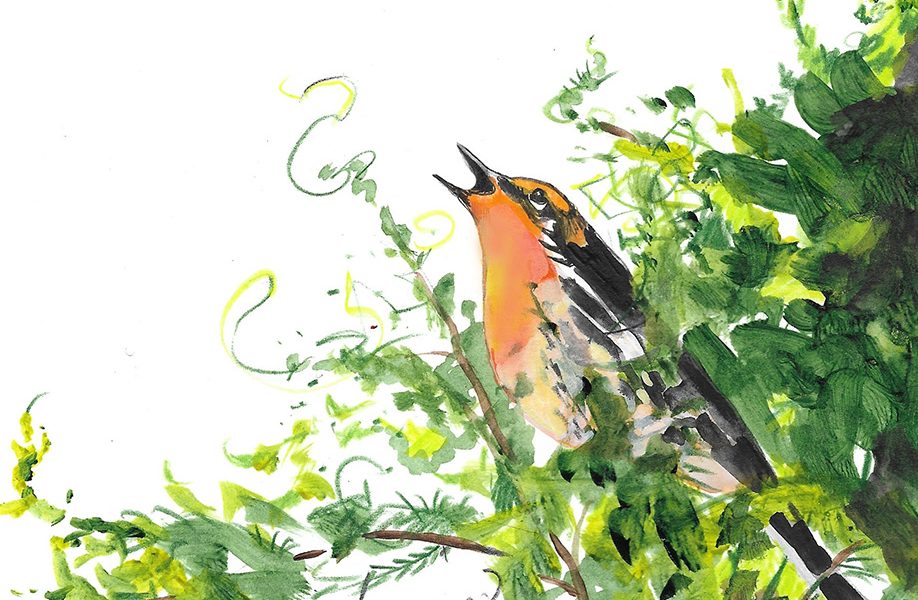


HOPKINTON, N.H. – One recent morning, trying to find the source of a warbler trill high in a white pine tree, I was rewarded with a brilliant flash of orange. It was my first sighting of a Blackburnian warbler, one of the most beautiful songbirds in the northern woods.
While Blackburnian warblers are not uncommon in mature conifer and mixed hardwood forests, they can be hard to see, since they forage and nest high in the branches. But once spotted, they are easy to identify. These avian gems are medium-sized, four to six inches long. During breeding season, the male has a bright orange throat, yellow and black facial markings, white wing patches and a black back with white streaks. The female is a paler, yellower version.
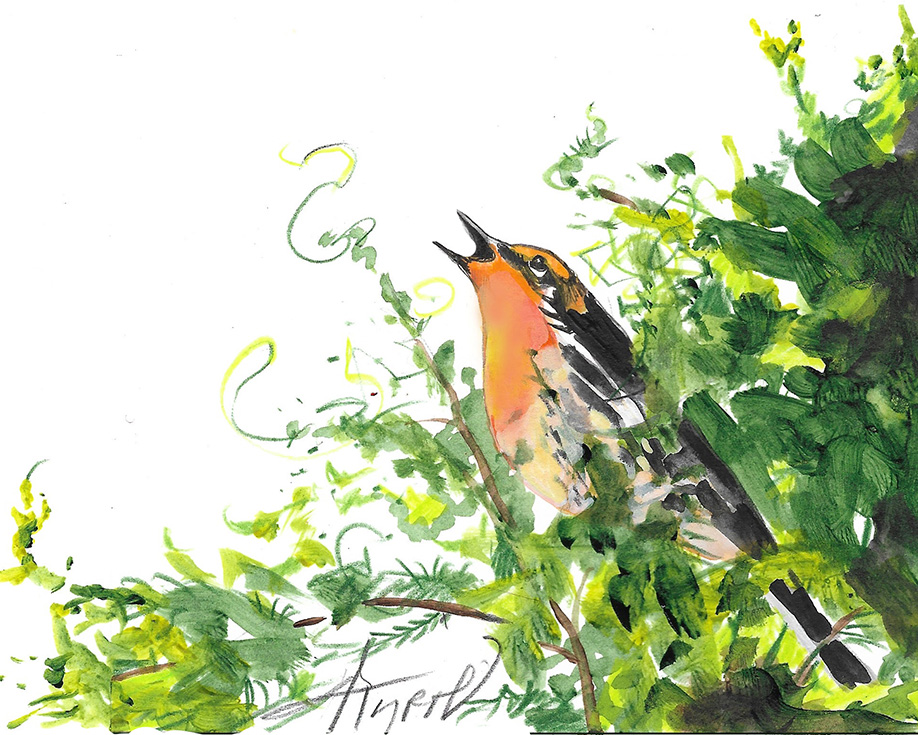
“The Blackburnian warbler is one of my favorite birds, with its fiery orange plumage and ethereal song,” said Tim Duclos of Vermont Audubon. “They’re some of the first warblers to return each year, and I’m always excited to see and hear them.” Despite their ability to evade searching eyes, they are also more common than a number of other warblers. “They may not visit your feeder, but they might be right behind your house,” said Duclos.
Blackburnians arrive in the Northeast in May. Males return first and potential mates come a few days later. Males sing from the tips of evergreens and the outermost branches of mature deciduous trees, where they deliver two main songs. Renowned birdsong expert Donald Kroodsma refers to these two vocalizations as dawn song and day song. In “Birdsong by the Seasons,” he describes listening to 12 males on one morning in western Massachusetts and analyzing their songs. Each male has a unique take on the dawn song and the day song and may have more than one version of each.
My first Blackburnian was singing its day song, an increasingly rapid series of two-note phrases ending with a slightly longer one. I would need to be up before sunrise to hear the dawn song, a series of quick rising whistles followed by a high-frequency chatter and ending with such high notes that most people cannot hear them. Kroodsma describes the beginning phrase of the dawn song as sounding like the bird is juggling pebbles in its throat.
During courtship, male Blackburnian warblers flick their tails and peck at branches to attract the attention of potential mates. The females build nests as high as 80 feet up in the branches of hemlocks and other conifers. They lay three to five eggs in a tiny cup lined with lichen, moss and grass. These birds are gleaners, hopping around in the branches and foraging for insects by starting near the base of a branch and moving outward before moving to the next branch. Besides insects of all kinds, Blackburnian warblers feast on caterpillars, including spruce budworm larvae.
Unlike some warblers, which are in steep decline, the Blackburnian appears to be stable. According to conservation biologists at the Vermont Center for Ecostudies (VCE), the population trend of the Blackburnian warbler over the past 35 years is flat, though there have been fluctuations up and down.
“Blackburnian and other mature-forest warblers appear to be doing well now that our forests consist of more climax stands of older trees, a habitat that is rather stable over the long-term, barring major logging or large-scale events such as ice storms, fire, disease and insect outbreaks,” said VCE’s Steve Faccio. “The warblers with the steepest declines tend to be those that utilize early successional habitat, such as blue-winged and chestnut-sided warblers.”
Deforestation in the bird’s winter habitat in Central and South America could affect the Blackburnian warbler along with other neotropical migrants. Climate change also presents a threat. “We’re seeing more extreme weather events than in the past, causing birds to get blown off course or stranded for long periods of time,” said Duclos.
This time of year, Blackburnians are well hidden by foliage. But when I hear a trill in the treetops, I look up. If a ray of sunshine strikes the throat of a Blackburnian warbler at just the right angle, I get to see the avian gem in all its glory.
Laurie D. Morrissey is a writer who lives in Hopkinton, N.H. Illustration by Adelaide Murphy Tyrol.

