



GREENSBORO − The yearly edition of The Hazen Road Dispatch, published by the Greensboro Historical Society, is out and available at the museum as well as Willey’s, The Galaxy Bookshop in Hardwick and other locations.
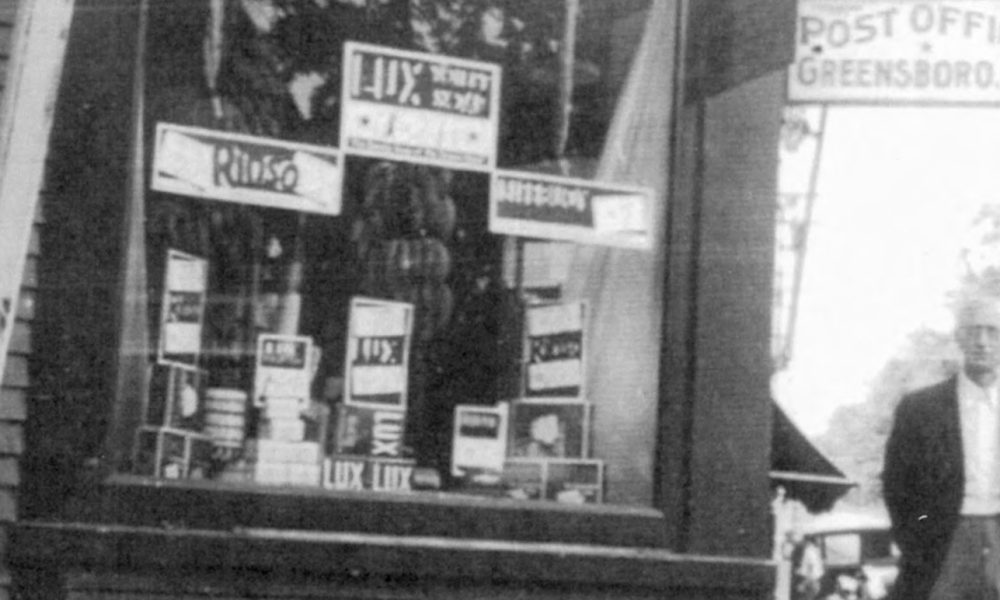
This edition covers such wide-ranging topics as the history of The Willey’s Store and the Buffalo Mountain Co-op and Market, the first part of a series on one-room schoolhouses, canal fever in the Northeast Kingdom, Alfred Hitchcock’s film “The Trouble With Harry,” Greta Garbo’s visits to Caspian Lake and two reviews of recent Vermont-relevant books.
“The Willey’s Store at 125: Change and Continuity” by Kyle Gray starts on the cover of this publication with a very beautiful color photograph of the store in the bright summer sun taken by the author. His article contains many photos of the staff and the building over the years. One of the remarkable aspects about the history of this country store is that it has stayed in the same family since 1900.
Gray does an excellent job in documenting the five generations of the Willey-Hurst lineage of management and especially of interviewing former and present employees. The three main owners for the first hundred years were Burt M. and Hattie P. Willey, Robert H. and Gertrude Willey and then Ernie Hurst and Phyllis Willey. Tom Hurst, his brother Robert and sister Lisa ran the store until 2010 when Robert’s son Robbie took over the present operation.
The buildings themselves have been joined, extended and renovated but still retain some of the charms of time, while the business has survived the historical crises of the Great Depression and more recently the Covid-19 epidemic.
Probably the growth of the summer community around Caspian Lake in the same period helped shelter Greensboro from some of the economic decline in other rural villages and towns of Vermont during the first half of the Twentieth Century. Willey’s remains the go-to place for most items of food, hardware and clothing and is a crucial community builder in contrast to the impersonality of most other commercial stores today. There is continuity in the helpful employees and one almost always meets neighbors while shopping there.
The history of a different but parallel store is that of the 50 years of the Buffalo Mountain market in Hardwick, written by Annie Gaillard, a long-term active member.
She recounts its modest start in a house on Wolcott Street as a co-op in 1975. Subsequently the store moved and grew larger in the Jeudevine Mansion in 1979, then to a location on Main Street in 1991 and presently in a very daring and innovative merger, to the site of the Village Market to the east in 2022. The bigger space allowes the co-op to continue its basic commitment to local produce with organic options and general health food but keep many conventional choices from the previous store to attract a wider customer base. Like Willey’s, the Buffalo Mountain Market is a very important community builder with personal service and a meeting place for friends, with many things not available elsewhere.
Paul Wood’s contribution is part-one in a fascinating exploration of the “One-Room Schoolhouse in Vermont,” which was the norm in rural areas until the consolidation movement of the 1960s and ‘70s. Apparently Elmore has the only remaining one of such schools in the state. The rule of thumb was that there should be a primary school for grades one through eight, within reasonable walking distance for all children. Public education for everyone was recognized early on, especially in New England, as fundamental to the functioning of a viable democracy and for economic growth.
The buildings themselves were fairly standardized in design, with good natural light from large windows and a central stove for heat, constructed on land set aside by the town or donated. One teacher usually taught all the grades, with older students helping in lower grades. Salaries were low, teachers often boarded with local families, and contributions of firewood and taxes were required from townspeople. Besides some patriotic pictures and maps on the walls, the interiors were quite plain, with only a minimum of books available for reference. Wood includes many informative photos of the schools and their equipment. Part 2 of Wood’s exploration (part 2) will focus on the difficult transition in Walden from dispersed one-room schoolhouses to a central primary school in the 1990s.
A not-very-well-known development in the history of the Northeast Kingdom is outlined by Robert K. Merrill and H. Clay Simpson in a piece on the “Canal Fever” in this part of Vermont in the early Nineteenth Century. Transportation was an important factor in economic growth in the state and roads were often inadequate to the task of moving agricultural products and building materials like lumber, bricks and stone to larger markets, so that they were serious efforts to see if canals could be constructed, particularly to link the Connecticut River with Lake Champlain through northern Vermont.
The success of the Erie Canal in New York State, completed in 1825, was a compelling model in the way it opened up the state and the Midwest to markets in New York City and beyond. Already a canal linking the southern end of Lake Champlain with the Hudson River in 1823 was making Burlington into a major lumber exporting center.
The map in this article shows proposed routes of canals from the upper Connecticut River both through Island Pond and/or St. Johnsbury to Newport and then along the Black River Valley south to Lake Eligo in Craftsbury and to the Lamoille River in Hardwick, hence west to Lake Champlain. But careful examination of the terrain by engineers to be traversed by such a route found a combination of significant gradients and a high cost caused these projects to be rejected in 1829. As it was, the development of railroads in the decades shortly thereafter supplanted any further interest in canals, by the 1870s giving farmers and the granite industry in the Northeast Kingdom much wider markets for their products.
Don Houghton, in his article “The Trouble With Harry: A Historiographical Note,” gives an entertaining overview of the history of some of the sites around Craftsbury and elsewhere used by Alfred Hitchcock in the filming of his classic movie about a corpse that wouldn’t stay buried.
Last fall, Rick Winston, the founder of the Savoy Theater in Montpelier and an immensely knowledgeable connoisseur of films, gave a delightful talk on this comic masterpiece at the Craftsbury Library and shared a wealth of information about its making.
Photographs and an extensive bibliography give an interested reader additional leads for further exploration. The “Trouble With Harry,” which was shot in 1954 and first came out in 1955, is basically an English comedy set in New England, which one never tires of seeing, with its excellent acting, the dry humor of its plot and the beautiful fall foliage scenery.
Greta Garbo was one of the supreme “femme fatales” of American films and had an interesting connection to Greensboro as described by Charles T. Morrissey and Dan Penrice. She was very close friends with Jane and John Gunther in New York City and came to visit them several times in the summer in the 1950s at their beautiful cottage at the northwest shore of Caspian Lake. John Gunther was the popular author of a series of “Inside” books on different countries of the world as well as the moving tribute to his son who died young, “Death Be Not Proud.” All three of them were very private persons not given to celebrity worship. The large rounded granite outcrops at that end of the lake may have been a favorite spot for Garbo to swim and sunbathe on her visits to the Gunthers, but there is no certain evidence that she discreetly skinny dipped there. Myths may be entertaining but slippery fish to prove. She preferred to be known as Miss Brown and apparently some local Vermonters said out loud of her that “She must have been a good looker when she was young!”
Two book reviews will interest anyone curious about Vermont history. J. Kevin Graffagnino’s new biography of Ira Allen is assessed by Timothy H. Breen, covering the life of one of the early founders of Vermont who was as complex and contradictory as his legendary brother Ethan Allen.
Even before the outbreak of the American Revolution in the mid 1770s, Ira Allen was deeply involved in land speculation in the Champlain Valley, buying large tracts of undeveloped wilderness cheaply and selling it at substantial profits to would be settlers. This was a widespread practice in the late Eighteenth and early Nineteenth Centuries as the newly-founded country expanded into Native American territories and made fortunes for some. But in the case of Ira Allen, his own chronic dishonesty ultimately caught up with him and he had to flee Vermont, dying penniless. So much for previously glorified heroes with feet of clay.
Morrissey reviewed “Vermontiana: An Annotated Checklist, 1764-1899,” another recently published work by J. Kevin Graffagnio. This is a profusely illustrated compendium of almost 300 pages of Vermont books and printed documents, many from his own extensive collections. Morrissey focuses on materials relevant to Greensboro and Craftsbury and is critical of a few details, but the work should be a treasure trove of primary sources. The author visited the Craftsbury Library this past April and gave an interesting talk about his research.

David K. Rodgers
David K. Rodgers is a writer, mason and card carrying dilettante, who dabbles and babbles in art. He has lived in East Craftsbury for the past 40 years.
