


CABOT – The school in Cabot’s District No. 5 was located on the road to South Walden, about three miles from Cabot Village. Over the years, the school was referred to by whatever family either lived nearby or had several youngsters going there. However, why it was referred to as Merritt School when it closed in 1943, is a mystery. No one seems to recall a family by that name living in the area.
One of the earliest settlers on that road was Daniel Webster Rogers, born in 1824. He was the son of Hanson and Hannah Webster Rogers, and married Louise Whittier (1826-1907), daughter of John Whittier Jr. They had five boys, James, Franklin, Charles Henry, Robert Harvey and Herman Alonzo and one daughter, Florence, who married Sam Norris. Florence and Sam eventually took over the Rogers farm sometime after the turn of the century when her parents moved to the village. That farm was later owned by Phil Pike Jr. For a few years the school was known as the Rogers School and later Smith’s School before it became Merritt School.
The original schoolhouse was a small one-story building, but as the population in that area grew, a new school was built directly across the road. Addie Arthur taught there in the 1920s. She earned $17 a week and paid $7 a week board. Addie Arthur later married Earle Pike and had to give up teaching. Married women were not generally allowed to teach in most Vermont towns at that time. That policy changed radically during World War II when teachers were in short supply.
When Eunice Fifield taught at Merritt School in the early 1930s, she had from 20 to 25 students. Children from Amadon, Houston, O’Brien, and Gochey families attended during that time, also five Pike and four Searles youngsters. By 1937 there were only 13 students. In an interview for the Cabot oral history book, Cabot Vermont, A Collection of Memories From the Century Past, published in 1999, Marjorie (Searles) Gendron described what it was like going to school when she was there.
She said, ‘We pledged the flag and the teacher read a passage from the Bible each day before classes began. There were two outhouses, one for the boys and one for the girls. In the winter you didn’t dilly-dally long when you were out there.”
Like most of Cabot’s one-room schools, either a parent or one of the older students served as janitor and was responsible for shoveling a path in winter, starting a fire in the big woodstove that heated the classroom and bringing a jug of water for drinking and washing hands. School was never canceled unless the teacher was too ill to be there. Most teachers boarded nearby, sometimes having to change boarding places every few weeks to distribute the privilege.
Donovan Houston told about his brother, Howard “cutting up” when Mr. Phelps was the teacher at Merritt School. “Phelps picked Howard up by the collar and was swinging him around and around. Howard’s feet hit a pail of water we’d brought up from a nearby spring and the pail flew right over Myrtie Salls head. She was on her knees getting a book or something, so she wasn’t hit. Nobody dared to laugh.”
Donovan said that when Dora Ennis taught there, she used “a big wide ruler to strike the palm of their hands if you misbehaved.”
Howard Walbridge went to school there when his aunt, Elsie Walbridge, was the teacher. He had strict orders to call her “Miss Walbridge,” never “Aunt Elsie.”
Merritt School finally got electricity in 1940, but by that time there were few students in the district and in 1943 the school closed and the building was sold. The few remaining youngsters from that area went to the Village School.
Everett and Mary (Lyford) Walbridge’s buildings are gone now. The house was taken down in 1982 and some of the lumber used to build a shed for Mike and Sally Rushman. Cabot’s Town Farm was on that road, but few people today remember when overseers like C.M. Fisher and later Ned Barnett helped destitute citizens through hard times and the Depression years at that farm.
In place of productive farms with mowed hayfields and pastures dotted with cows, now there are single-family homes tucked behind stately trees along the paved two-lane highway that is South Walden Road. A spacious recreation fieldhouse shares parking space with the impressive Cabot Fire Department building. Further along the road is where the relatively new highway department garage stands and beyond that about 900 acres are preserved as the Cabot Town Forrest. The dairy farms with large families of youngsters needing schooling are gone, along with any evidence of the school that once served them.
Across town and high on Danville Hill, Read School was located in District No. 6 on the west side of what is now Urban Farm Way, and at the intersection of an old road that used to go west towards what is now the Langone farm. It is unclear when this school was first opened, but it appears on a map of Cabot dated 1858. That building was described in the Superintendent of Schools Report in 1885 as being “less than worthless.” Some of the families living in the area at that time were E. P. Reed, D. W. Reed, C. Russell F. Hall, N. Davidson, several Morses, and A. Heath, so there were sufficient students to warrant building a new schoolhouse. The superintendent’s report described the new schoolhouse as being “a few rods away on land purchased from Mr. Batchelder,” and “the best fitted and furnished house in town.”
When Arecca (Gamblin) Urban first attended Read School, Jesse Beaton was the teacher. Arecca remembered there were cloakrooms at the entrance, lots of windows for good light, a big stove in the middle of the classroom for heat and the customary communal watter jug. Unfortunately, the schoolhouse burned down in 1918. Authorities thought that mice chewed the matches in the teacher’s desk, starting a fire. Florence Smith, one of Allan Smith’s daughters, was teaching there that year and the Gamblin children and the Smith’s youngsters were her only students. After the building burned, classes were held in the Smith’s living room for the remainder of that year and the following year students were sent to school in the village.
Arecca drove a horse to school picking up fellow students with a pung sled or buckboard wagon along the way, a little over two miles to the village. There was a road that came from what is now Urban Way to where Menards (now the Langone farm) lived, and Arecca said it was bitterly cold some mornings going down through there. She was only in fifth grade when she began driving the school bus, and did it for several years.
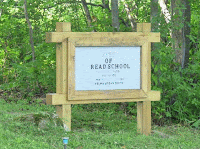
Only a few people knew about the Read School or where it was located until Arecca’s daughter, Velma (Urban) Smith had a sign made in about 2013 so that the school where her mother and so many other youngsters in the Danville Hill area first trudged to classes each day would not be forgotten.
Cabot’s one-room schoolhouses served their communities well for many years. They were where children not only learned their three Rs, reading, writing and reckoning (arithmetic), they also learned social skills by joining with adults at neighborhood parties, special school events and celebrations.
It was not uncommon for a teacher to have 20 or more students learning at different grade levels. Older students sometimes helped tutor younger students and because classes were held in one large room, students learned from hearing the recitations of upper grade students.
The teacher’s word was law and if a student disobeyed the rules, punishment was usually strict and immediate. It might be a whack or two on the hands with a ruler, staying after school to finish assignments or helping with manual labor such as bringing in wood for the woodstove. It was rare for parents to question a teacher’s discipline methods. Most often, having been disciplined at school meant more punishment when the errant youngster arrived home.
The school bells that called students to class in these little one-room schoolhouses are silent now and the memory of them fades a little more each time a former student disappears from our midst.

Jane Brown
Jane Brown is a member of the Cabot Oral History Committee.
