


HARDWICK – When I was eleven, I found a VHS tape in the upstairs bedroom of my grandmother’s home. The tape, titled “2001: A Space Odyssey,” was Stanley Kubrick’s 1968 epic science fiction film. I was curious, naturally, having heard Kubrick’s name in the cultural zeitgeist growing up. So I watched it. And then I watched it again. I admit wholeheartedly, my first viewing was one of confusion and boredom.
My second viewing, however, left a lasting impression on me, shaping an early perspective on artificial intelligence, more commonly referred to as A.I. (AI)
I remember thinking to myself, “We aren’t that far away from this,” and so on. A 2001 baby, I grew up during the whirlwind rise of social media and mobile smart technology.
“Nothing good can come of this,” was my other observation. In the decade that followed, I fear those initial observations have proven correct.
AI in its current form has no legal guardrails in this country, with few states passing regulatory bills in recent years.
AI assistants and features have been implemented across the web writ large, despite the evident flaws in the accuracy of generative AI.
Many Twitter/X users like myself see replies under countless posts, with a command for Elon Musk’s AI engine embedded into the app: “Grok, make nude, add ….”
Deepfakes of a sexual nature are rampant in these spaces, forcing many women to either privatize their pages or turn off their replies entirely to prevent such comments. This can be fruitless in some instances, which is an even more frightening prospect.
Nothing good can come of this, I reiterate. Has anyone considered what lewd and lascivious images may be generated of under-aged girls and boys, the current generations of which have grown up online?
Surely I am not the only one who is concerned, but sometimes it truly feels that way.
If that isn’t reason enough for you, the Environmental and Energy Study Institute (EESI) reports that large data centers can consume up to 5 million gallons of water per day, equivalent to the water use of a town populated by 10,000 to 50,000 people.
With larger and new AI-focused data centers, water consumption is increasing alongside energy usage and carbon emissions.
According to the EESI, data centers have a thirst for water, and their rapid expansion seriously threatens freshwater supplies. As reported by scientists at the University of California, Riverside, each 100-word AI prompt is estimated to use roughly one bottle of water (or 519 milliliters). This may not sound like much, but billions of AI users worldwide enter prompts into systems like ChatGPT every minute. Large language models require many energy-intensive calculations, necessitating liquid cooling systems.
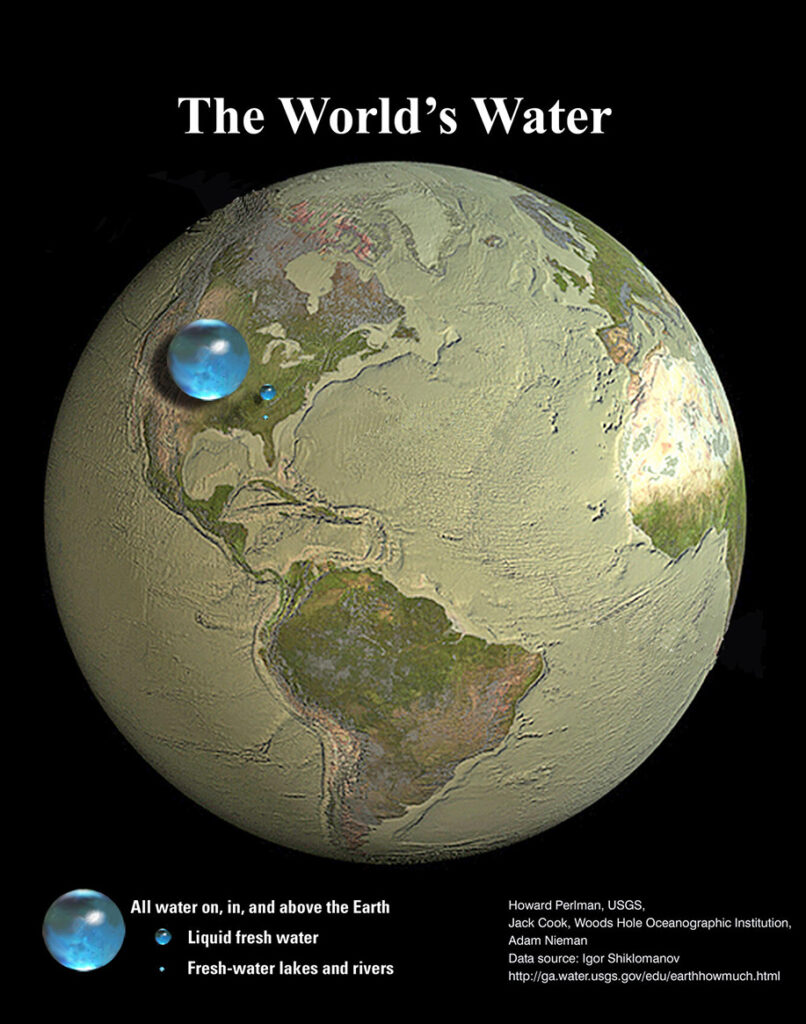
Only 3% of Earth’s water is freshwater, and only 0.5% of all water is accessible and safe for human consumption. Freshwater is critical for survival. On average, a human being can live without water for only three days. Increasing drought and water shortages are reducing water availability.
According to a recent story published in Forbes.com, already A.I.’s projected water usage could hit 6.6 billion m³ by 2027, signaling a serious need to tackle its water footprint.
I also fear for the generations that will grow up with generative AI at their disposal, for surely their critical thinking skills as well as creativity will be impacted by the use of artificial intelligence.
The human brain, in all its wonders, is like muscle. Use it or lose it. To generate an answer or result instantaneously will only reinforce instant gratification. We have put our younger generations at a disadvantage by eliminating the learning process, finding the answer or doing the work themselves.
There are of course other concerns with artificial intelligence, which I encourage readers to explore on their own.
The question I pose is, are we Bowman or Poole?
Will we overcome HAL, the dangers of artificial intelligence, or end up voiceless and aimless, lost in space.

Raymonda Parchment is a Hardwick Gazette reporter. She recently graduated from Vermont State University - Castleton with a Bachelor’s Degree in English. She is a strong supporter of freedom of speech, and the right to publish information, opinions, and ideas without censorship or restraint. She is a lifelong lover of the written word, and is excited to join the team as a staff member.
