




Walter P. Slayton was born on July 1, 1831, in Calais, the son of Capt. Jera Slayton and Betsey (Kendall) Slayton. At the time of his birth, his father was twenty-seven years old and his mother twenty-six. Walter was born on the Slayton homestead — land first settled by his grandfather around 1790 — the same farm where his father had been born and would later die. Few Vermonters of his generation could claim such uninterrupted ties to a single property across three generations.

courtesy photo
Walter grew up in Calais as one of five children, with two brothers and two sisters, in a farming household long rooted in the town. In 1850, at age eighteen, he was living at home with his parents. By 1860, he was working as a farmer, still in his parents’ household, reflecting the common practice of family-based agriculture in rural Vermont. In 1861, he appears independently in local land records, executing a mortgage deed, signaling his transition into greater economic responsibility and personal engagement with property ownership.
After reaching his twentieth year, Walter also pursued education, teaching school for six seasons. Like many rural Vermonters of education and ambition, he taught during the winters while farming in the summers, balancing intellectual work with agricultural labor.
Farming, however, remained his lifelong vocation.
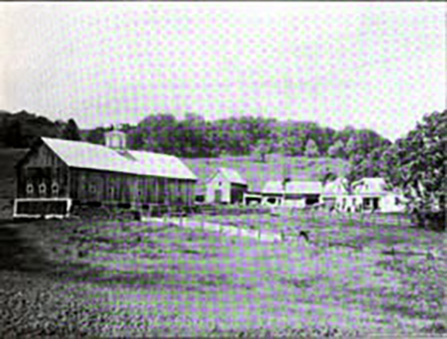
courtesy photo
By 1870, Walter had established himself as head of his own household, a status he maintained in subsequent censuses. He continued to be recorded as a farmer in 1880, holding both real and personal property, and remained steadily employed in agriculture throughout his adult life. Over a farming career spanning roughly forty years, Walter developed a substantial and diversified operation. His farm comprised approximately 175 acres, including a sugar orchard of about 800 maple trees, reflecting the importance of maple production in central Vermont. He kept twenty cows, produced hay annually, and regularly sold cheese, butter and hogs, indicating a farm run for sustained commercial output rather than subsistence alone.
Walter was also deeply involved in the civic life of Calais. Over the course of his adult years, he held nearly every town office, with the exceptions of town clerk and commissioner. During the Civil War era, he served as constable, a position of trust involving local law enforcement and order during a period of national uncertainty. He continued in that role for ten years, both during and after the war.
His public service extended beyond the town when he was elected to the Vermont Legislature in 1872, representing his community at the state level and joining the ranks of Vermont’s citizen-legislators in the postwar period.
To sustain the scale of his agricultural operation, Walter employed hired labor. He employed John Martin by the year, and Martin’s wife kept house for the Slayton family. By the time this account was recorded, they had been in his employ for fifteen years, reflecting long-standing working relationships and the stability of Walter’s household and farm management.
The 1900 federal census confirms Walter’s birth in July 1831 and records him at age sixty-eight as a land-owning farmer in Calais, still living independently near the close of his life. Unlike many Vermonters of his generation who migrated westward, Walter remained in the town of his birth, continuing the Slayton family’s enduring connection to land and community.
Walter Palmer Slayton died of tuberculosis on December 3, 1903, in Calais, at the age of seventy-two. He was buried in Short Cemetery, Calais. His life reflects continuity, stewardship, and public service—rooted in the same soil settled by his grandfather, shaped by the example of his father, and sustained by decades of productive labor and civic responsibility.
This account originally appeared in the Settlers of Calais Facebook Group on January 30.
Ted Wheelock lives in California and has ancestors from Calais, where he periodically visits with distant cousins and the historical society.

