


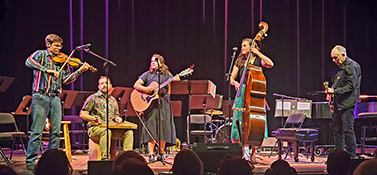
GREENSBORO – Opera Vermont, from the Manchester area, returned on February 13 and 14 to the Highland Center for the Arts in Greensboro for the fourth time to give a compelling performance of “La Boheme” by Giacomo Puccini (1858 -1924), music that combines the composer’s rich melodic gifts with his fine theatrical instincts in a plot full of passionate romantic love that coincided nicely with Valentines Day.

photo by Paul Fixx
One of Puccini’s most popular works, the libretto of “La Boheme” was by Luigi Illica and Giuseppe Giacosa and was based on the original novel of Henry Murger, “Scéne de la via boheme”, written in the 1840s, and the opera was premiered in Turin in 1896, conducted by Auturo Toscanini. Here engaging humor alternates with tragic pathos in depicting the lives of poor artists living the Left Bank in Paris.
In this production, the orchestra was necessarily limited, consisting of eight musicians (piano, two violins, viola, cello, base violin, flute and clarinet), all very ably conducted by Calin Marcel Manson. Props for the act were minimal, but an appropriately visual background was projected onto hanging ships of cloth in varying colorful abstractions created by a local painter, Priscillia Heine of Greensboro Bend (who is currently having a show of her paintings at the HCA gallery), the colors corresponding to the emotions of the characters, with the videography and editing by Maria Maciak. Costume design and props and set design were Elsa Althoff and Sarah Spletzer. The stage manager was Katelyn Geary, the artistic director Joshua Collier and technical director was Matt Payne.
The opera begins without any overture, as Puccini gets us right into the drama, set in the first act as a garrete in the Left Bank of Paris on Christmas Eve, originally intended in the 1830s, but in this conception made contemporary.
Two artists, Marcello the painter and Rodolfo the poet, are complaining about the cold, as they have no wood for the stove, and they lack both food and wine. Brad Noffsinger Morrison as Marcello begins singing with a very commanding baritone voice having an admirable depth of color and excellent projection, in connection with Brian Mengles as Rodolfo, whose expressive tenor has a fine range. There are delightful comic scenes as they attempt to warm the place up by burning several acts of a love play by Marcello.
Two other friends who share the garret arrive, the musician Schaunard, portrayed with great state presence and a very professional baritone by Darrell J. Jordan, and the philosopher Colline, well acted by bass Brian J. Alvarado with characteristic reserve.
Schaunard brings in bread, fruit, and a bottle of wine, and they all enjoy their temporary good fortune. Quite hilarious is next scene when the landlord Benoit, well sung and interpreted by Alex Karav, knocks on the door and demands the rent, but they drive him away by getting him drunk and bragging about his feats with women, to which the four tenants feign moral outrage as he is a married man.
Then three of them go out to join the Christmas Eve celebrations in the streets, leaving Rodolfo to try and finish one of his poems. He soon has a visitor from another apartment in the building, Mimi, sung with a great beauty and power by soprano Kathleen Echols. She wants to borrow something, but her candle has blown out and she has lost her key, yet it is love at first sight for Rodolfo. They have some particularly lovely duets as their mutual attraction grows. She is a seamstress who sews flowers; however she is already weakened by signs of consumption (tuberculosis). Together, they leave the garret to join their friends in the streets.
In the second act, they all take a table for dinner outside at the Café Momus, but their pleasure is cut short for Marcello when his former lover Musetto appears, a role taken by soprano Erin O’Rourke, with superb musicality in her voice as well as being perfectly in character, accompanied by her current wealthy suitor Alcindoro, skillfully sung by Alex Karav.
After testing Marcello to see if he still loves her, they become a couple again. All the Bohemians leave and Alcindoor is stuck with the bill. Ordinarily this is a crowd scene with a large chorus, including children and soldiers, but it had to be cut judiciously to accommodate this production.
In the third act, set in February in the snow by an inn at one of the gates of Paris, Mimi and Rodolfo have parted due to his excessive jealousy, yet what is really hiding his deeper fears of her impending death and his helplessness to prevent it. This scene ends with a memorable double duet where Rodolfo and Mimi have reunited, while Marcello and Musetto argue furiously, a brilliant dramatic juxtaposition, well illustrating the old adage that there is no love without pain.
The fourth act is back in the garret with Marcello and Rodolfo, but soon Musetta brings in Mimi, who is extremely weak and failing. She is laid on a couch while Musetta goes to get medicines and a doctor. Colline sings a moving aria with feeling, where he gives his old coat to Mimi to keep her warm. Her dying scene is deeply poignant, with Marcello expressing his terrible remorse.
The cast got a standing ovation for the appreciative full-house audience. All the singers were clearly enthusiastic in their roles and had wonderful ensemble coordination, which combined with their youthful voices and convincing acting transported us to another world. Let’s hope Opera Vermont continues to come to Greensboro.

David K. Rodgers
David K. Rodgers is a writer, mason and card carrying dilettante, who dabbles and babbles in art. He has lived in East Craftsbury for the past 40 years.
