
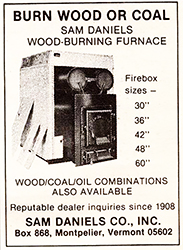


HARDWICK – Claire “Sue” (Goodrich) Slayton, grew up hearing stories about her grandfather, Samuel Daniels of Sam Daniels Manufacturing Company Inc., a maker of wood and coal furnaces in Hardwick and Montpelier from 1908 through 1969.
Google Images
Graduating from Hardwick Academy in 1966, Slayton has many memories of Hardwick’s unique community history. From the foundry to sock hops in the academy gymnasium, she remembers some of Hardwick’s bygone but significant moments and features.
Slayton never met her grandfather, the company’s founder, but was often regaled with stories by her mother.
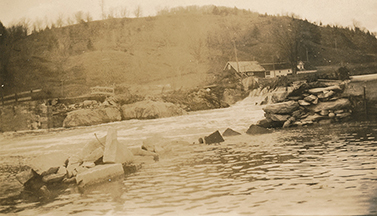
“One story my mother told me, about the ‘27 flood, and the water, the dam and the river. All of the water was coming up near the building, and he didn’t know what to do, so he got all his workers to get all the stoves and anything they could throw onto the river bed, to keep the water from coming up. My mom says there’s a lot of stoves and everything buried in there, somewhere.
“My mom told me he also made, I’ve never seen one, and Mom says they’re still around, a big bucket you can collect sap in, on a sled.”
Her mother also told her the history of the swinging bridge, refurbished by her grandfather so his workers could use it every day.
According to the Hardwick Historical Society’s (HHS) volume no.10, issue 2, in March 1915 the voters at town meeting instructed the selectmen to spend no more than $350 to build a bridge from a point between the former Gazette building and the flatiron building, which stood where the small park beside the swinging bridge now exists.
President of the HHS and author Elizabeth “Wiz” Dow wrote, “Sam Daniels had recently purchased the property across the river now called the Daniels Block, and he wanted a good bridge for his employees to have access to their work. Sam Daniels was an aggressive and highly competent inventor and businessman who took over the actual construction; he finished it in February 1916 . . . Daniels built the bridge far enough above the river that winter ice and spring floods did not cause a problem. His bridge lasted 105 years, with very little maintenance.”
Of what Slayton remembers about the furnace business, she said, “us kids had the run of the place.” The showroom in particular held some memories. “That’s where he had the big furnace, and I’d crawl inside it and crawl around it, inside the furnace.”
She remembers trips down to Boston to pick up scrap metal. “We’d throw the scrap metal into the furnace. At 2 o’clock in the afternoon when they tapped it was when all us kids would go down.”
Pouring molten metal into the mold, workers would tap, or punch a hole to let out the trapped air, often causing a spray effect of piping hot material.
“We’d watch them filling the buckets, watching them fill the bowls. They’re memories that will never come back, it’s kind of sad, ’cause those kids got to do it. We got to see it. You’d sit there, and you’d watch those men sit there, this pile of dirt. They had these little tools, and they would shape what it was, cover it with sand, and then they’d pour it and it would make the shape. We got to see all that.”
She laments that most children now rarely see the processes by which most items are made or produced.
“If I go through a town that has a foundry, the smell, it brings it all back,” said Slayton.
She continued her recollection of the production process, “And, then they’d have to wait and let it cool, and they had this big jackhammer. I mean, that thing was huge. They’d go and they would hit it, and then the sand would go away, and they’d brush it off, and there, what is it? It was a sight, behold, it really was. You know, you run back, and you’re throwing in the scrap metal. You have no clue what it’s going to be.”
The furnace industry once sustained many families in the area, with a carpentry shop and foundry as well as a storefront for parts and repair.
“He really expanded the business, he had a lot of workers,” she says of her grandfather, “just about the whole town. It made jobs.”
Daniels also had contracts with the U.S. Department of Defense to make parts during the World War II.
Founded before the wonders of automation, furnace production required a human at each step of the process,.“I mean you had everybody, right from the beginning. You had the welders, you had the piece-makers, and there were all these machines that were hand-worked on to make the shapes and bend it.”
Some may remember Slayton’s mother, Ezoa (Daniels) Goodrich, a kindergarten teacher for many years. “She loved kids, and she just wanted to be around kids, so she started a kindergarten. She did it for twenty years.”
The polio epidemic, peaking in the 1950s, was a noteworthy memory; “You’d go down to the hospital and they’d be in the iron lung. I had the shot, and then we went to school and we had to take the sugar cube.”
A Hardwick Academy graduate, Slayton recalled the original building’s location, up on the hill. Everything was in a group, she says of Hardwick Academy. “It didn’t matter what your ability was, what your intelligence was, you were part of the group, and that was it.”
“Hardwick Academy; I kind of miss it, because it was one big family. From the first grade, to seniors you knew everybody.”
She remembers the old Hardwick. “It was called Little Chicago,” she said, a time when there were seven bars in the downtown area, with angled parking on both sides of the street. “Stores were open, everything was open. You’d walk down, there’d be a fight going on Main Street. That was a given, you could go down and watch the fights. Okay, who’s going to fight tonight? That was a given, you went overstreet to watch the fights,” she said with a laugh.
Slayton also provided examples of classic Hardwick terminology; downstreet, upstreet and overstreet. If you lived above Main Street, you went downstreet. If below, you went upstreet. If you lived mid-level, you went overstreet.

Raymonda Parchment is a Hardwick Gazette reporter. She recently graduated from Vermont State University - Castleton with a Bachelor’s Degree in English. She is a strong supporter of freedom of speech, and the right to publish information, opinions, and ideas without censorship or restraint. She is a lifelong lover of the written word, and is excited to join the team as a staff member.
