


HARDWICK – Barred Woods Maple is an organic and ecologically conscious maple sugaring business located in northern Vermont. They produce maple syrup from their 300 acre sugarbush, which is part of a much larger parcel of land conserved through the Vermont Land Trust. They also use their syrup to create value-added products including maple sugar and granola at CAE’s Vermont Food Venture Center (VFVC) in Hardwick.
photo by Kelly Bogel Stokes
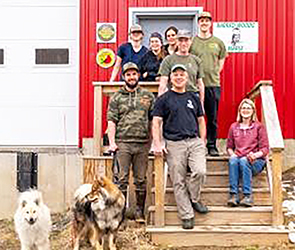
Their big red sugarhouse, built in 2021, sits on an eastern slope of Cold Hollow Mountain in the town of Belvidere. Barred Woods is a collaborative partnership among four owners that began in 2017 as a way to conserve land and work within their rural community to help employ people. Their love for the land, ecology, and habitat, and their intent for a working landscape that fosters the economy and community led to a sugaring operation that now employs around 10 people year-round, making Barred Woods one of the largest employers in their small rural town.In 2025, Barred Woods ran 27,000 taps from their 300 acre sugarbush.
The highest elevation on their parcel reaches over 3,000 feet in elevation, near the summit of Cold Hollow Mountain. With the sugarhouse at around 1,100 feet in elevation, gravity helps the sap flow downslope, and they also have a vacuum releaser system to pull the sap into the sugarhouse.
“This year, we tapped about 34,000 trees. It was another big year for snow, so we did have to spend some time digging out our sap lines, despite them hanging at around five or six feet above the ground. The sugaring season is off to a good start. The weather has been a little inconsistent, with longer stretches of below-freezing temperatures where the sap does not run, but it looks like we have some good looking sugar days ahead,” said Daniel Paggi.
On a tour of the sugarhouse, co-owner, Matt Paggi, explains how the eastern slopes of their sugarbush, and the mountainous ecology of Vermont generally, is an optimal habitat for sugar maples, which favor moist, but well-drained soils. Though it’s a challenge to navigate on the mountainous ridges in winter, when snow is often at least five feet deep, they use ATVs, snow shoes, and often end up wading through deep snow to tap the trees from the end of December through February.
The sugarhouse, which also houses their packaging and labeling warehouse is the most active when the sap is flowing during March and April. A cycle of nighttime freezing and daytime thawing temperatures creates negative nighttime and positive daytime pressures in the maple tree. When a maple is tapped, the sap will flow through the hole in the trunk because positive daytime pressures inside the tree are greater than the outside air pressure. On average, maple sap is roughly 98% water and 2% sugar. Barred Woods uses reverse osmosis to concentrate the sugar content before boiling, significantly reducing the evaporation time and saving energy: Matt explains if the sap coming in is at 2% sugar, the reverse osmosis system brings it to roughly 20% sugar, effectively reducing the amount of time for evaporation by ten times.
Another benefit is that they are able to recycle all of the byproduct water from the reverse osmosis to clean their equipment systems. After reverse osmosis, the concentrated sap is refrigerated at about 34 to 35 degrees Fahrenheit, and is held at that temperature until it goes into the evaporator. For boiling, the evaporator is brought up to temperature, to about 217 degrees Fahrenheit, which is maintained and monitored during the boil. The buoyancy of the syrup is also closely monitored with a hydrometer to ensure that the density, and thereby the sugar concentration, is correct and consistent. As it finishes boiling, the syrup moves from the evaporator pans through a final filtration process and finally into storage barrels, which are sealed at a high temperature.
Barred Woods’ record for syrup production in 2025 was 25 barrels, or 1,000 gallons of syrup in one day. On average, they are able to process about 400 gallons of syrup per day during the sugaring season.
In Hardwick, there is a wonderful maple smell in the air at the VFVC when Barred Woods Maple uses the kitchen to turn their syrup into sugar for bulk sale, spices, and granola products. They started working at VFVC in 2017 when their sales were increasing but they didn’t have a full kitchen that was inspected for food safety,“ said Barred Woods Maple co-owner Barb Paggi.
“The VFVC is great. The people are really friendly and very helpful. We use equipment and the storage facility for products. It works great for us because we don’t have the space to do this at our facility. As we’ve grown, we’ve been able to get more kitchen time.”
Barred Woods typically uses VFVC kitchens three times per week, using about one barrel (or 40 gallons) of syrup each visit to produce about 250 pounds of sugar and 100 bags of maple granola products.Back in Belvidere, they bottle syrup for retail and package and label nearly 250 pounds of maple sugar each day for sale and to mix into other products.
Because Vermont is the highest-producing state for maple syrup, Barred Woods has diversified their market with value-added products. Although the whole team brainstorms new products together, Barb takes the lead on creating new recipes for value-added products. For each barrel of syrup in storage, the team measures the sugar content with a glucometer, and makes notes on which barrels will be best suited for each product. They have found that the lighter, amber syrup is best for their sugar and maple cream.
This spring 2026, Barred Woods will be breaking ground on another facility at the sugarhouse site in Belvidere that will hold a commercial kitchen to replace the work they currently do at the VFVC. They received a grant for middle-of-the-supply-chain producers through the Inflation Reduction Act, which will help fund the new facility and expand their level of production, which in turn will increase their bulk purchasing from smaller scale maple syrup producers who often have a hard time finding buyers.
Learn more about Barred Woods Maple and purchase their delicious maple syrup and other products online at barredwoodsmaple.com/.

