



HARDWICK – A summer study committee submitted its Dam Emergency Operations Planning Report to the Vermont General Assembly on August 18, 2025. The committee identified gaps in the emergency operations planning (EOP) process for dams and recommended creation of a pilot project for one or two state-owned dams in order to test the EOP development and implementation process and to determine more accurate costs.
H.778 was developed to move that process forward and has passed to the Senate, where a proposed amendment allocating $375,000 for two projects was set for consideration. May 5.
Scott Johnstone, then Morrisville Water & Light General Manager, and now also serving as Hardwick Electric Department (HED) General Manager, was a member of that summer study committee and said, “generally, the state’s dam safety division does regular inspections. Most dams are rated poor, largely because they don’t have a hydraulic model of what properties get inundated in a flood event.” Those studies are very pricey, he said, “so unless you generate power one likely would not do them.”
The study committee’s discussion was that each community is supposed to have an EOP as a requirement of receiving money from the state, said Johnstone. “However, not many do (though Chittenden has an incredible plan due to robust and talented volunteers). We talked about having RPC’s (regional planning commissions) engage to help but they’d rightly want money to help with this work. So, in the end, as I recall the report, we recommended that the local emergency agencies become more rigorous in having these plans in place and then keeping them up to date.
To that end the study committee’s report recommended two pilot projects to look at state-owned dams, beginning the process of identifying what are best practices for developing dam EOPs throughout the state.
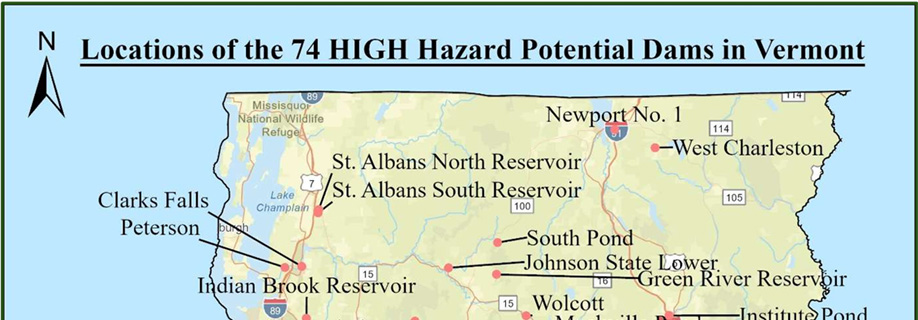
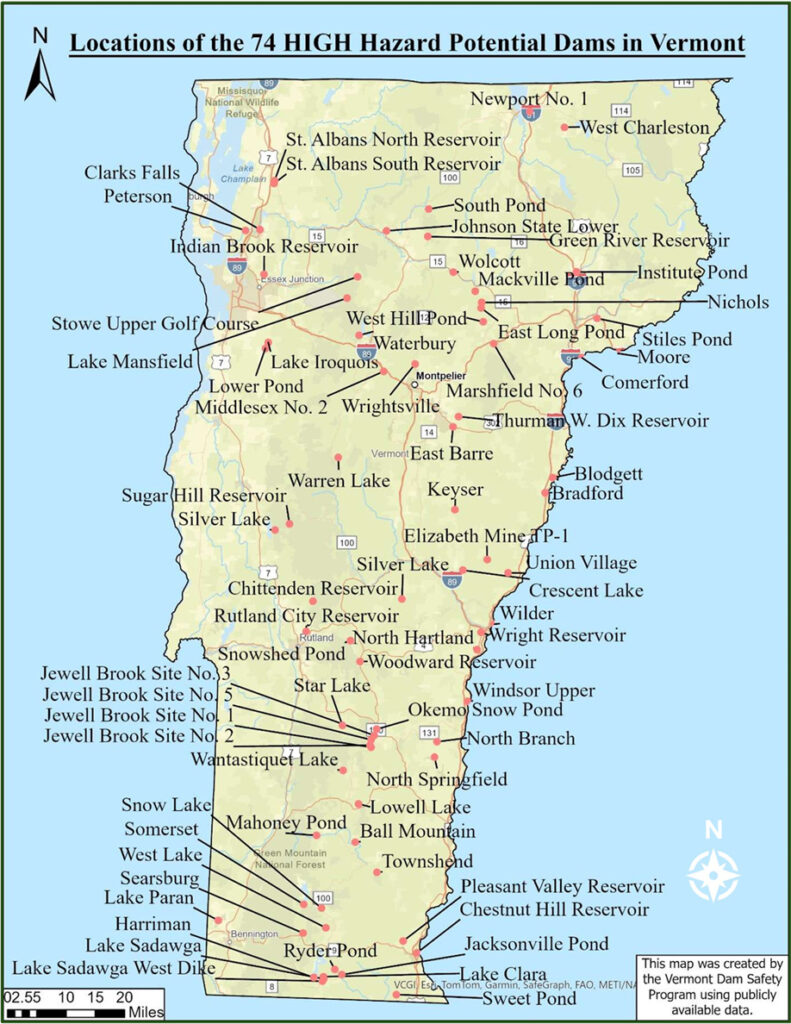
According to a map created by the state’s dam safety program, HED has high hazard dams along the Lamoille River upstream of Wolcott, at Mackville Pond, Nichols Pond, East Long Pond and West Hill Pond.
The Wolcott dam is equipped to generate power; though it has been undergoing repairs since 2023 flooding put it out of operation. The other dams are not equipped to generate power.
EOPs are created to allow appropriate mobilization of emergency responders if a dam breach seems imminent, said Johnstone. HED may need to update its plans and it was on his list of things to look into, he said in March, soon after he joined HED.
Hardwick’s Jackson dam is not classified as a high hazard dam because there’s not a large population below it. It has, however, been the subject of recent studies looking into modeling of Lamoille River flood conditions with and without the dam, along with the potential removal of hundreds of thousands of yards of silt build-up behind it in Hardwick Lake and the river.
Initial estimates of removing Jackson Dam, which shows signs of deterioration, with cracks that may go all the way through the concrete structure, and potential undermining of it, could be between $4 and 9 million. Removal of the silt could cost as much as $50 million more, with less expensive options possible that involve stabilizing what is not removed, said an SLR consulting report.
The Hardwick Select Board charged SLR with taking the next steps to develop a proposal and cost estimates for removal of Jackson Dam.
Johnstone said the failure modes of concrete dams like Jackson Dam and the high hazard HED dams, are different and less catastrophic than those of earthen dams. While earthen dams can fail like the fabled 1810 runaway pond disaster in Glover that drained Long Pond in 90 minutes, concrete dams crumble slowly, generally giving those downstream adequate time to respond, said Johnstone

