




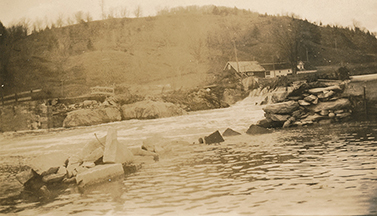
HARDWICK – One detail in the Jackson Dam study stayed with me after I read it. When the SLR engineers began trying to measure how much sediment had accumulated behind the dam, they pushed a fourteen-foot probe rod straight down into the lakebed. In several locations they still did not reach the original river bottom.
In other words, the river has been quietly rebuilding its own valley behind the dam for decades.
That detail helps explain why the future of Jackson Dam has become an important conversation for Hardwick and the surrounding watershed.
The dam was originally constructed in the early 1900s to support hydroelectric power generation downstream. That purpose faded long ago, but the structure remained, creating the impoundment called Hardwick Lake.
The study itself grew out of ongoing concerns about the aging structure, sediment accumulation and the role the dam may play during major flood events. The Caledonia County Natural Resources Conservation District commissioned the study with support from the Town of Hardwick to evaluate current conditions at the site, examine how the river system has changed over time, and explore what future management options might look like.
What the recent study makes clear is that the landscape around the dam has continued to change. Sediment carried down the Lamoille River and Alder Brook has steadily filled much of the reservoir area behind the structure. In some places the depth of accumulated material is still not fully known.
Dams do not operate in isolation from the rivers that feed them. Over decades, sediment, floods and channel movement gradually reshape the system around them. What was built for one set of conditions can function very differently under another.
The Jackson Dam study looks closely at how the river is behaving today and what that means for the future. One of the questions researchers examined was how the dam interacts with flood flows.
Many people assume dams reduce flooding. In some cases, they do. But the modeling in this study suggests the situation at Jackson Dam may be more complicated.
Because so much sediment has accumulated behind the structure, the impoundment now provides limited flood storage. During large storms, the dam can act less like a reservoir and more like a narrowing in the river.
Modeling indicates that restoring the river channel through this area could lower flood elevations upstream by several feet during major events.
Those findings highlight how much the system has evolved since the dam was first constructed, but leave open the question of what should happen next.
The study also looks at the practical realities of managing a site like this. Removing a structure like Jackson Dam would be more than a simple matter of demolition.
The sediment stored behind it represents decades of river movement. Any future decisions will need to consider that material; what is left or removed, how what remains is stabilized, how the channel adjusts, and how nearby land and infrastructure are protected during the transition.
The conversation is less about a single structure and more about how the river system itself is changing.
Hardwick has spent the past several years learning difficult lessons about how rivers behave during large storms.
Flood recovery, buyouts, stabilization projects and new planning efforts have all underscored the same point: the landscape continues to evolve whether we plan for it or not.
The Jackson Dam study is part of that effort to understand what our rivers are doing and what options may exist for the future.
The river will keep moving. The real question is how we choose to live with that movement.
Kristen Leahy serves as the zoning and floodplain administrator and the resilience and adaptation coordinator for the Town of Hardwick.

