

HARDWICK – There is a phrase used across several disciplines. That phrase is, “The purpose of a system is what it does.”
If I invent a shoe-shining machine, and sell it as a shoe-shining machine, and people talk about it as a shoe-shining machine, but what comes out the other end isn’t shiny shoes but instead a pile of shredded leather, it isn’t a shoe-shining machine: it’s a shoe-destroying machine. It doesn’t matter what we call it, and insisting that it is anything but a shoe-destroying machine isn’t compatible with the simple facts.
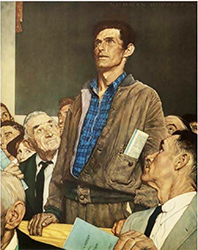
If I say a voting system is meant to ensure that voters are engaged and informed, but I do so by excluding voters who simply do not have the means to make it to a town meeting, then the purpose of the system is to disenfranchise people without means.
In the case of Hardwick’s shoe-shining machine, it works just fine if you feed it shoes made by hand, of quality leather, with cork linings and linen laces. In fact, once upon a time, everyone in town wore shoes just like that, because that was the only kind in town. But these days, when most people are wearing sneakers, muck boots, and knock-off Birks, the machine is obsolete to the point of being harmful to most people who want to use it.
In case it isn’t obvious, this isn’t really about a shoe-shining machine: it’s about town government.
There was a time, not too distant, when the voting system in Hardwick made perfect sense. That was a time when the population was much smaller, life was slower, the horizon was farther away, and agriculture made up the bulk of employment. Most people lived according to the same rhythms and schedules. Most people knew each other personally. Today, however, with a larger population, modern schedules and more diverse employment, the shoe-shining machine is eating far more shoes than it shines.
The question at hand is this: Do we simply shrug and say that anyone who wears muck boots isn’t allowed to vote?
Defenders of poll taxes claimed that a token fee for the administration of democracy is hardly a barrier at all. Defenders of poll taxes had spare money in their pockets and elevated social, political, and fiscal positions reinforced by grandfather clauses and waivers subject to interpretation by the boards and commissioners that they themselves had appointed.
“The poll tax is best known as a tool of disenfranchisement. Before Jim Crow, however, the poll tax served a variety of other fiscal and social purposes. . . After independence, the fiscal importance of the poll tax waned, but its role as a tool of social control grew. . . Poll taxes were supplemented with occupational taxes, often imposing a larger burden on tradesmen than large landowners, ” according to Brian Sawers, in his 2017 legal article, “The Poll Tax before Jim Crow.”
Defenders of literacy tests claimed that an illiterate can hardly be properly informed, and that uninformed voters are poison to democracy. During the Jim Crow era, Southern states devised shoe-shining machines that promised to ensure the qualification of voters fairly and equitably.
James Vardman, a Mississippi legislator during their 1890 constitutional convention, said, “There is no use to equivocate or lie about the matter. In Mississippi we have in our constitution legislated against the racial peculiarities of the Negro. When that device fails,
we will resort to something else.”
Similar remarks were made later, by John B. Knox at the Alabama constitutional convention in 1901: “The convention’s goal is to establish white supremacy in the State, within the limits imposed by the Federal Constitution.”
While similar machines were being constructed and advertised all over the Antebellum South, public support for the measures trumpeted their common sense protection of, and the continuance of, the great American tradition of enlightened democracy.
Some readers, perfectly well-intentioned and without any intent to discriminate, will choke at the idea of comparing a longstanding local tradition to something as heinous as Jim Crow laws. I would posit that these people have never seen the pair of work boots they depend on reduced to a pile of refuse at the insistence of someone for whom the machine works perfectly well.
To this I would say that the purpose of a system is what it does, and the world changes whether we like it or not, and although we may very well desire everyone to enjoy the luster of freshly daubed wax, we must first recognize that the existing order cannot possibly deliver on the ideal.
We can either acknowledge that the machine has become harmful in its obsolescence, or we can continue with the classic fallacy of appeal to tradition as a way of refusing to admit it.
I ask that you consider the above and find the courage to admit that change, while perhaps uncomfortable, is necessary if we are to back our belief in participatory democracy with the currency of reality.

