

GREENSBORO – A special town meeting will be held at the Highland Center for the Arts on Tuesday, June 30, at 7 p.m. The meeting will decide if Greensboro should vote on all public questions by Australian ballot instead of floor votes at town meeting. Albeit well intentioned, making this change would be a mistake.
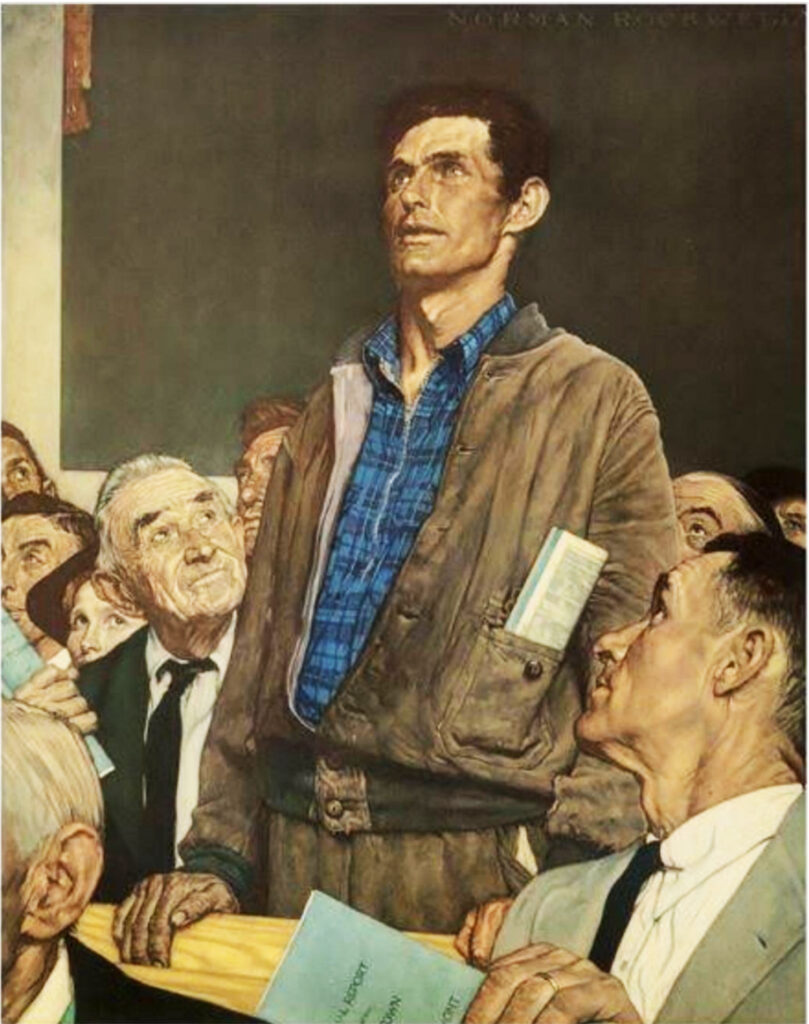
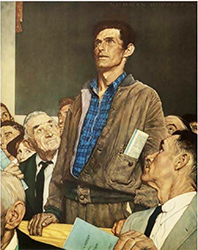
When the school in Arlington, burned down in 1940 the select board scheduled a special meeting for January 18, 1941. They proposed building a new school that would cost more than the insurance settlement and would require the town to borrow money. Jim Edgerton was a local farmer. He was the lone dissenter at that meeting. His farm had been ravaged by disease, and he argued it would be less expensive to tuition students to neighboring schools.
Norman Rockwell lived in Arlington. He was at that town meeting, and he realized that moment embodied the very essence of democracy. It became his painting, “Freedom of Speech.” In the painting the people next to Jim wear white shirts and ties. Jim’s fingers are dirty. He wears a stained leather jacket and a flannel shirt. But in Rockwell’s painting it is obvious Jim is more than just a vote. The painting conveys what lies at the heart of the First Amendment. Jim is a voice and he is being heard. He stands, speaking his truth face to face with his neighbors and his neighbors listen.
Being our neighbors keepers, working together, building barns together and going to town meetings together are traditions that are sewn deep into the soul of Vermont. From our earliest days, through the Civil War and two world wars we met and we built our democracy talking and debating together at town meetings. Those meetings have been much more than a piece of paper dropped in a ballot box. They are neighbors talking to neighbors, listening to arguments, asking questions, proposing amendments and showing a different way to see something. Town meetings are discussion, debate, deliberation, and often, compromise. They are Vermonters in white shirts, in flannel shirts, in muck boots, Bean boots and high heels sitting, standing, speaking, debating, disagreeing, reasoning and working together.
Today our school budgets are voted by Australian ballot. The number of people who show up for an informational meeting can be counted on one hand. When the budget is voted down the only alternative is to vote again, and again, as is the case with Mountainview this year, until everybody gets tired, fewer and fewer people show up, and something finally passes. Australian ballots have not served our schools well. Today, based on almost all credible data, Vermont public schools have some of the highest costs and some of the poorest outcomes in the country.
Our farms are disappearing. Our school is almost gone. With cell phones and computers we are connected to the other side of the world, but we are increasingly disconnected from our next-door neighbors. Increasing participation in democracy is a good idea but it isn’t good enough. We can take other steps to increase participation. We can hold town meetings on Sundays or in the evening. We can live stream meetings.
It is Greensboro’s great good fortune to be small enough to continue this tradition of freedom and democracy so finely evoked in Rockwell’s “Freedom of Speech.” Our democracy doesn’t depend on expensive campaigns or the votes of people we never see. Meeting together and standing and speaking our truth like Jim Edgerton, even if we stand alone, to speak freely and be listened to has been a 200 year gift that we should not let go of lightly.
David Kelley is a lawyer and former high school debate coach.

David Kelley is a Vermont attorney. He lives in Greensboro and is a former chair of the Hazen Union School Board. He was part of the legal team that represented more than two dozen rural elementary school districts that appealed forced mergers under Act 46.
