


courtesy photo
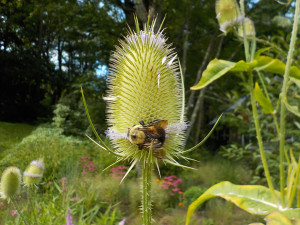
Teasel is a weed loved by bees. The flowers and stems are very prickly, so wear gloves when picking them.
by Henry Homeyer
CORNISH FLAT, N.H. – If Jack, of Beanstalk fame, were to visit my garden, I think he would be impressed. I’m not sure how tall his beanstalk grew, but I got out my 10-ft. tripod Hasegawa pruning ladder and took a picture of a flower blossom while standing on the top step. The flower, a black-eyed Susan stood 111 inches tall on a thick stem that has withstood the wind and rains of recent weeks without any staking. It is truly a Goliath.
But this is no ordinary black-eyed Susan. Its Latin name, Rudbeckia maxima gives you a clue about its inclinations. It wants to be bigger and better than any other in the same genus, or family group. Its common name is large coneflower, which is appropriate as the flower does have a large black cone surrounded by yellow petals. I’ve read that it commonly grows six- to eight-feet tall, but this year it has exceeded that and may still be growing. The leaves are few, but large, and blue green in color. Quite interesting. The leaves are mostly clustered towards the bottom of the stalk.
courtesy photo
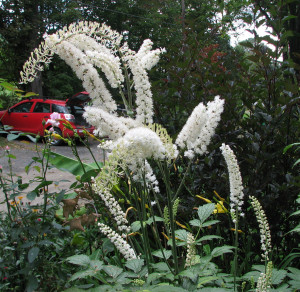
Snakeroot or Cohosh is loved by bees and has a strong scent.
Large coneflower is not commonly sold in nurseries. But if you find one, or better yet, three, plant it where it can strut its stuff. It does well in full sun, and average, moist soil. Perhaps because my soil is above average (it is rich, black and fluffy), my plants are taller than average. A few words of warning: Rudbeckia maxima hates to be moved and can take a couple of years to recover from transplanting or, at least, mine did.
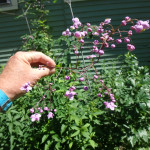
Another tall, lanky plant I love is a meadow rue called Thalictrum rochebrunianum “Lavender Mist.” My go-to flower book is “Manual of Herbaceous Ornamental Plants” by Steve M. Still. This is an 800-page text that tells me most everything I need to know about any flower I want to grow: where a plant will grow best, zone hardiness, flower description, how best utilized, related species and much more.
Still’s book says “Lavender Mist” commonly grows four- to six-feet tall with delicate lavender sepals, no petals, and “primrose-yellow stamens.” Like the Rudbeckia above, mine get tall, often eight feet or perhaps more and has large parts of the stem bare of leaves. The finely cut leaves are on a few side branches along the tall stem. This one does need staking sometimes to keep it erect in rain storms. It is a splendid cut flower, very dramatic in a tall vase. “Lavender Mist” does well in part shade and rich soil. Half a day of sun is fine.
courtesy photo
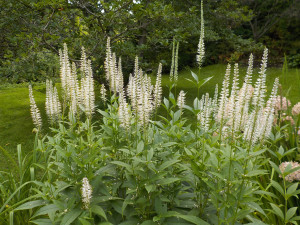
Native Culvers root is delicate looking, but strong.
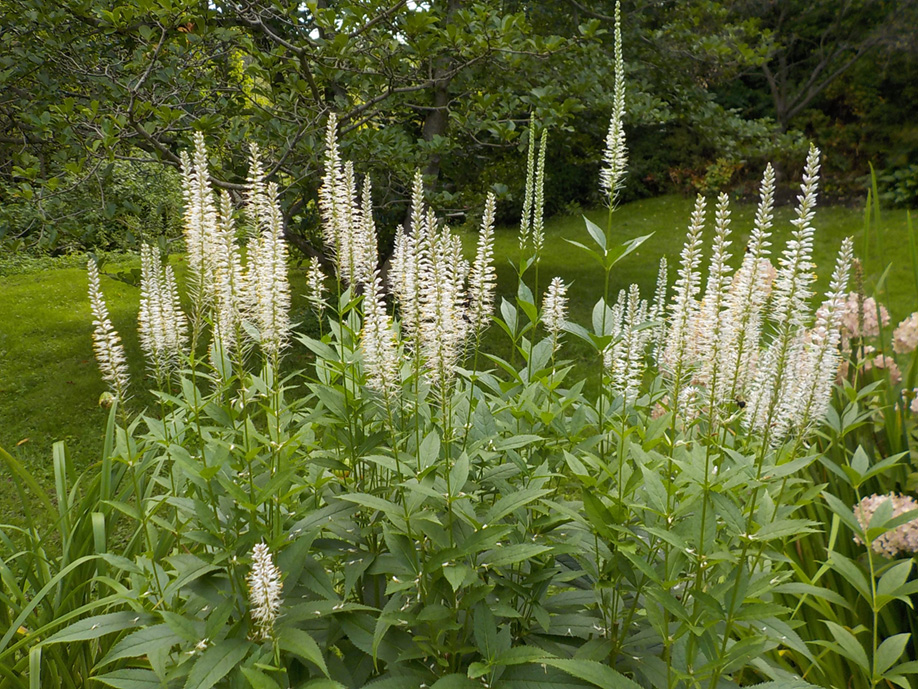
Some years ago at a garden-design competition in the Loire Valley of France I happened upon a Culver’s root (Veronicastrum virginicum) called “Fascination.” It is a tall plant, six- to seven- feet tall for me. The flowers are lilac-rose colored spikes and quite striking. But no one had them for sale in the States until I finally found one for sale at a Mom-and-Pop roadside corn and tomato stand that also sold marigolds and geraniums. Huh. How did it get there? I don’t know, but I bought it and still have it 20 years later.
“Fascination” flops in rainy weather and needs to be surrounded by three strong stakes and a barrier of string. But if I remember to cut back the stems by half in mid-to-late June, it does not flop and produces many more flower spikes. Instead of one per stem, it produces six or so smaller ones, and a bit later in the summer. Mine is blooming now.
I’ve come to love the common white Culver’s root even better than “Fascination.” It only gets to be four-feet or so tall, but needs no staking. Bees and wasps love it, too.
courtesy photo
Meadow rue “Lavender Mist.”
While visiting a farmer in Ohio I spotted a fascinating big plant called teasel, growing in his corn field. I was told that teasel (Dipsacus spp.) was a horrible weed, and that I was crazy to collect seed from it (though I did anyway). It is biennial with a spiny stalk and leaves, and sculptural blossoms that are not like any other I have seen. Hard to describe, see the photo with this article.
Each spring I pull out all but two or three first-year teasel plants so they do not take over my garden. I have three this year, and one is easily eight feet tall. The flowers are fabulous in an arrangement, and can be used dry all winter. Outdoors the stems stand up in wind, snow and ice and are endlessly fascinating to me.
Another favorite tall native plant of mine is called snakeroot, bugbane or black cohosh. Its scientific genus used to be Cimicifuga, but now it has been changed to Actaea. I grow two species, Actaea racemosa and A. ramosa. They bloom starting in August and are a great treat for pollinators, especially bees of all sizes and types. They bloom in alphabetical order, A. racemose first, then A. ramosa. They can have a very strong scent, which I like as much as the bees do.
Snakeroot is a native woodland plant, but will do well in full sun or part shade so long as there is plenty of moisture. There are also named cultivars such as “Hillside Black Beauty” that have leaves that are deep purple to almost black and are very striking in the garden. This spring I had “Hillside Black Beauty” growing next to a Rodgersia with big almost-orange leaves, and the combination was breathtaking. Later those orange-tinted leaves turn green.
If you garden on a flat area, think about growing some tall perennial plants to give your garden a more interesting look. And mix in some shrubs or small trees to give you height in winter. But that’s an article for another day.
[You may e-mail Henry at [email protected]. He is a garden consultant and the author of 4 gardening books.]


