


HARDWICK – Town administrators sent a message with recent water and sewer bills asking residents to conduct a self-inventory of their water service lines to help identify lead and galvanized pipes. Only about 20% responded, said Hardwick’s Town Manager David Upson.
With so few homeowners responding, Hardwick’s water system staff and engineering firm have been going door-to-door since September to gather the necessary information. Only 65% of buildings had been surveyed as of last week, according to Upson.
Upson said the process begins by identifying where lead and old galvanized pipes are in service. Once identified, plans will be made to replace pipes and a project will then be undertaken to carry out the work.
It’s critical to collect the information now because new Environmental Protection Agency rules impacting drinking water require water systems to create an inventory of service lines and submit it to the Vermont Drinking Water and Groundwater Protection Division by October 16. If the water system lists at least one service line made of lead, galvanized pipe requiring replacement or unknown materials, a replacement plan is also required by the due date.
Funding may be available to replace customer-owner service lines for those identified before the October 16 deadline, said Upson.
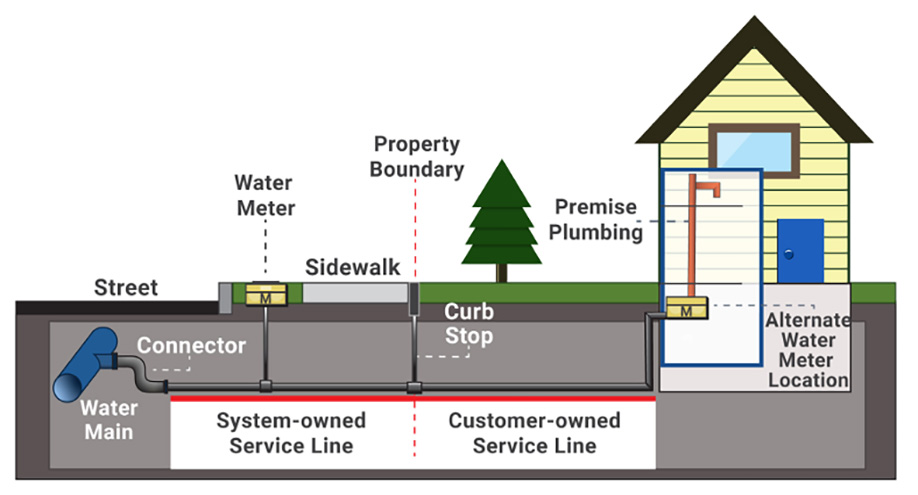
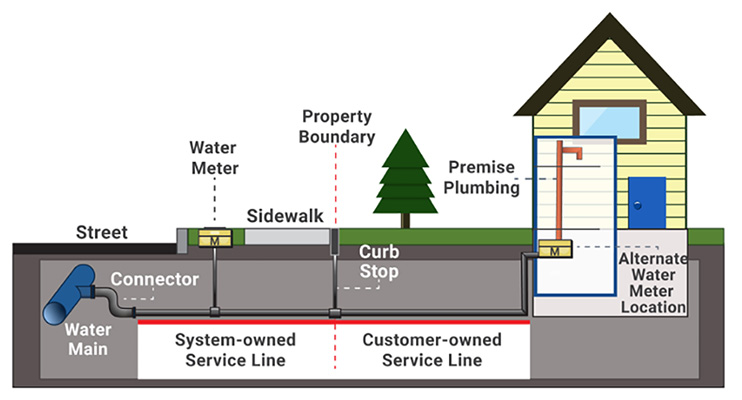
In this water service line diagram, the system-owned portion spans from the water main connector to the property boundary or curb stop. The customer-owned portion is the part of the service line that extends from the curb stop to the meter box or isolation valve where the building’s plumbing connects
The self-inventory procedure is to locate where the water line enters the building, take a photo and send it to [email protected].
It is possible to perform a quick test to determine if a pipe is lead using a screwdriver, a magnet and a penny. Simply scratch the pipe’s surface, look at the color and tap it with a coin. Lead pipes will be shiny, a magnet will not be attracted to them and they will make a dull noise when tapped with a coin. Copper lines will be the color of a shiny penny, won’t attract a magnet and will make a metallic ringing noise when tapped with a coin. Galvanized pipes will be a dull gray and a magnet will be attracted to them.
Upson said Hardwick has no water mains made of lead and has been replacing lead and galvanized town-owned service lines in areas of town where curb stops have needed replacement.
Lead poisoning is a serious but preventable health problem. Lead is a highly toxic metal that has been commonly used in many household, industrial and automobile products. Too much lead in the body, or lead poisoning, can cause serious and permanent health problems. Children and people who are pregnant are at special risk.
Lead gets into drinking water as it moves through lead or galvanized iron pipes and fittings, lead solder and brass or chrome fixtures. Lead cannot be seen, smelled or tasted. Testing is the only way to know for sure if lead is in the drinking water.
Those with questions may contact the Town of Hardwick at (802) 472-6120.

Paul Fixx is editor of The Hardwick Gazette and lives in Hardwick.
