


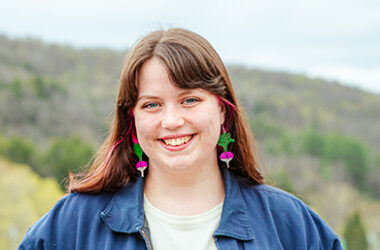


CALEDONIA COUNTY — Amanda Cochrane hadn’t really considered running for the legislature until she was asked to consider it by the woman retiring from the position.
When Sen. Jane Kitchell called, Cochrane reflected on her past work with marginalized groups, and how she could amplify the voices of rural communities.
“People in the Northeast Kingdom often feel like their voices aren’t heard,” she said. “A lot of times, it feels like the voices of Montpelier and Burlington are just more prominently listened to, and so it felt like a good fit.”
Now, Cochrane is the Democratic candidate running for the Vermont Senate-Caledonia District, representing the towns of Barnet, Danville, Groton, Hardwick, Newbury, Peacham, Ryegate, St. Johnsbury, Stannard, Walden, Waterford and Wheelock.
Cochrane lives in St. Johnsbury with her husband and three children who are 15, 13 and 10. In her spare time, you can find Cochrane coaching her children’s basketball teams, or playing pick-up on her own.
Cochrane grew up in Arlington, Mass. She attended Colby College for undergrad and got her MBA in nonprofit management at Brandeis University.
Currently, she is the executive director of Umbrella, based in St. Johnsbury. Umbrella is a non-profit organization that supports survivors of domestic and sexual violence, along with other family-based programs.
Cochrane believes her experience in social services and Umbrella has shaped her opinions on policymaking and community intervention.
“That put me on my trajectory to continue to work on behalf of people who are the most marginalized in our communities,” she said.
“I worked in child welfare, worked on environmental justice in a post-industrial community that had a lot of pollution and disinvestment,” she said.
She feels particularly well-versed in the youth well-being and development sphere from not only her career, but from serving on the boards of Child Advocacy Centers serving Orleans and Caledonia counties.
“I find it meaningful to connect young people to the community work because they have great ideas,” she said. “And that can really be formative in what they end up going into in life.”
“It’s essential in any kind of social service setting or really any setting to have opportunities for youth to meaningfully contribute,” she said.
To support youth, Cochrane said schools need adequate funding, But she understands rising property taxes are frustrating for many Vermonters.
She says property taxes increased so much this year due to state COVID funding running out, as well as rising healthcare costs in schools, and deferred maintenance on buildings. She sees this time as an opportunity to re-evaluate school funding. For example, she thinks capital expenditures should be handled separately from a school’s operating budget.
“I think spending guardrails are important,” she said. “I think a couple of those things may get us closer to where we need to be in terms of controlling spending while still meeting the needs of schools.”
She also wants to evaluate how the state funds mental health care.
“Where else are we spending mental health dollars in our state?” she asked. “Can some of that support school based clinicians? Can we partner with our designated agencies and maybe more in depth ways to provide some of those services within schools, but funded separately and differently?”
Cochrane also wants to help young adults who may be interested in relocating to Vermont or staying here. She says affordable housing is a huge component of this, and that more downtown or village housing could create enticing spaces for young people that spark a feeling of community.
“I think young people might be looking for more in town housing, downtown housing, so they can move to some place that has a really cool village,” she said, “a place that they can go grab some food, has some cultural piece, has a green, where they can just be part of the community.”
Even as she encourages more young people to live here, she wants to maintain the character of our unique state.
“People don’t want to move to suburbs,” she said. “I’ve seen way too many states who’ve done that, and now everything’s just overrun with suburbs that just look the same everywhere.
“We have a beautiful character,” she said. “How can we build on that while retaining our working lands?”
Kate Lewton writes for the Community News Service, a University of Vermont journalism internship, on assignment for The Hardwick Gazette.

