
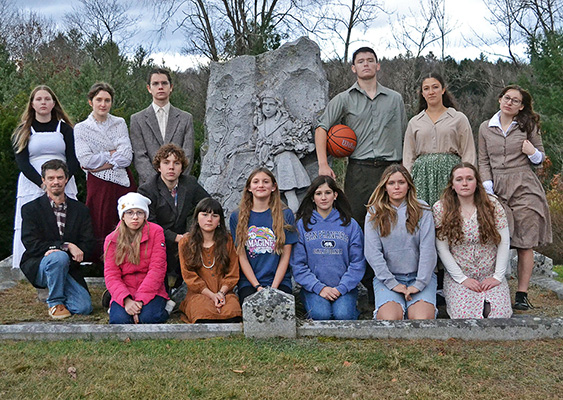


HARDWICK – An intermittent rain added an air of mystery during a slow walk through the Main Street Cemetery for Hazen Union School Drama Club students’ performance of “Hardwick, 1924.”
Students portrayed historical figures from Hardwick in 1924 near where they lie in the cemetery. Writer and Director Marc Considine compiled histories of each figure from articles and obituaries published in the Hardwick Gazette and other sources.
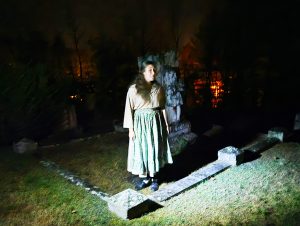
Student guides Serenity Leach, Summer Chernovez, Kassidy Gann and Madeleine Crank each led audience groups into the cemetery.
The first stop visited 16-year-old Sadie Davison, artfully portrayed by Sadie Gann, who, through Davison’s voice, introduced the recurring theme of workers in Hardwick’s then-thriving granite industry, where her father worked. Her story was one of great hardship and need, with four of her mother’s 11 children dying young and having just one cow, lost as winter was coming on. The family moved to New Hampshire, though she gained a suitor in Hardwick while there nursing a sick family member back to health.
After a short, dark walk, we met a young and cocky Eddie Barr, of the Barr’s Better Beverages family, energetically brought to life by Ethan Gann. Barr’s pop arrived from Italy with the first granite workers, but left the business, got a cart and sold cold drinks to the workers. He expanded with a refrigeration unit and distributed cases of flavors made with secret recipes that included Fruit Bowl and Orange as far away as Morrisville, said Gann.
Seville Murphy then appeared in the guise of self-assured Lawrence (Larry) Shattuck to gather Barr for their town team basketball game against a team “all the way up from Holyoke, Mass.”
From Murphy, we heard a tale of Shattuck’s father and uncle John racing bicycles up to Greensboro Bend, through Greensboro and back. Uncle John was playing basketball then, but Barr’s pop can’t play because he had a recent case of “appendix-itis.”
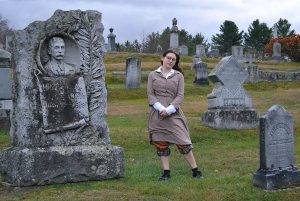
photo by Vanessa Fournier
Before his departure, Murphy took the group to visit Will Helms as Shattuck’s uncle John Edward Appolt. Helms recounts Appolt learning the printing trade from Charles Laymon and later following when Laymon bought the Hardwick Gazette. We learn Appolt became the owner and editor of the Gazette within eight years, continuing until his 1948 retirement.
Helms’ rendering of Considine’s quite accurate portrayal of a small-town editor’s lonely life included meeting Calvin Coolidge, the Ku Klux Klan recruiting in the area and writing obituaries of his friends. It brought chuckles to this editor despite the somber cemetery setting.
Our guide next led us to visit Mrs. Jay (Grace) Woodbury as enlivened by student Juniper Book. The Woodbury’s lived with her husband’s parents where Jay worked the farm with his father and Grace taught school after graduation from Goddard Seminary, class of 1914.
Her story of poverty, and getting help from her mother-in-law, also named Grace, was moving and brought a visceral sense of difficulties then faced in the world as we learn she continued to travel to Moretown to teach until it was discovered she was with child. She had twins, both of whom died within a few weeks and are buried next to their mother, as the child her mother-in-law lost was buried beside her too.
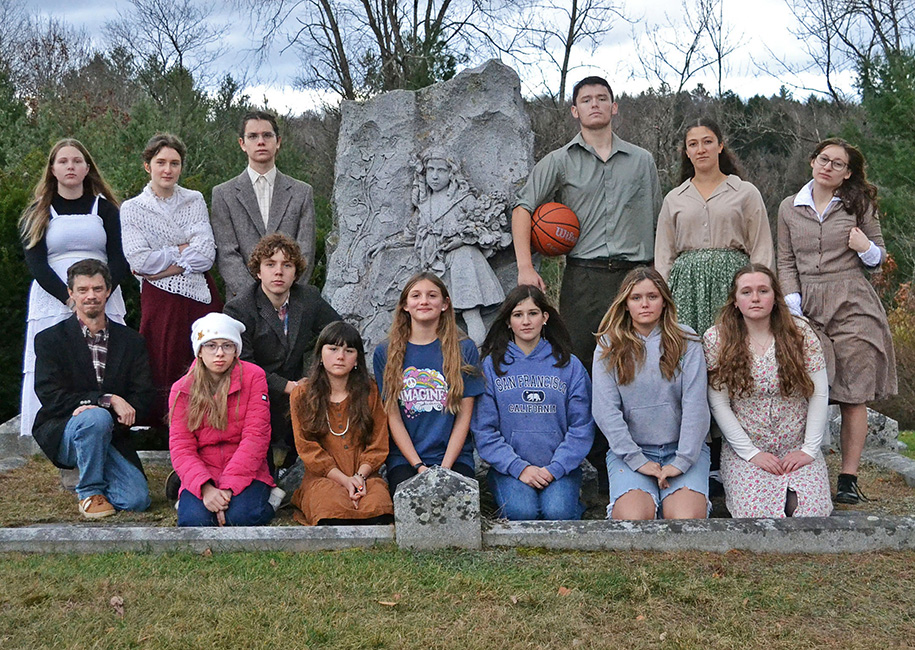
photo by Vanessa Fournier
At our next stop we met a poor unnamed woman portrayed by Lana Stacey. Considine says her story combines details from multiple people, with others, the actors voice each person’s actual words where they were available. Otherwise, he says the opinions presented are fictional, but extrapolated from research.
Stacey shares her character’s husband worked as a bootlegger to get by, ending up in jail, so she and her children were sent to the poor farm. There they shared a single room, working for their keep until her children were sent to live with new families. She was buried without even a stone to mark her place; forgotten in death as in life.
Our guide told us of Eleonora Ambrosini, as she showed us “perhaps the most famous sculpture in the Main Street Cemetery.” Ambrosini died when she was eight years old and her father carved the stone for her.
Ursa Goldenrose, as Eleonora’s mother Antoinetta Ambrosini, then appeared from the darkness to tell us her death was called tuberculosis, but “it was the granite that killed her,” despite the work being in the family’s blood. They were marble carvers from Lake Como in northern Italy.
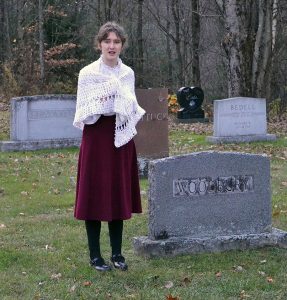
photo by Vanessa Fournier
Goldenrose’s moving portrayal of the difficult life and untimely deaths of a family making a living in the granite trade and dying from dust inhaled there, brought home the difficult history of that business.
Our guide voiced Willie Woodbury Marshall, said to be away and perhaps at his summer home on Caspian Lake, or more likely in Florida. Marshall started as a traveling salesman, working his way up to have “built much of this town including many of the buildings downtown as well as many houses and tenements.” He was said to have bought property and sold it to the town at triple the price.
We were next guided to visit Blanche (Drown) Walsh, whose story Megan Cane brought to life; telling us of Walsh’s father who had many unfortunate experiences working at the Mack Quarry. We learn he always considered himself lucky, thanking God for his survival, the years he had with his wife and being loved by everyone because he ”treated everyone kindly, no matter where they came from.”
Our final stop brought us to see and hear Quinn Molleur’s portrayal of Albert Norcross and the two loves of his life: His wife of 52 years, Addie, and the Town of Hardwick. We learn Addie couldn’t leave the house or take care of herself in her last decade, but he never left her side. We learn his job distinguishing the worthy from the unworthy poor weighed upon his conscience as the worthy poor were provided with necessities or sent to the poor farm, out in the hills, while the unworthy were shipped out of town. Either way, out of sight, he said.
His closing speech offered much food for thought as he suggested the town “prospered on the backs of immigrants” and now turns its back on them, continuing to say “Hardwick is the great town that it is as a result of their work . . . their skill . . . and their lives that they sacrificed if only to sustain their pride and their families. Scores of young men . . . men with wives and children… have died, working in the granite sheds for meager pay and in unsafe conditions. And now that they are gone, leaving little for their families, does it not fall on us to support them?”
Considine’s recreation of the Hardwick of a century earlier was skillfully and memorably brought to life by the students who quite believably became their characters for a somewhat damp audience. The performance seemed appropriate on the Day of the Dead, celebrated in some places as a festive occasion to remember friends and family members who have died.

Paul Fixx is editor of The Hardwick Gazette and lives in Hardwick.
