
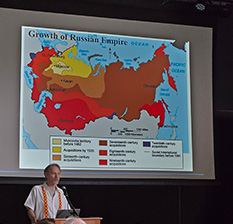



GREENSBORO − Adrian Ivakhiv came to the Highland Center for the Arts in Greensboro last Wednesday evening and gave a fascinating talk, “Ukraine the Climate of War and Peace,” setting that tragic conflict in a more global context that has serious consequences for all of us. He holds the J.S. Woodsworth chair in the Humanities at Simon Fraser University in Vancouver, B.C., and was formerly a professor at the University of Vermont. He has long summered in Greensboro with his family, connected by marriage to the Grays. He is the editor of a new book, “Terra Invicta, Ukrainian Wartime Reimaginings for a Habitable Earth,” a collection of different authors on such subjects as history, food, literature, art, poetry, personal experiences and scholarly explorations of Ukraine’s distinct culture. His ancestry is Ukrainian and he has visited the country many times over the past 35 years, most recently at the beginning of this summer.
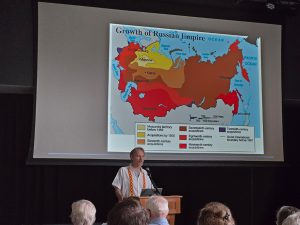
Russia invaded Ukraine on February 24, 2022, in a blatant violation of the Budapest Memorandum of 1994, which guaranteed respect for Ukraine’s territorial boundaries in exchange for giving up its nuclear arsenal at the time of its independence from Russia with the breakup of the old Soviet Union following 1989.
Expecting an easy blitzkrieg victory, the Russian forces soon became bogged down by fierce Ukrainian resistance. Euphemistically labeled a “special military operation” by Putin, it is now in a stalemate on multiple fronts, with an estimated loss of over a million Russian soldiers, many drafted from ethnic minority groups from the eastern part of the country.
The utter brutality of Russian troops, especially to civilians, quickly made the Ukrainian people aware of how deadly any Russian occupation would be and united the vast majority behind President Zelensky. Attacks by Russian drones and missiles have occurred almost nightly, targeting cities and towns, civilian infrastructure as well as military installations, the latest on July 4, involving some 500 weapons lasting eight hours, said to be Putin’s gift to Trump.
Russia’s vicious war is both ecological and cultural. Among innumerable atrocities was the destruction in 2023 of a large hydro-electric dam on a major river in central Ukraine, causing widespread flooding, while agricultural land near the war zones have become mine fields. Potential attacks on nuclear power plants near battlefields could prove catastrophic consequences for the spread of radioactive material over large areas of the country and beyond, far worse than Chernobyl.
Ukraine’s extensive wheat production in regions of rich black soil, crucial to many third world countries, is now prevented from being exported through the Black Sea. On the cultural side, the avowed aim of Russia is to destroy the unique monuments and heritage of Ukraine’s past, ban the very language and literature of Ukrainian and impose a ruthless dictatorship over the whole country.
Russia is the last colonial empire in the world. Other European countries gave independence to most of their former colonies within decades of the end of World War II, but until the dissolution of the Soviet Union, Russia maintained control over a vast area of eastern Europe as well as central and northern Asia.
There is a long, horrible history of Russia’s suppression of Ukraine’s cultural identity. The czars forbade the language, which continued in far worse forms under Stalin, who caused the death by starvation of six million Ukrainian farmers who owned their own land in the early 1930s, as well as killed countless numbers of the Ukrainian intelligentsia in the same decades. Putin’s annexation of Crimea should have been opposed at the time, for it set the precedent for the invasion in 2022.
Ivakhiv went into some of the background behind the current crisis of climate change and how that is tied into the war in Ukraine. The present geological period has been labeled the Anthropocene, reflecting the profound effects that human beings have had on the earth in recent centuries. Different vectors enter into this equation: colonialism by Europeans after 1492 in North, Central and South America, Africa and Asia, with the extraction and modification of resources without any accountability for the cost to the natural world and people. Another vector is the plantation system, which meant cutting down trees and introducing single crop agriculture; capitalism combined with unencumbered imperialism; and subsequently the industrial revolution powered by coal and then gas and oil fossil fuels, increasing the proportion of carbon in the atmosphere. Ecocide becomes genocide for those powerless people who are in the way of such developments. The competition for rare metals and access to other resources, is leading to increasing wars. Russia is still a major exporter of gas and oil despite shrinking markets due to solar energy and electric vehicles, and it needs Ukraine for pipelines into western Europe.
How are the Ukrainians surviving after three-and-a-half years of brutal warfare? Ivakhiv characterizes the general attitude as earthy stoicism. There is widespread traumatization with a quarter of the population displaced within Ukraine or to other countries, but also a deep resilience and a new pride in speaking Ukrainian as opposed to Russian.
Kiev remains a vibrant city with many shops, restaurants and bookstores, but one must know where the nearest bomb shelter is located. While Ukrainians have never had a good working government, they have had a taste of democracy and personal freedom so they feel they can make changes now, but the alternative of a Russian occupation is unthinkable.
The spirit of the undefeated land that Ukraine is, informs the title of Ivakhiv’s book, “Terra Invicta.” The Latin phrase terra invicta can be loosely translated as “always invincible” or “always to victory.” Its subtitle “Ukrainian Wartime Reimaginings for a Habitable Earth” points to the connection Ivakhiv made during his talk between the armed conflict and a habitable environment.
Ivakhiv’s book “is a series of critical and creative articulations of pasts, presents and possible futures involving humans and the more than human world,” says the book’s pre-publication notice.
In his talk, Ivakhiv connected the pressures resulting from ecological change due to a changing climate with military aggression resulting as resources and the needs for them change.
He mentioned the book’s wide range of essays by a similarly wide range of authors, many of which bring a humanitarian or artistic perspective to understanding of the connection Ukrainians feel to their land and the spirit of grassroots engagement that has risen in them as they have prepared to lay down their lives to protect their way of life and land.
With the withdrawal of military aid from the United States under the Trump regime, Ukrainians realize that they can’t rely on other countries, though NATO has a fundamental commitment to defending democracies.
Zelensky continues to have high approval ratings, and a recent successful attack by Ukrainian drones and missiles destroying many planes on bases within Russia has helped to boost national morale. Extensive documentation of the barbarity of Russian forces is being gathered to take to the International Criminal Court in the Hague to show extensive war crimes against humanity have been routine. Questions from the audience ranged over some of the above summarized topics but also raised issues of the effects of war and climate instability on refugees and immigration all over the world. Looking forward to an end to the war in Ukraine is most people’s hope, but with so many unpredictable variables, realistic models of the future are difficult.
The indomitable spirit of Ukrainians came through in all of Ivakhiv’s comments, particularly in comments about his recent visit to a writer’s conference about which he commented, “I was surprised at how spirited people are.” We may think that Ukraine is far away and whatever happens there is not going to affect us personally, but it is a grim warning for what could happen anywhere in the world when demonic aggression by totalitarian countries is not opposed.
For information about the armed Russia-Ukraine conflict, Ivakhiv suggested visiting justsecurity.org

David K. Rodgers
David K. Rodgers is a writer, mason and card carrying dilettante, who dabbles and babbles in art. He has lived in East Craftsbury for the past 40 years.

Paul Fixx is editor of The Hardwick Gazette and lives in Hardwick.

Thanks for your wonderfully detailed review of the talk – I appreciate it very much!
One quick correction – “Terra Invicta” means “Unconquered Earth.”
Best,
Adrian