




GREENSBORO – “The Great Maple Syrup Bubble” was the subject of a talk by Greensboro Resident and Northwestern University Emeritus Professor of History Tim Breen, following a brief Greensboro Historical Society business meeting led by President B.J. Gray, last Monday, August 4.
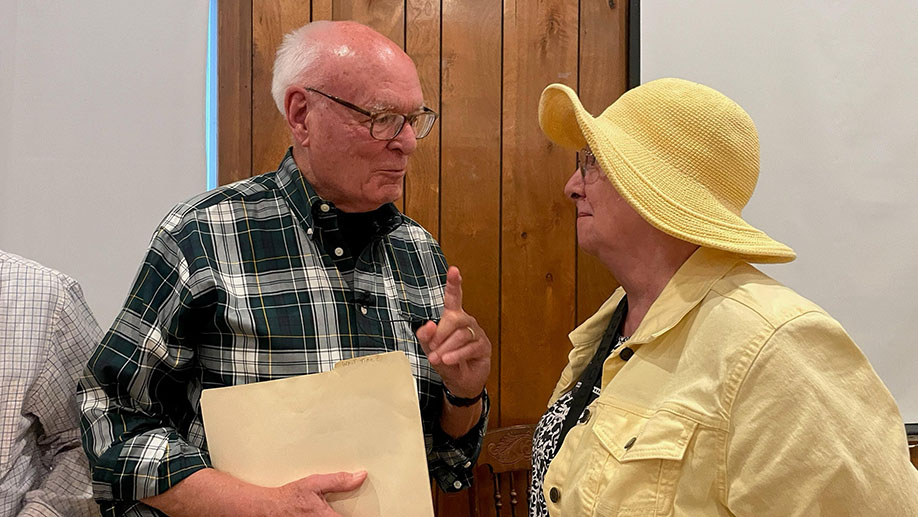
photo by Kyle Gray
The business was gotten through quickly with all officers reappointed and Jan Terwiesch appointed as a new trustee.
Notable successes in the past year include receiving funding to add UV protecting window shades in the society building’s Hill exhibit, Dan Penrice’s editing of this year’s Hazen Road Dispatch, fundraising and siting of a memorial bench for Tom Hurst in the society’s garden and two newsletters edited by Jenny Stoner.
Renee Circosta was named as the year’s outstanding member and Harvard protein Chemist John Tillotson Edsall will be the subject of next summer’s exhibit.
Breen’s talk identified an economic bubble involving the production of maple sugar from sap, between 1789 and 1792. Promoters insisted it would transform the economy of the United States. He identified its causes and effects, involving the greed, hype, misinformation and gullibility required for the making of all good bubbles. Those looking for a connection to Greensboro had to wait for the end, where Breen finally made the Greensboro connection.
Like all good bubbles, this one had its winners and losers, with the founders of Greensboro being among the land speculators who capitalized on the failed bubble, said Breen.
Breen cited three ingredients for the making of a bubble: First there is the belief that a source of wealth exists, second is the opportunity for ordinary people to benefit and third are persuasive testimonials.
In 1790 maple sugar satisfied all three, he said.
Sugar was then mostly a product of the West Indies and had transformed American and British diets, said Breen. “What was once an extravagance was now a necessity.”
Making for the bubble was the possibility of replacing West Indian sugar, made by the blood and sweat of blacks, with a Vermont product, he said. Adding to the moral dimension was a 1790 visit to Vermont by Thomas Jefferson, before he became President.
Interestingly, while replacing the work of black people in the West Indies with the work of Vermonters, there was no hint in newspapers of the time taking notice of the condition of enslaved people in the U.S., said Breen.
It was said maple sugar was a patriotic act, driving immigration, recommending itself as a benefit to small business. And of course, promoters said, “Making maple sugar was easy.”
“Inconsistencies abounded,” said Breen, and books about the process abounded as well. It was clear from them that the process was complicated, with a long and expensive list of equipment required. In addition any number of accidents, from overheating, to ash falling into the product, could cause it to be worthless.
Answering a question after his talk about who benefitted from the bubble, Breen suggested it was those who provided the equipment, not least of which were the manufacturers of the copper kettles preferred over steel kettles, prone to rust.
Seeing an opportunity, the Dutch Holland Company sent two representatives to survey the market. They journaled their activities, writing, “There is in the whole state of Vermont, a considerable number of maple trees.”
In the end, transporting maple sugar was difficult and expensive because of its density. And white sugar, supplied from the West Indies, was preferred over the brown product produced from the sap of Vermont’s maple trees, said Breen. Most farmers apparently found more lucrative work in animal husbandry, where the fruits of their labor could be sold locally.
Discovering that, the Holland Company representatives, and others, saw another great opportunity in land speculation. Some speculators went bust, said Breen, and at least one in the area landed in jail. Greensboro’s founding land speculators seem not to be among either of them, Breen later confirmed.

Paul Fixx is editor of The Hardwick Gazette and lives in Hardwick.
