
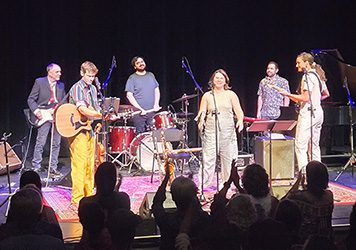

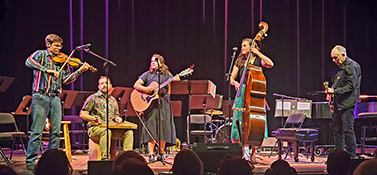
GREENSBORO – “Abbey Road,” the last studio album recorded by The Beatles, offered a creative outlet for the many talents of the Birdhouse Band and its guests during a sold out show this past Saturday evening at Highland Center for the Arts (HCA).
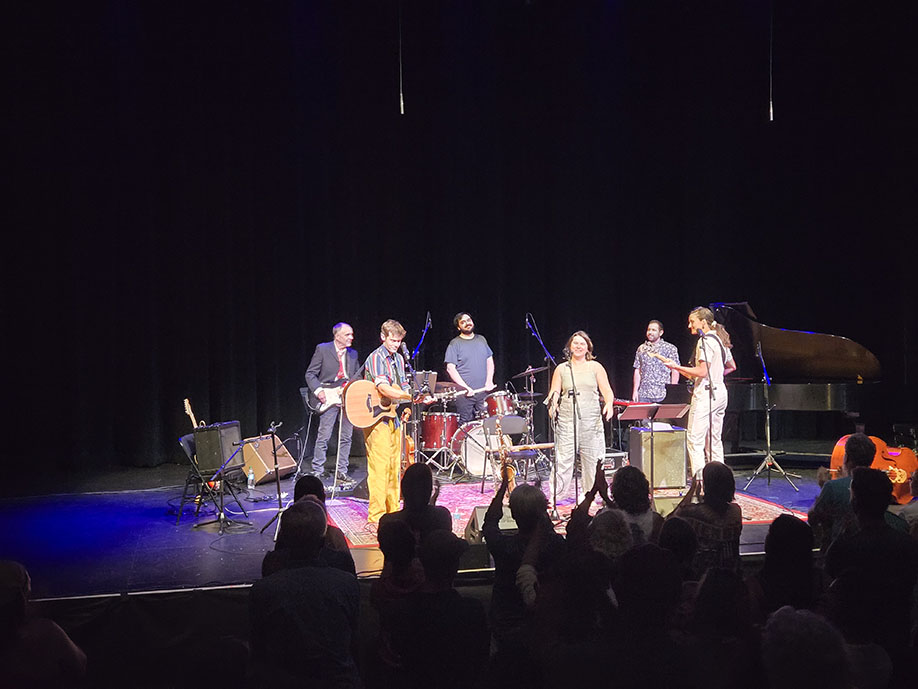
photo by Paul Fixx
Birdhouse Band’s standard line-up includes Mavis MacNeil (vocals, acoustic guitar, flute, tenor saxophone and various effects), Annie Rowell (upright and electric bass, vocals), Roy MacNeil (acoustic guitar, violin, vocals) and Andrew Kehler (keyboards), with the evening’s guest performers Randy Bulpin (electric guitar) and Andrew Palumbo (drums).
Before intermission and the main event, the full group warmed themselves and the audience up with two covers that hinted at the harmonies to come.
First up was Lake Street Dive’s “Bad Self Portraits.” Gloria Gaynor’s 1978 hit, “I Will Survive” came next, energizing the appreciative crowd as each of the performers highlighted their considerable talents before the band segued into “Les Yeux Noirs” (Dark Eyes) by Django Reinhardt, beautifully sung by Rowell..
The core group shared three original songs, first a tender, well-crafted tear-jerker of a tune, “Milkweed” written and sung by Mavis bemoaning a lost love. Rowell then sang her “When Will I See You Again,” another love song, followed by Roy’s “No One is Born.”
A cover of Brian Wilson’s “Love and Mercy,” from his first solo album, took the band into a break.
Their performance, billed as, “A Homage to The Beatles,” proved to be just that as the six-person line-up returned after a longish break, performing the entire “Abbey Road” album, mostly uninterrupted.
Their amazing recreation contained just enough of their own creative interpretations to make it interesting, while staying true to the essential aspects of The Beatles’ last recorded studio album, from 1969.
The original is so densely layered, I had my doubts about the ability of six performers to recreate even a small portion of it live. Those doubts were unfounded as critical aspects of the Beatles’ rhythm section were masterfully handled by Plainfield’s Palumbo on drums and Rowell’s electric bass.
Wherever I expected the performers to go after what is most certainly hundreds of times I’ve heard the album (and might even be thousands), they went with dynamics and energy that didn’t disappoint. They laid a foundation that would be the envy of even McCartney and Starr, given their inability to substitute second takes in the evening’s live performance.
Details of the performance are essentially irrelevant because the entire 47 minutes and 23 seconds must be taken as a whole by anyone familiar with the original.
Following the performance, Mavis said, “It was a really daunting project to take on, given how iconic and complex of an album it is. . . . We had so much fun figuring out how to cover as many important lines as possible.”
My ears caught just one missed cue that brought a pleasant laugh from the performer, but was essentially irrelevant, as one could see the joy evident in every member of the band. Given their obvious pleasure in playing together, which came through from beginning to end, they brought something new to the album that the original doesn’t have, despite its technical mastery, as The Beatles were beginning to dissolve, and Lennon is said to have already informed his bandmates of his intention to leave after “Abbey Road.”
Birdhouse Band’s interpretation lasted a bit longer than the album for just a few instrument changes and a standing ovation following the climax of the album’s final “Medley.” That interruption of the original’s 20 second silence before McCartney’s final “Her Majesty,” brought smiles to the faces of all the band members. Roy then insisted the audience settle into the required silence before the band launched into “Her Majesty.”
Of particular note were sound effects bubbles blown by Mavis under the sea in the “Octopus’s Garden,” her various effects with a rain stick, a bird call and others best experienced yourself. “I always love an opportunity for a playful sound effect,” she said after the performance.
Roy’s enthusiastic rendering of the melodies and effects on both violin and guitar throughout were too numerous to catalog. Ditto on seeing him perform for yourself.
Rowell expertly recreated what I once referred to as “McCartney’s lead bass” sections in the original album’s side one ending, “I Want You (She’s So Heavy).” Again, attend one of the next two performances to hear her for yourself.
Kehler had a challenge recreating the sounds of the original that came from a Moog synthesizer, a Hammond organ, a Fender Rhodes electric piano and a Steinway upright, in places played by Billy Preston. Kehler was up to the challenge and, hidden in a mostly unlit back corner of the stage, drew little attention, except through his masterful playing, sometimes bringing color to the rhythm section and sometimes taking on the melodic line.
Palumbo knocked it out of the park with his own particular flair, recreating Ringo Starr’s only drum solo in the entire Beatles catalog in the final “Medley,” during “The End.” There too Bulpin showed his chops on the guitar solos, originally performed two bars at a time in sequence by McCartney, Harrison and Lennon, then repeated twice more. Hear that and pay particular attention to the wonderful expressions on Palumbo’s face throughout the performance when Birdhouse Band and friends perform The Beatles’ “Abbey Road” twice more for those wanting to experience it themselves, or again.
Another HCA performance is scheduled September 6, at 7 p.m., with tickets at highlandartsvt.org. They will then be at the Plainfield Opera House, with Jess O’Brien, September 20, at 7 p.m. Get tickets at the door.

Paul Fixx is editor of The Hardwick Gazette and lives in Hardwick.
