
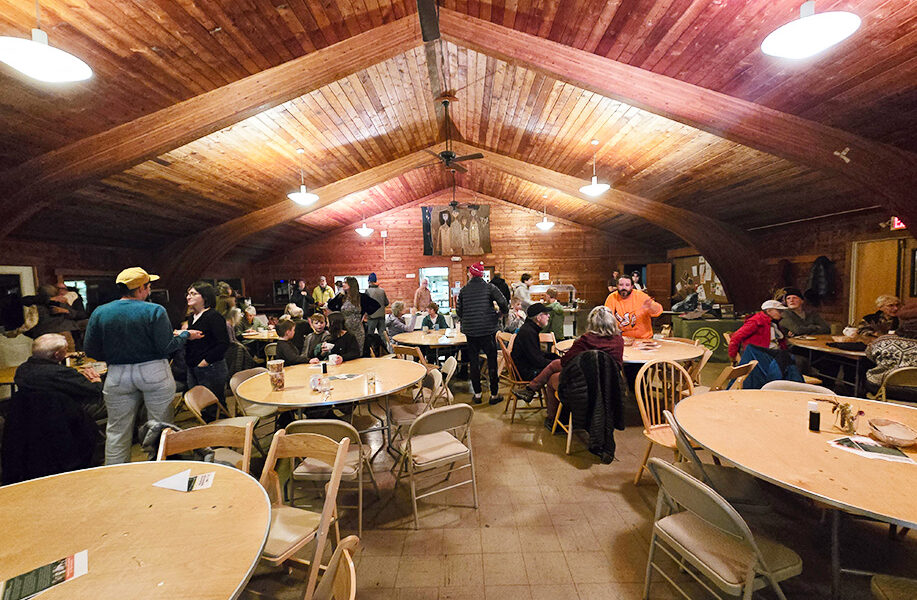




CRAFTSBURY COMMON – A gathering to discuss work being done around state school redistricting was held the evening of November 21, following a well-attended community meal in the Sterling College Dining Hall.
In sharing plans for the open forum, Sterling college faculty member in Ecology, Gustavo Requena Santos said, “The state Committee of Education is planning to host 3 or 4 public engagement meetings across Vermont to receive public comments on their proposals of alternative maps for the new statewide school districts. However, meetings will be . . . overlooking families and schools in the NEK.”
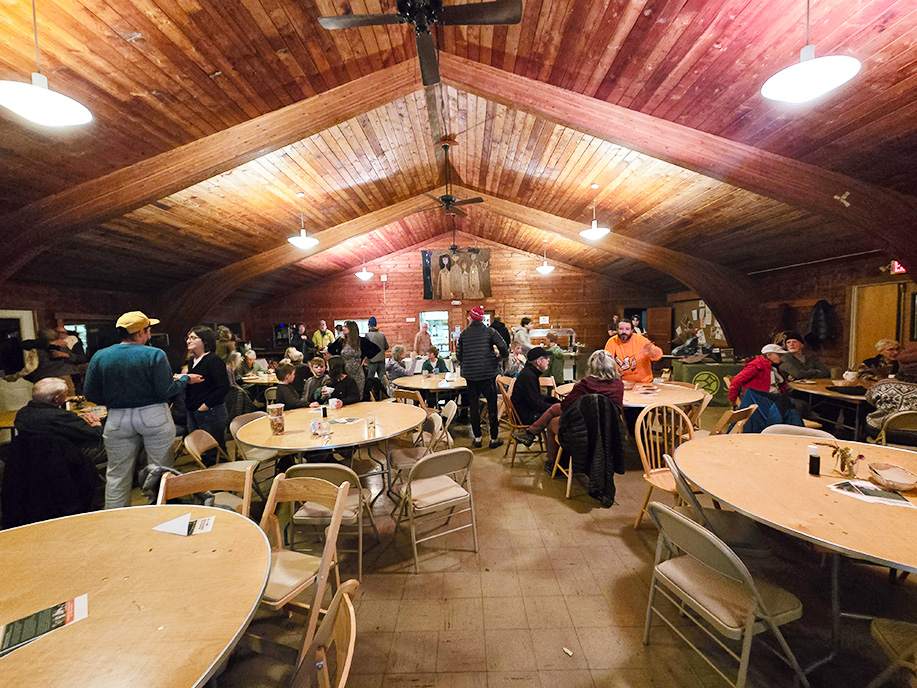
photo by Paul Fixx
To fill that gap, the message continued, “Sterling College, in collaboration with other local educators and organizing initiatives, will host an extra-official public commentary meeting . . . where community members can engage broadly with each other and have some great food prepared in our kitchen from locally sourced produce.”
Despite the recent Sterling College announcement about degree programs ending after the spring semester, and the many conversations about it during the meal, those gathered in the Dining Hall, turned their full attention to Ranny Bledsoe’s presentation.
Bledsoe, who serves on both the Hazen Union School Board (HUSB) and the Orleans Southwest Supervisory Union Board (OSSU), shared roughly the same overview she had shared at an earlier presentation in Hardwick.
Between then and the Sterling gathering, the state’s redistricting landscape had changed so she’d added a new slide titled, “Gotta love Vermont,” highlighting a vote by the state’s 11 person School Redistricting Task Force created under Act. 73.
Bledsoe noted, “On November 10, the Commission voted 8-3 not to propose a map to the legislature, but to a phased approach to school reform that emphasizes cooperative services and voluntary mergers instead of mandatory consolidation, with the long-term goal of establishing comprehensive regional high schools.
The slide quoted Governor Phil Scott, who had responded to the task force recommendation, saying, “They didn’t redraw the lines, and they were supposed to put forward three maps for consideration, and they failed . . . it would appear that those who didn’t fulfill their obligation are OK with the ever-increasing property taxes, cost of education, and they don’t want to see change, or at least not immediately.”
Bledsoe’s slide said, “At their meeting on November 20, the Commission reiterated the course of action it had taken on November 10.
A number of local and state legislators were on-hand, including three Redistricting Task Force members, creating an effective alternative to the four other task force gatherings to solicit public input.
Local Rep. Leanne Harple, serves the Orleans-4 District that includes Craftsbury, Greensboro, Albany and her hometown of Glover, and joined the meeting.
A replacement for former Orleans County Sen. Samuel Douglas, who recently resigned, has yet to be appointed, but Senate Minority Leader Scott Beck, a task force member, was on-hand, representing the State Senate.
Also attending were Redistricting Task Force Co-chair Rep. Edye Graning (Chittenden-3) and member Rep. Rebecca Holcombe (Windsor-Orange-2).
Four attendees raised their hands to indicate they were school board members.
In a different and effective approach from what has happened at other area gatherings to discuss the redistricting process, attendees were divided into small groups and asked to offer their thoughts about local schools and the redistricting process.
The groups then shared key takeaways, with former Rep. Katherine Sims saying that the goal, problems and challenges are different for different people and not clearly identified. An important issue is healthcare, which is not targeted by the state’s current process, she said. Other groups echoed their concerns about rising healthcare costs.
Bledsoe shared that school boards and the task force have been frustrated by a lack of adequate data to guide good decisions.
Another group said they saw the process as disruptive, without clearly defined positive outcomes.
The top-down nature of the current process was noted by several groups, as was the critical importance of small schools in providing an effective place-based education.
Several groups suggested current funding of PreK-12 education through local property taxes needs reform, to include, or be replaced by, an income-based tax, perhaps taking guidance from recommendations of the Public Assets Institute.
Among the many things that organizers will be compiling from the meeting was a clear sense that many in attendance make decisions for their children to attend schools in very rural areas is specifically to take advantage of the small school experience, something that many fear redistricting could eliminate.
In a final comment, it was suggested that everyone involved in current decision making around education make an effort to , “Do no harm!” which was a guiding principle of the School Redistricting Task Force.
Supporting the meeting was Northeast Kingdom Organizing (NEKO) through its Operations Director Audrey Grant who provided the agenda and shared news that NEKO is organizing NEK day at the Vermont Statehouse, Thursday, January 2, and answered questions about NEKO’s other work in the NEK.
Editor’s note: An incorrect date for the event in the photo caption has been corrected.

Paul Fixx is editor of The Hardwick Gazette and lives in Hardwick.
