


With Vermont’s Town Meeting Day upon us, most questions involve funding, or who will be responsible for making decisions in our towns.
At school district meetings we have budgets for education to vote on, most of which have gone up, some astronomically for several years.
Our state legislature ponders education funding and some degree of cost reduction by consolidation. Some of any savings to be found will be eaten up through increased transportation. There might be some savings from combined purchasing power and fewer buildings to maintain, but health care costs and paying living wages aren’t going to be helped much by consolidation, except perhaps in fewer teachers to educate our students.
In all the education funding talk, I have yet to hear anyone cut administrative costs.
Vermont’s education system is smaller than that of many cities. Consolidating purchasing for office supplies, heating and transportation fuels could be done statewide and immediately. Why haven’t we heard that suggested?
Our individual health care costs and groceries keep rising, usually faster than an average person’s income.
The average auto now costs close to $50,000.
Now fuel costs are likely to rise due to new conflict in the Middle East, that the news isn’t hesitating to call a war.
The average Vermonter isn’t unique in this country. The average American is being financially squeezed in much the same way.
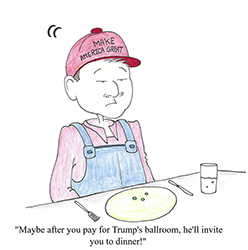
It’s no secret that the very wealthy are getting wealthier by the day, some of which was accelerated during the Covid-19 pandemic. That increase in the relative wealth of those with capital to invest contrasts with that of the average American family. Most families now live paycheck to paycheck with little savings and a lot of debt, often in their mortgage, if they can afford to take on that debt. I’m not going to call that owning a home, because most Americans own only a portion of their home, a bank or lending company usually owns most of it.
It’s the same with a vehicle. Most family vehicles are owned by a bank or lending company too.
Recent federal tax legislation has served to move more wealth to the wealthy, just as it has since the mid-1970s.
For 50 years this country has been redistributing wealth to the wealthy and making it harder for a family to get by.
The stress that puts on individuals and families is real. It creates mental health and substance abuse issues when people aren’t valued by society for the contributions they make to it.
While the Vermont legislature says raising taxes on wealthy Vermonters may drive them from the state, I suspect it’s not as significant as one might expect. The Vermont lifestyle attracts people to Vermont and causes them to remain.
We might be able to adjust the Vermont economy to improve the lives of average Vermonters, but the real solution is going to come from adjusting federal tax policy to raise taxes on those individuals and businesses who’ve been taxed less year after year, for those 50 years.
Wealthy Vermonters will not want to move to other states when federal tax policy there is the same as here in Vermont.
Will some move to other countries? Probably.
Will the lives of Americans improve? Definitely.
Some think we can cut costs to make Vermonter’s and American’s lives more affordable. There’s undoubtedly some waste in the system where savings can be found. Other cost cutting will eventually make itself known in worse health outcomes through products and an environment that are less safe.
Deteriorating infrastructure will take a toll in wear on our vehicles and higher prices for goods delivered by vehicle because maintenance for the companies maintaining those vehicles will cost more.
Insurance costs will rise when maintenance on public buildings causes accidents and other workplace health issues when state and federal oversight is cut to create short-term savings.
We can’t cut costs to fund prosperity. The last 50 years have proven that.
Funding prosperity will take creating an economy that funds average families through a living wage.
That’s the solution.
To have a look at some of the data about the Vermont economy you can look on the Public Assets Institute website at publicassets.org
Paul Fixx, editor

Paul Fixx is editor of The Hardwick Gazette and lives in Hardwick.
