



BURLINGTON – Newly emerged maple leaves coupled with the recent cool, rainy weather provide perfect conditions for a common spring fungal disease called maple anthracnose.
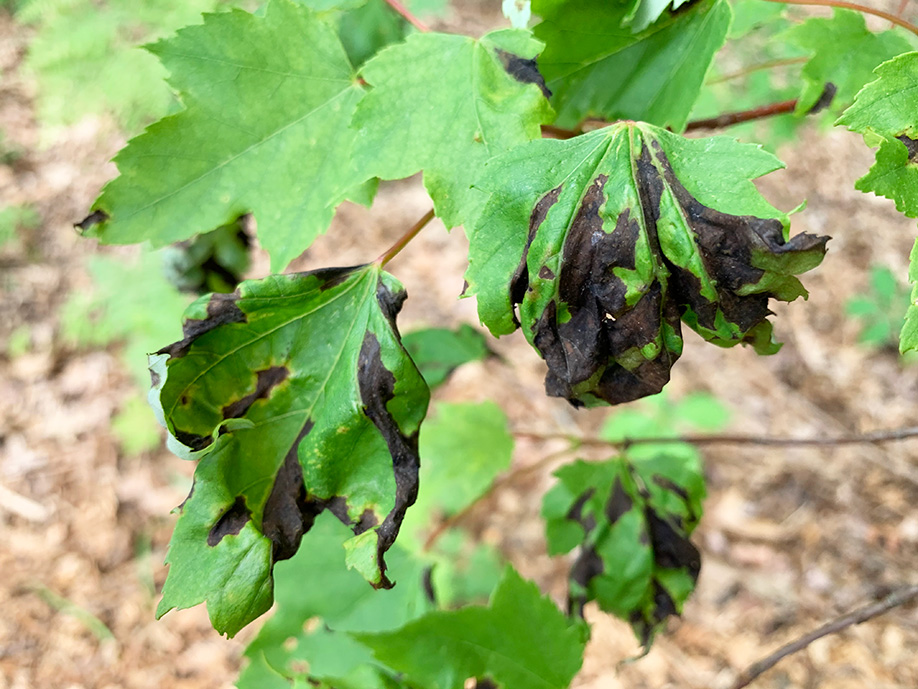
courtesy photo
There are several fungi responsible for the damage. All native and ornamental maples are susceptible including sugar maple (A. saccharum), red maple (A. rubrum), Norway maple (A. platanoides), silver maple (A. saccharinum) and Japanese maple (A. palmatum).
The symptoms of the disease can vary with the type of maple, but in all species, irregular, dark brown spots or blotches develop on the leaf margins and along and between the leaf veins. The damage often starts on the lower and interior branches of the tree.
In severe cases, defoliation and twig dieback can occur, but the tree will often flush out new growth. As the season progresses and temperatures warm, the foliage and shoots become more resistant to infection, and we rarely see new infections after May and June.
Although caused by different fungi, oaks (Quercus sp.), ash (Fraxinus sp.) and sycamore (Plantanus sp.) can exhibit similar foliar anthracnose symptoms in the spring and early summer. In sycamores, during rainy springs, 90 percent shoot dieback can occur that may result in abnormal branching despite a new flush of leaves.
All the anthracnose pathogens overwinter on infected fallen leaves and in twigs and buds. Raking leaves may help reduce the amount of the pathogen present in the spring, but we typically don’t see the disease every year since some springs are warmer and drier.
With well-established trees that are in good health, the disease does not cause any long-term damage and is mainly aesthetic. Anthracnose can be a more serious concern in trees that are young or weakened due to insects or other stressors. In this case, trying to improve the vigor of the tree throughout the rest of the season by adequate fertilization, watering during periods of drought, mulching and pruning will help lessen the impact of the disease.
Dr. Ann Hazelrigg is the University of Vermont Extension plant pathologist and director of the UVM Plant Diagnostic Clinic.

Dr. Ann Hazelrigg
Dr. Ann Hazelrigg is the University of Vermont Extension plant pathologist and director of the UVM Plant Diagnostic Clinic.
