


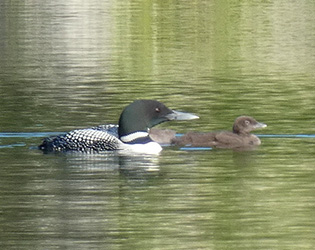
VERMONT – Loons are doing really well in Vermont. It is hard to imagine with all the threats they face that the overall loon population has recovered, for now.
Back in 1983, only seven loon pairs nested in all of Vermont. In 2025, the Vermont Center for Ecostudies (VCE) Loon Conservation Project documented 115 nesting pairs with a record 103 chicks surviving into late August.
It is still sad to see a loon die from a human-related cause like lead tackle, so VCE and the Vermont Fish and Wildlife Department encourage anglers to deposit their lead tackle in one of the 34 collection tubes at boat accesses statewide, including at Caspian Lake and Lake Elligo.
If you see a loon diving nearby while fishing, reel in for a short time or move down the lake, so loons do not learn to associate anglers with an easy food source
Four loons died of lead poisoning from fishing gear in the past two summers on Caspian Lake, Fairfield Pond, Spectacle Pond and Maidstone Lake. Three others died from complications with fishing line and hooks on Cedar Lake in Monkton, Joe’s Pond and Sunset Lake in Benson.
On the natural side of things, four loons were killed by other loons in territorial fights on Green River Res., Little Hosmer Pond, Mollys Falls Reservoir and Lake Salem.
In the past year, bald eagles have learned that loons on Caspian Lake are a source of food. Last January a chick of the year became frozen-in and a bald eagle showed up a few hours before I did to rescue it. We do not know if it was the chick raised on the lake or another one that flew in.
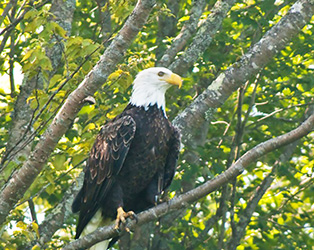
More recently on Caspian Lake, a bald eagle grabbed one of the two chicks a month ago.
Caspian Lake and Green River Reservoir have both contributed to the return of loons to Vermont.
Caspian Lake has one nesting loon pair, but almost more importantly, provides habitat for non-breeders and visiting loons. Boaters often observe groups of five to even 15 loons hanging out.
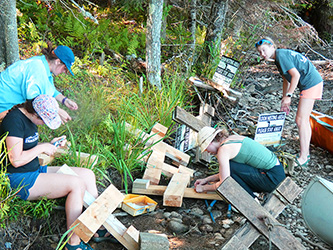
Somehow the territorial pair has been able to defend the northwest section of the lake from these other loons and successfully raise many chicks over the past decade. The loon pair first nested on Aspenhurst Point in 2016, but raccoons took the eggs within days. VCE placed a floating nesting raft nearby, and the loons have used it consistently since. Having the loons nest on the raft reduces potential conflict with human shoreline activity as well.
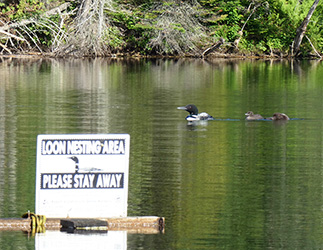
Stew and Becky Arnold are the primary VCE volunteers on the lake who help with the nesting raft, nest warning signs and monitoring the status of the pair.
The future of the Green River Reservoir (GRR) hydroelectric dam has been in the news a lot recently. A loon pair has called GRR home since statewide loon monitoring began in 1978. It provides some of the best loon habitat in the state, with all its bays and islands, and now supports four pairs of loons. The bays provide defendable territories in the 60 to 100 acre range, and the islands provide ideal nesting locations away from shoreline predators.
Morrisville Water and Light (MWL), the current owner of the GRR dam, has been able to keep the water levels relatively steady during the May to July loon nesting period, which prevents nests from flooding too often. Occasionally nests do flood from large thunderstorms that cause water levels to rise.
In contrast, Hardwick Lake, which is a flow of river reservoir, fluctuates dramatically during rain events, and the loon pair there has only had success using a floating raft; all natural nest attempts have flooded out.
The controversy around the GRR dam has to do with water level fluctuation from fall to spring and its impact on water quality. MWL says they need to be able to fluctuate the water more to make the dam financially viable. Because the state won’t permit that, MWL would like to sell the dam to the state of Vermont. State officials are undertaking studies about the dam’s safety, but are still hesitant about wanting to own another dam.
Hopefully a long-term solution can be found to ensure that both loons and people have access to the GRR waters and shorelines.
Lakes need to be healthy for loons to breed successfully, but loons can also tolerate a wide range of conditions. Hardwick Lake, for example, is often very murky, and it is mostly drained every winter, yet the pair there has been able to raise many loon chicks over the past 20 years.
If you would like more information about loons in Vermont, visit the VCE website, vtecostudies.org. The New Hampshire Loon Preservation Committee website has lots more information about loon behavior and natural history, https://loon.org/about-the-common-loon/.
Eric Hanson is a Vermont Center for Ecostudies Loon Biologist.

