

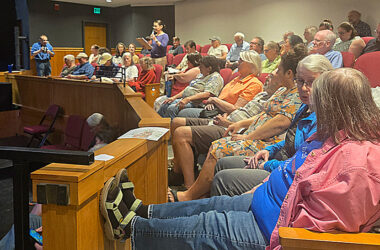

GREENSBORO – Area business owners and residents have expressed a mix of reactions to a new 1% local option tax in Greensboro, which passed in a special vote last Thursday.
Two other issues on the ballot passed easily, with $500,000 approved to purchase a new fire truck in a binding vote, with 112 in favor and just 30 opposed.
About two-thirds of voters were in favor of a non-binding, advisory question asking to exempt the Town of Hardwick from municipal tax on the Caspian Beach property for five years, with 95 in favor and 45 opposed. Voting on the option tax was much closer, with 72 voting yes and 68 no.
If Greensboro’s select board proceeds with the work necessary to implement the voter’s wishes, a 1% tax will be added to short-term lodging rentals, prepared meals and served alcohol.
Hill Farmstead’s Shaun Hill estimates the one percent option tax on served alcohol at his establishment could exceed the reported room tax.
He said he only recently learned about voting on the potential tax via Front Porch Forum.
There were multiple stakeholders the town doesn’t seem to have reached out to, according to Hill.
He suggested that, while he could pay more attention to what the town is doing, “their methodology was flawed,” and the town should have done more to “reach out to key stakeholders.”
In a recent Front Porch Forum (FPF) post, Hill wrote “Since Hill Farmstead’s visitors and customers are estimated to provide more than 80% of the revenue for this local option tax fund, I’d like to encourage more direct dialogue with the businesses most affected and supportive of the town’s efforts … There is no doubt that Hill Farmstead brings the majority of traffic to the community and remains one of its significant employers. As such, this proposal feels less like a shared community initiative and more like a tax levied directly upon Hill Farmstead and its visitors rather than upon short-term rentals or second, third and fourth homes being used as income properties instead of community housing.”
Hill suggested there are other ways to raise $10,000 without opening the door to a new tax on customers. Vermont businesses are already required to collect and remit 9% tax on prepared meals and a 10% tax on served alcoholic beverages.
Smaller, but no less concerned, Wilson Farm’s Lindsay Beer said, “If the additional tax was added we would pay between $500 and $1000 in an average year. While that may seem like a small amount, small businesses in Vermont are threading the needle right now more than ever.
“We need our community to be supporting the few businesses that still exist in our towns, not placing additional burdens on them.
“I voted no on the 1% local option tax yesterday, and I was disappointed to see that the majority of the voters chose to vote yes, perhaps not understanding the long term impact that it could have on local businesses and themselves.”
Rob Hurst, part owner and manager of Willey’s store estimates the additional 1% tax would add just over $1,000 annually to the tax that store remits to the state. Greensboro’s share would be 75% of that; roughly $750.
Hurst is taking the possibility in stride, recalling that discussion of a local option tax has come up at town meetings for many years. He is seeing it as an item to add as a line item on receipts that will simply pass through to the state, as many other towns have already done. While he said some small number of people might change their buying habits because of the tax, he sees a benefit to the town; understanding it needs to look at all revenue sources, which will help keep property taxes lower.
Resident Nancy Riege held a somewhat different view, posting on FPF in the lead-up to last Thursday’s vote, “I am also concerned about all the Airbnb’s, short-term rentals advertised above board and especially those that are not. I believe we all agree there is a huge need for housing, especially for people who work in the area, so why don’t we encourage long term rentals?” wrote Riege.
She suggested giving incentives to those who are willing to rent long term and said, “Short term rentals make more money for the individuals who own them but are really hurting small towns and businesses.”
Riege says she’s heard of other towns in Vermont trying to deal with this issue, suggesting Greensboro look into what other towns are doing to deal with such a heated subject.
Another area resident, however, felt similarly to Hill. Jennifer Lucas also posted on FPF saying, “I urge Greensboro voters to vote no on the third question on the Nov. 13 ballot. The additional 1% tax is proposed as an easy way to raise about $7,500 for the town, without any administration, and levied on mostly ‘outsiders.’ That is a mistaken concept as all of us will pay the tax whenever we have a drink at Hill Farmstead Brewery, buy a sandwich, coffee or muffin at Willey’s; eat at Highland Lodge or have our visiting families stay in a local rental….”
She continued, “This tax is also very discriminatory as it is applied to only those businesses and rentals that are already complying with the law to report revenue. For short term rentals, this tax would be on top of the additional 3% Vermont tax landlords pay that is not assessed for any other lodging. As many here rent out their properties to help pay very high property taxes, and due to market forces, cannot pass along these tax increases, this tax becomes a local burden.”
In 2024, short-term rental income in Greensboro reported to the state came to a little over $830,000. Adding the 1% local option tax last year would have generated $6,225 after the state’s 25% cut. That 1% tax on somewhat higher revenue in 2023 would have resulted in a payment to Greensboro of just over $7,300.
Short-term rentals are those under 30 days, but properties rented less than 15 days each year are exempt from the tax.
State estimates are that roughly 25% of short-term rental revenue is not reported to the state, resulting in under-reporting of that revenue with no tax paid.
Town estimates of $7,500 to $10,000 income from the new local option tax have only included the short-term rentals. Because there are less than 10 businesses reporting on each of the sale of prepared meals and served alcohol in Greensboro, data on that economic activity is not available from the state, which suppresses it to protect the confidentiality of taxpayer information.

Raymonda Parchment is a Hardwick Gazette reporter. She recently graduated from Vermont State University - Castleton with a Bachelor’s Degree in English. She is a strong supporter of freedom of speech, and the right to publish information, opinions, and ideas without censorship or restraint. She is a lifelong lover of the written word, and is excited to join the team as a staff member.
