




HARDWICK – In the early morning of August 24, 2022, FBI agents raided my house. Unbeknownst to me, for the previous three weeks I had been renting one of my Airbnb spaces to Brian Preller, a participant in the events of January 6, 2021, at the U.S. Capitol. The FBI had a warrant for his arrest which they executed without incident and left my home intact a few hours later.
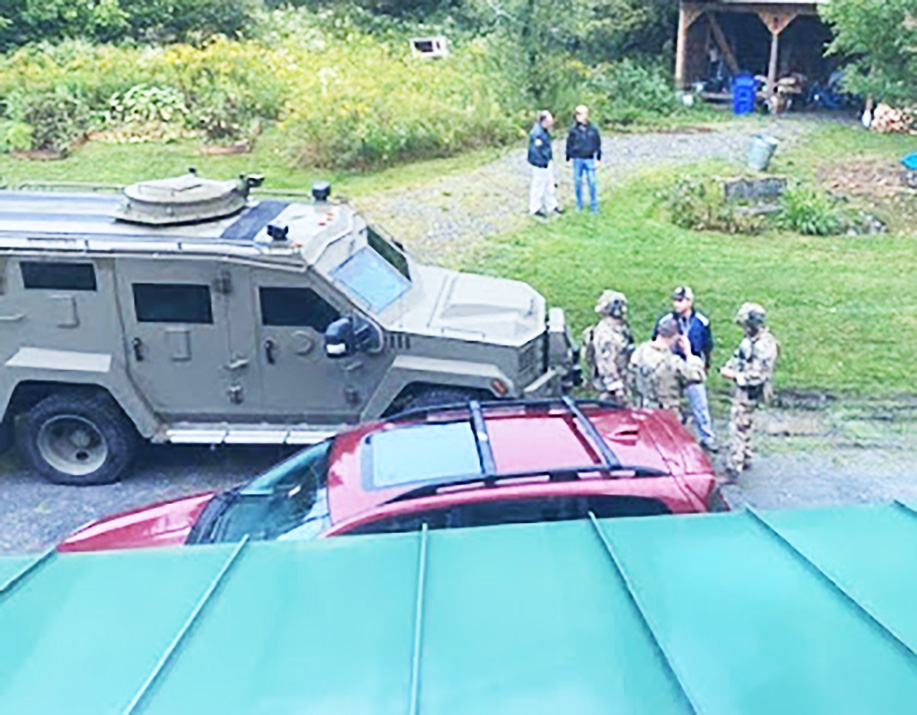
photo by Amy Rosenthal
I won’t easily forget that day. It was alarming at first to see armed men surrounding my house, upsetting the quiet and calm of my usual Vermont existence. As I stood outside in my pajamas waiting for the agents to arrest Brian and take him away, my alarm turned to curiosity as I chatted with the FBI agents about the charges against Brian, about how long they had been surrounding my house (since 2 a.m.) and whether or not I could offer them coffee and muffins. They initially refused my hospitality but commented that they knew about my muffins and scones from my Airbnb reviews. They also knew about my older dog, Lewis from the reviews as well but were unfamiliar with the new puppy, who hadn’t been mentioned in any Airbnb reviews yet because she had just come to live with us.
It was at that point that I realized Brian, and my house had been under surveillance for about a week. As the hours dragged on, forensic officers searched the airbnb and secured the scene, and the other agents stood around catching up and eventually accepting my offer of muffins.
For weeks afterwards the dogs would check the many spots in the woods around the house where agents had hidden themselves in advance of the raid. It was a daily reminder of the events that had taken place weeks before.

photo by Amy Rosenthal
I gained important lessons and gifts from the experience. I learned a lot about myself. I learned I had the capacity to stay calm and gracious in the face of such an unusual event.
Once all the excitement was over and the arrest was made, I served muffins and coffee to the agents who had been surrounding my house since 2 a.m. and were wet and hungry. They were grateful and remarked about how it was the most beautiful place they had ever raided.
Chalk up one more positive point for Vermont!
The second, and I think the most important lesson, was not about me, but about how others reacted to the raid, the arrest and its aftermath as I told and retold the story of that morning to a variety of people over the years.
Others reacted quickly to the details of the events and made judgments about the experience based mostly on their personal and political perspective. They would offer their opinions freely about what I should have done differently: How I should never have allowed the FBI or the January 6th conspirator onto my property; how I must be more careful about who I rent my Airbnb space to, especially those with guns; and why in the world would I have let him come back for another week to finish out his reservation once he made bail.
I learned that, while many talk a good game about the need to heal the rift between factions in the country and create a climate of mutual respect for different perspectives when given the chance, few choose to do so.
No one ever asked if I was all right or what I thought about those events.
The third and probably most improbable outcome of the experience that caused me to become weirdly adjacent to the events of January 6, was that Brian and I developed a unique and yet important relationship.
While Brian was away in Rutland being arraigned I had to make the decision whether or not to let him come back to complete the last week of his reservation. After consulting my own conscience and a friend whose opinion about complex issues I value greatly, I realized there was no good reason to not honor the remainder of his reservation.
I hadn’t felt unsafe with him during our numerous coffee conversations before I knew he had been involved with the January 6 uprising, so there was no reason to suspect I would feel unsafe after his arrest.
Having worked for years with victims of crime through the Vermont Department of Corrections, and having spent lots of time talking with those who had been convicted of crimes, I knew how easy it is to judge someone by the last worst thing they had done as opposed to the next good thing they might do.
Before his arrest, Brian had shared many details about his life, none about his involvement with the Guardians of Freedom, but a lot about his life as a teen father; he had married the mother of his child while staying in school and supporting them financially.
He share how he had done two tours in the Middle East with the Florida National Guard; how upon his return home he had difficulty finding work; and how he eventually found a job as a security guard in a housing project.
He talked about how important it was for him to interact with residents there with respect and positive regard.
He later shared that he joined the Guardians of Freedom originally because they made him feel like he belonged and that his organizational and management skills had value that he had put to good use. He had since left the group and was no longer affiliated with them..
My conversations with Brian after his release were the most interesting conversations I had ever had with someone whose political views couldn’t have been more diametrically opposed to mine.
I got to share my thoughts about January 6th with him and he got to share his story with me.
I shared what it was like to see the assault of the institution that I held in high regard and I was honest with him about my feelings of disgust, horror and fear as I watched the events of that day unfold.
I told him what it was like for me, a Jewish woman, to watch white supremecists use racist and anti-semitic chants to whip the mob into a frenzy.
He denied being either racist or anti-semitc. He proclaimed himself an anarchist and said in his defense that his group had trained both black and Jewish anarchist groups from all over the world to shoot guns and strategize ways to topple and resist governments.
I countered that you can’t march side by side with individuals who are advocating white supremacy and wearing camp Auschwitz sweatshirts while claiming you aren’t one of them or don’t somehow support them. You can’t pick and choose.
I watched as he began to think about that. And, how eventually his thoughts about that day became a bit more complicated for him, as did mine.
He told me about the Guardians of Freedom, and it’s their relationship to the Trump Administration, and I learned a lot about how deeply involved that administration was with anarchist and anti-government groups.
Brian was very clear that he hadn’t shown up at the Capital because he was a Trump supporter. Quite the opposite; he said he and his group had no respect for Trump at all.
He said he was there because, as an anarchist, he appreciated Trump as a disruptor, someone whose behaviors and approach to governing were going to put an end to government as we know it and give the power to govern, or not, back to the people.
Overturning the results of the election to please Trump was just one step in the right direction as far as they were concerned.
Trump was a pawn for them, albeit a powerful and dangerous one: one whose only value was to cause the government to become so weak and chaotic that it would eventually fail.
While his anarchist rhetoric was fundamentally horrifying to me, he pointed out that anarchists and those on the left agree on several points: that governments should not tell us who we can and cannot marry, and that they should keep their hands off decisions about medical interventions, especially as they apply to women.
These were points I hadn’t ever thought about, having considered anarchists as nothing but violent disrespectful disruptors whose only goal was to advocate for chaos and create a culture where every person was out for themself, something January 6 only confirmed for me.
We agreed to disagree over the government’s responsibility to help the needy, the necessity of taxing citizens, police oversight and the role of woke government to attain and maintain civil and human rights.
I came away from those conversations realizing I would never be an anarchist, but also understanding that things were more complicated than I had originally thought and many in this country did not share my respect or faith in the government.
I came away grateful to have been able to talk with Brian about things that I could only have speculated about before.
I believe he came away grateful that someone was willing to listen and argue with him respectfully.
Before he left he told me he would check in with me on the anniversary of the arrest to let me know how he was doing.
I wondered to myself if I actually wanted to be reminded yearly about the events of that day in August.
He didn’t call the next August.
He did one better: he called me the next Mother’s Day to thank me for my kindness towards him at the time and to let me know he was still awaiting trial.
He contacted me again the next Mother’s Day to let me know he was about to complete his sentence that included eight months of house arrest.
Last Mother’s day I didn’t hear from him.
By then he had been pardoned and I was busy trying to make sense of what has been happening in the world since January 2025 and making it through each day.
Then came the fifth anniversary of what is now referred to as J6.
I have been giving my relationship to it and to Brian a lot of thought.
I have written and re-written this essay a few times over the last few weeks trying to capture my thoughts and feelings.
None of my drafts seem to say what I have wanted to say.
They have been filled with all kinds of advice about how to make it through these challenging times.
This January 6, as I was trying to refine my latest draft, I texted Brian to see how he was doing Within a minute of getting my text, he called me.
We talked for an hour, picking up where we had left off during our last conversation.
He is living back in Florida now, having spent his house arrest time working hard for Amazon delivering packages; work being the only thing someone on house arrest is allowed to do.
His relationship with his girlfriend, who he had come to Vermont with, was over. He felt isolated and vulnerable in New England, believing that, if others found out about his relationship to January 6th, he would have been given a hard time.
He is no longer a member of any group. He has become politically agnostic, believing both sides are corrupt and not worth supporting. He has come to understand his affiliation with an anarchist group had more to do with his personal demons than his political commitments and it was about needing to belong and to matter; something I think most of us can relate to.
He now sits in the middle, not taking sides.
While he still has some conspiracy theory notions about government corruption and presidential politics, he is no longer a Trump supporter.
He worries about the echo chambers on both the right and the left that have failed to move us towards any kind of solid leadership and way forward.
He is disgusted with what is happening in America and would like to leave.
He filled me in on his family and I finally had the courage to ask him about the pardon. He was frank with me, saying it really helped him. He acknowledged that not having to put on an application that he was convicted of a felony for his involvement in January 6th has helped him get back on his feet and not be judged harshly by others.
He didn’t think that the pardons should have gone to everyone. He believed those who were not violent like him, deserved them and those individuals who caused physical harm should never have been pardoned.
I asked if he thought those who prosecuted him should be prosecuted in return. He said he thought they should only be prosecuted if there was evidence they had done something illegal, but not because of Trump’s spite and need for revenge.
When I challenged him about giving in to hyperbole and generalizations in his accusations, he said he appreciated how respectfully I disagreed with him.
I joked that we should take our conversations on the road.
He said he would do it with me any time. He said we could model how to have these kinds of conversations in a civil manner. He said he would go with me because he knew I would never “punch him in the face”. And I know he would never punch me in mine.
There is a lot of talk about the need and importance of working across the political aisle and not finger pointing or pre-judging who others are just because they disagree with us politically.
It’s easier said than done, but it must be done.
What has come out of the FBI raid for me, and by extension January 6, is a unique relationship with someone I would never have had a relationship with before.
I highly recommend it.
It has given me the opportunity to put theory into practice and have conversations in a respectful way about difficult topics on which there is only minimal agreement.
It made me be J6 adjacent, and gave me access to other perspectives and points of view that took me out of my own echo chamber; something that needed to be done.
In the end though it gave me a great story to tell that will become part of my family’s lore as they tell and retell the story about the day the FBI came to grandma’s house.
Amy Rosenthal has lived in Hardwick since 2005, is a Justice of the Peace, a former Hazen School Board member and a member of the Hardwick Equity Committee. She has five grandchildren who are still too young to understand what happened at their grandmother’s house, but eventually they will.


Great story. Every zealot, whether right or left, should read this. Thanks for sharing!
Thanks Tom, We thought so too. -Paul Fixx, editor
Wow, what an amazing story. You were given such a gift, insight to such an opposing mindset. And you were so open to it. That, I find very admirable. I don’t think I have that ability.
Thank you so much for sharing
Congratulations, you do realize part of this man’s official diagnosis is to make one feel at ease? You really shouldn’t have posted an essay without understanding the true violence that he caused every single person he has ever come into contact with.