

CORNISH FLAT, N.H. – If you like to hike or snowshoe in the winter, you might like to learn the names of the trees you see. Do so, and the trees will seem like your friends. No need to greet them as Sally and Bob, know them as sugar maple, ash or white pine. Let’s start with a few evergreen trees.
White pine (Pinus strobus) has clusters of five soft needles, each about three inches long. Branches grow in whorls off the trunk; each year the tree grows just one new set of branches, so you can see how fast they grow by observing the distance between whorls on the main trunk. From a distance you can see clumps of needles pointing up near the top of the tree.
courtesy photo
Canadian hemlock (Tsuga canadensis) has short, flat needles that feel soft to the touch and have a white line on the underside of each. It is one of the few trees in the woods that can grow in deep shade as well as full sun.
There are several kinds of spruce (Picea spp.), but all share a characteristic separating them from hemlock trees: turn over a branch and observe the color of the leaves. If the needles on the top bottom of the bough are the same color, it is a spruce. Spruce needles are pointy and sharp.
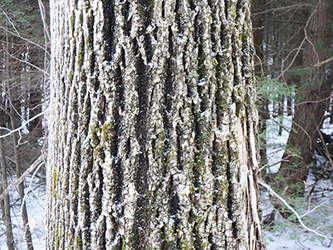
Recognizing bark is a great way to identify trees. Summer or winter, if you know the look of a tree’s bark, you can identify it. It takes practice, of course, and careful observation.
Some bark is very distinctive. Beech (Fagus grandifolia), for example, has a smooth gray bark that you can learn in moments. I love to run my hands over the bark, as if petting an elephant. Young beech, particularly, hold onto their leaves in winter, which is also a good clue. The leaves are oval with sharp points along their edges.
Most everyone can identify white or paper birch (Betula papyrifera) by its white, peeling bark that is easily removed from a tree by enthusiastic Scouts anxious to start campfires.
Gray birch (B. populifolia) is similar to white birch, but does not peel like its cousin, and has a dirtier look.
Yellow birch (B. alleghaniensis) peels like white birch but is a golden or silvery gray color.
Did you know young white birch are not white at all? They have a deep reddish black color and are spotted with small white dots or short white lines, lenticels that feel rough if you rub your hand over them. Eventually, after seven or eight years, white birch saplings will start to turn white.
Branching patterns help to identify trees at any time of the year. Most species of trees and shrubs have what is called alternate branching. That means that as your eye follows a branch, the twigs and leaves alternate from one side to the other. A limited number have opposite branching with twigs facing each other across a branch. Of course, just to confuse us, sometimes twigs or leaves have broken off on a tree like a maple that usually have opposite branching.
There is a mnemonic for trees that have opposite branching: MAD Cap Horse. Translated, that means Maple, Ash, Dogwood, member of the Caprfoliacea family (honeysuckle, viburnum and elderberry, among others) and Horse chestnut. So if you see opposite branching, you can eliminate lots of possibilities.
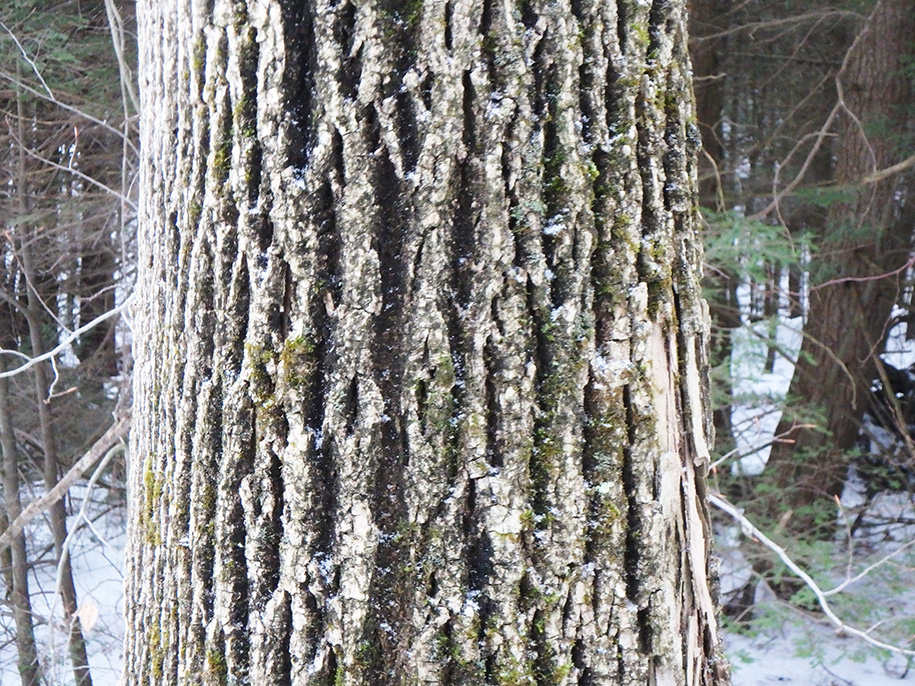
Of the opposite branching trees, white ash is an easy tree to identify by bark: it has prominent ridges with deep furrows. It is dark brown or deep gray. The leaf buds are large and pointy, and new growth tends to be thicker than that of most other trees. Unfortunately this wonderful tree will probably disappear from our woodlands due to a foreign invader, the emerald ash borer.
courtesy photo
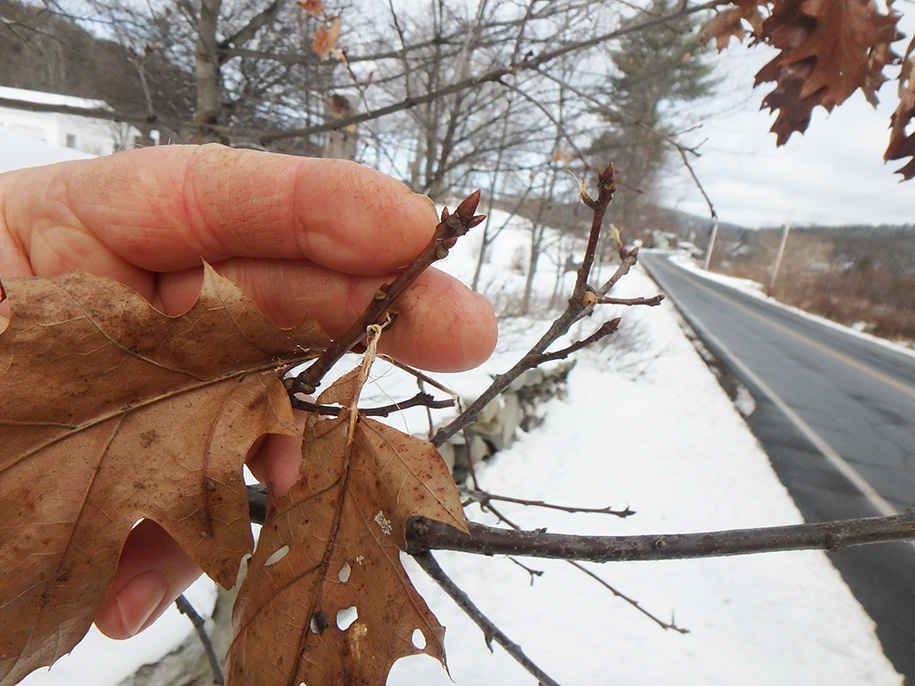
Buds at the end of a branch are another distinctive characteristic of trees in winter. Red maple (Acer rubrum) and sugar maple (A. saccharum) can be distinguished by their buds, for example. Sugar maple terminal buds are sharp and pointy, red maple buds are blunt and reddish in color, especially as we approach spring. Sugar maple buds are grayish or purplish-brown. And the bark of an old sugar maple is distinctive.
Oaks have opposite branching and hold on to their leaves throughout part of the winter. There are two major groups of oaks: the red and white oak families. Both have lobed leaves; red oaks have pointy tips on their lobes, while white oaks have rounded lobes. A good tree book can give you clues to narrowing down which of the oaks you are seeing, though red oak (Quercus rubra) and white oak (Quercus alba) are the most common.
When not in the woods, you might want to be at a spring flower show. Here is the lineup: Connecticut Flower Show will be in Hartford, Conn., February 20 to 23. The Philadelphia Flower Show is February 28 to March 8. The N.H. Orchid Society Flower Show will be March 6 to 8 in Nashua, N.H. The Capital Region Flower Show, is in Troy, N.Y., March 27 to 29. Lastly, the Chelsea Flower Show, in London, England, will be May 19 to 23.
Homeyer is a lifelong organic gardener living in Cornish, N.H. Write him at [email protected]. His column appears once a month.

Henry Homeyer is a life-long organic gardener who has lived in Cornish Flat, NH since 1970 (except for his time in Africa as a Peace Corps volunteer and country director).
Homeyer’s website is Gardening-Guy.com and has many of articles from previous years. He receives e-mail at [email protected] or P.O. Box 364, Cornish Flat, NH 03746.
