
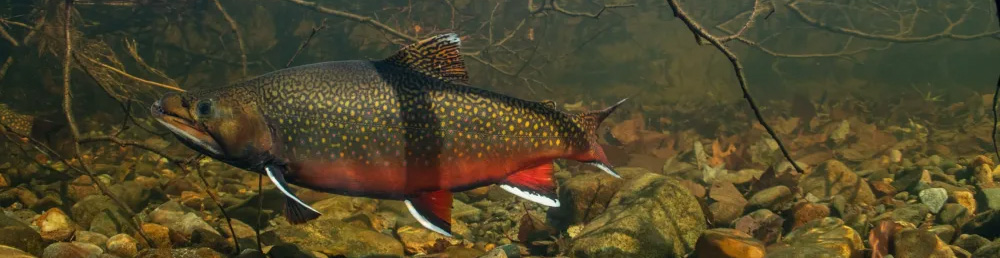

PLAINFIELD – Brook trout populations are in decline across the eastern United States due to human-caused climate change leading to warming water temperatures.
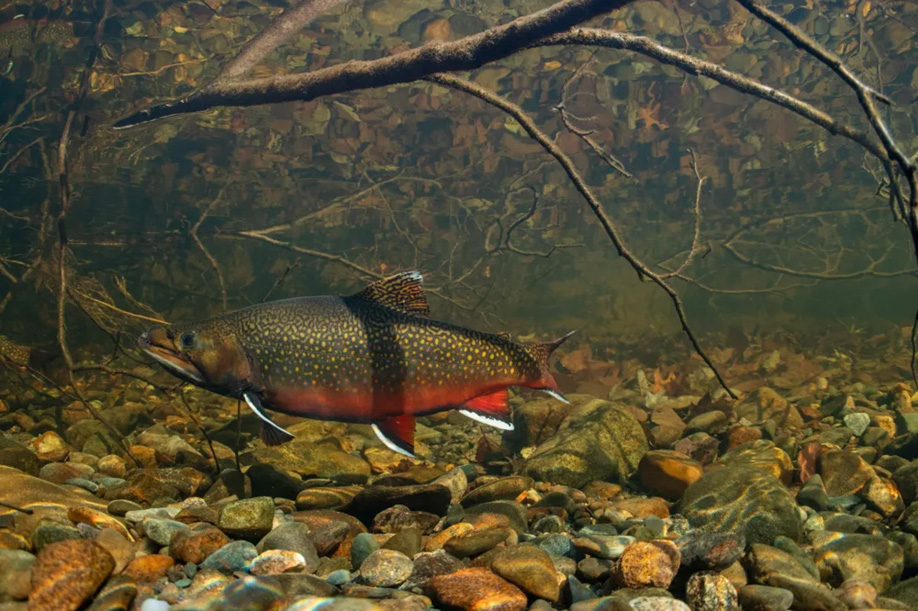
photo courtesy of Peter Abdu, Vermont Fish and Wildlife Department
But in Vermont, the state fish is doing well.
“We haven’t observed large-scale declines in brook trout populations in Vermont,” said state fisheries biologist Lee Simard. “Our data suggests that brook trout populations are still thriving and stable here.”
The brook trout‘s resilience is partly thanks to Vermont’s naturally cooler northern waters. But it’s also the result of ongoing conservation efforts by the Vermont Fish and Wildlife Department.
For the past 13 years, state fisheries biologist Jud Kratzer has led Vermont in a brook trout conservation strategy called strategic wood addition. It involves adding woody material, like tree trunks and branches, to specific spots in streams, almost like building a beaver dam.
“It’s an ‘addition’ because we’re adding something that’s lacking,” Kratzer said.
The wood slows the water current down and creates deeper pools, which stay cooler in the summer and don’t freeze as easily in the winter, both great for trout. And the messiness of the wood piles also helps the trout avoid predators.
“It provides great cover for fish like brook trout,” Kratzer said. “And the wood captures leaves, which decompose and become food for insects, which are food for fish.”
It was over a decade ago when Kratzer first had a hunch that adding wood to streams would improve fish habitat. He conducted two studies that proved him right.
“We found that brook trout biomass tripled, on average, in places where we added wood,” he said. “So we had more and bigger brook trout. Three times as many.”
The importance of this work is underscored by Simard, who said that brook trout are a “bellwether for watershed health.”
“If your brook trout populations start to go, that’s a very strong indication that your whole system is becoming degraded,” Simard said.
Brook trout are one of the most targeted species by Vermont anglers, so losing them would carry both significant social and economic consequences, Simard said.
Strategic wood addition isn’t the only trout conservation effort happening in the state.
Julie Butler is a fish biologist with the U.S. Fish and Wildlife Service’s Lake Champlain Fish and Wildlife Conservation Office.
She says the office is partnering with groups in the Winooski River Basin to make it easier for trout to move.
“It is pretty critical for any fish to be able to move around within a variety of micro-habitats, because they know where they need to be,” Butler said. “If it gets too warm, they’re looking for cooler water. And if it gets too cold, they’re looking for a more temperature-regulated area.”
In Vermont, old dams and too-small culverts make it harder for brook trout to swim between stream systems. The solution? Remove the dams and replace the culverts.
Butler says that, through the end of next year, there are about a dozen projects across the state that will open over 125 miles of connected habitat for brook trout.
“This work has definitely ramped up, not only in the [Winooski River] Basin, but across the state,” she said.
Simard said while Vermont’s trout populations are steady right now, they’re not immune from the effects of climate change and other human-caused threats.
“Climate models are certainly predicting that the conditions being experienced by the mid-Atlantic and southern states in the brook trout range are going to be moving towards, if not being on top of, Vermont in the coming years,” Simard said.
These conservation efforts then, he said, are intended to help brook trout, and the streams themselves, be more resilient to change in the future.
Finn Hummel and Isabelle Fitzgerald write for the Community News Service, a University of Vermont journalism internship, in partnership with Vermont Public.

Finn Hummel
