


MONTPELIER – As you probably know, Vermont is at a crossroads, many argue a crisis, concerning the costs to operate Vermont’s public education system and the results. Property taxes have grown 40% in the last five years, while results are declining.
Before digging into the details of what Montpelier did and didn’t do this session, it is important to understand Vermont’s public education landscape.
Some will look at these numbers and direct their ire toward our public school teachers, support staff, administrators, and school boards. Please don’t. Vermont’s education problems are systemic and demographic-based. Educators are doing their best to deal with a system that has increasingly become chaotic.
K-12 enrollment peaked at 104,000 students 30 years ago. Currently, Vermont has 74,000 K-12 public school students. With today’s birthrate, Vermont will likely bottom out at around 62,000 K-12 students in our public schools.
Vermont has the oldest public school building stock in the country, and many have not been renovated. The estimated cost to rebuild and renovate our existing schools is $6B. Vermont’s annual spending on public education is $2.5B.
Math and reading literacy test scores have dropped by a significant amount. Decreases have indeed occurred in most of the rest of the country, but the scores in Vermont have decreased more than the average, and our trend continues to be negative.
Vermont’s high school graduation rate was 92% only five years ago. It is now at 83%. There are economic factors involved here, including Vermont’s tight labor force and high minimum wage.
We have the second-highest per-student spending in the country, over $30,000. When General Fund and federal dollars are counted, spending exceeds $35,000 per student.
Vermont operates 56 public 9-12 high schools with 20,800 students, an average of 371 per high school. We operate 108 public 7-8 middle schools with 11,092 students, an average of 103 students.
There are 289 public schools serving 78,000 Pre-K to 12 students. These schools have 23,000 employees, a ratio of 3.4:1. Maine is the next lowest at 4.8:1. The national average is 7:1.
Vermont has 119 school districts that are served by 52 superintendent offices.
To achieve better results, increase opportunities and options for students, spend less on administration, and reduce the property tax burden, Vermont’s Agency of Education supports moving toward a system where we retain local elementary schools, centralize middle schools, and regionalize high schools while making career and technical education readily available.
One hundred nineteen school districts make this unattainable in most of Vermont. Lines on maps work against these goals and make it nearly impossible to retain our local elementary schools and centralize and regionalize our upper grades. Students cannot just cross district lines to receive the opportunities that they deserve.
Governor Scott wanted the Legislature to form far fewer school districts than Vermont currently has. A majority of legislators wanted the process to be voluntary, but with cost containment as a motivator. H.955 is the byproduct of this conversation and is awaiting the governor’s signature.
Specifically, H.955 divides the state into seven shared service districts (CESA) for the initial purpose of facilitating merger conversations between districts. Each CESA is divided into merger study groupings to achieve districts that have at least 2,000 students, as practical. Two thousand may not be practical in some rural areas.
H.955 provides a process for districts that won’t or can’t merge. In the end, they could be assigned to a larger district or continue to operate if they can meet educational goals.
On the issue of public tuition, school choice, and independent schools, nothing in H.955 restricts a district from continuing to utilize school choice. None of the 18 independent schools eligible to receive public tuition are restricted in H.955.
There is a lot of fear in Vermont about forming fewer districts; much of that fear flows out of the potential for public school closure, especially elementary schools. Small towns are correct to be concerned about losing their elementary school. Local elementary schools can fit into larger school districts; local middle and high schools may not, depending on the area. But, that will be for each district to determine using an agreed-upon article of agreement.
What is far more likely is grade closure across Vermont. One hundred eight middle schools and 56 high schools will likely collapse into fewer middle and high schools, while retaining nearly the current number of elementary schools.
I hope that each district in our area will work toward a solution that is focused on student opportunities and options, and providing them in a way that will take pressure off of property taxpayers.
There is no one-size-fits-all answer. Each existing school district will do this in its own way. Please be involved and follow the conversations.
Scott Beck is a senator from the Caledonia District, including the towns of Barnet, Danville, Groton, Hardwick, Newbury, Peacham, Ryegate, St. Johnsbury, Stannard, Walden, Waterford and Wheelock.

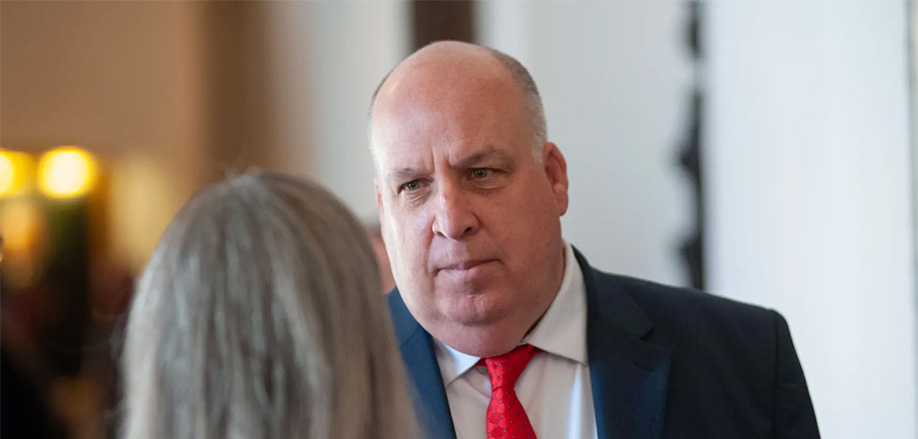
Sen. Scott Beck
Sen. Scott Beck is the Senate Minority Leader and represents Caledonia County
