


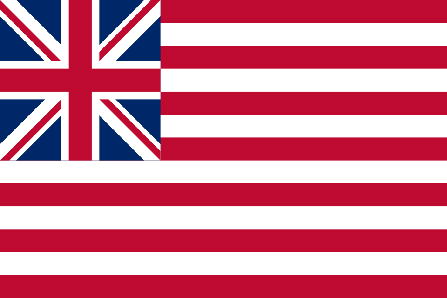
CABOT – The American flag’s long and varied history began before Betsy Ross was said to have stitched the first flag in 1777. There were several versions of the American flag. One of the first had 13 red and white stripes to symbolize the 13 colonies and the British Union Jack in its canton, acknowledging Britain.
from the internet
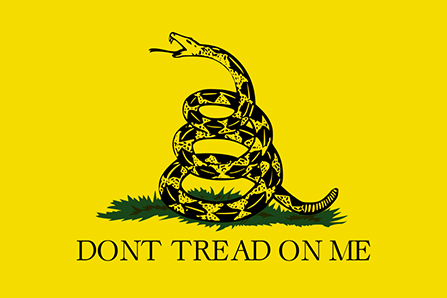
That was abandoned during the colonies’ quest for independence. A flag designed by Christopher Gadsden in 1775 had an image of a coiled snake on a mustard-yellow background with the inscription, “Don’t Tread on Me,” and was used by the Continental Marines in the early years of the war.
from the internet
Another version has the snake angled full length on a background of red and white stripes. “Don’t Tread on Me” flags remain a symbol of American patriotism.
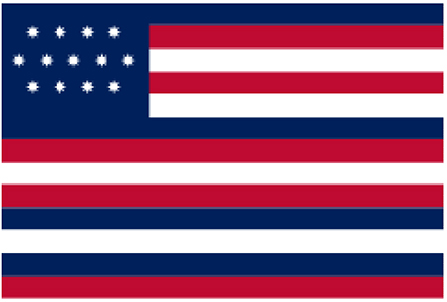
The Continental Union flag was flown by John Paul Jones on his ship Bonhomme Richard in 1775. Four years later Jones captured a British frigate, Serapis, but the Bonhomme sank in the skirmish. Jones took over the Serapis and raised a new flag with red, white and blue stripes, and stars on a blue background.
from the internet
The legend about Betsy Ross sewing the first American flag is well known but may not be true. One version is that George Washington went to her with a design that included six-pointed stars and stripes, while another version has Ben Franklin commissioning the flag. There is no historical evidence that Eoss was approached by either Washington or Franklin. There are, however, documents showing that in May of 1777, she was paid by the State of Pennsylvania for making naval flags.
Regardless of who was responsible for the new design, it featured 13 alternating red and white stripes and stars arranged in a circle on a blue canton. The first of these flags had six-point stars, but eventually the five-point stars were adopted. The symbolism was intentional, carefully thought out by leaders of our young, struggling Union: 13 stars and 13 stripes in honor of the 13 colonies;
white stripes signified purity and innocence, and red stripes stood for hardiness and valor; the blue field in the upper left corner signified vigilance, perseverance, and justice
When Kentucky and Vermont joined the Union in 1794, two stripes and two stars were added to the flag, but when more states were formed, adding stripes was abandoned and the design retained the 13 stripes for the original 13 colonies and more stars were added as new states joined the Union. The last change was in 1959 with the addition of Hawaii and Alaska.
There are rules about displaying our national flag. It should only be flown from dawn to sundown unless it is illuminated at night. It should not be flown in bad weather and should never touch the ground or anything beneath it. It should be raised smartly but lowered with reverence and properly folded into a triangle for storage. It is flown at full mast above any other banners except on occasions of national sorrow when it is ceremoniously lowered to half-mast.
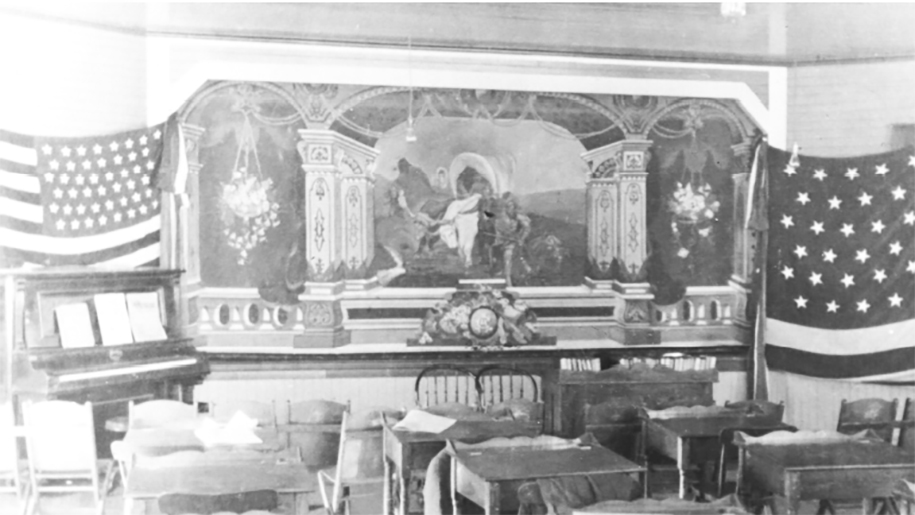
photo from the Cabot Oral History Committee
The flag should not be used as clothing or draped as decoration. It is never flown upside down except as a signal of extreme distress. When a flag becomes worn, faded or soiled, it should be removed and disposed of respectfully, generally by burning.
Wearing a flag pin or other jewelry is generally considered patriotic. President Nixon was the first president to wear one of the popular little metal flag lapel pins. That started a trend that ended abruptly when he resigned in disgrace.
The pin was mostly forgotten until 9/11, when many showed their patriotism by wearing the pins.
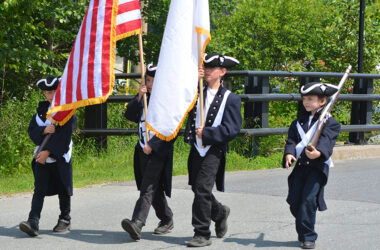
When a flag passes by in a parade, it is saluted by military personnel and civilians stand and place their hand over their heart. Honoring the flag by reciting the Pledge of Allegiance at civic meetings or in public schools is required by law in many states: Only Arizona, Hawaii, Nebraska, Wyoming, and Vermont do not require it in public schools, although some still say the Pledge. Students have the option to remain seated and not participate without repercussion.
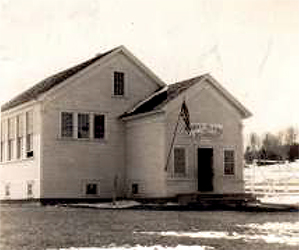
When I was in school at the one-room Cabot Plain school, every day someone was responsible for putting up the flag outside in the morning and retrieving it when classes were over. This was an honor reserved for an upper-grade student.

photo from Jane Brown collection.
Some schools had a tall pole, but the Plains school had a flag holder attached to the front of the building. When the bell rang signaling the start of classes, we took our seats and waited for our teacher’s “All rise,” before standing beside our desks to face the classroom flag. We placed our right hand over our heart and recited the Pledge of Allegiance in unison. Some teachers had us also sit with hands clasped on our desk and heads bowed as we recited the Lord’s Prayer. We weren’t particularly
aware of denominations, and nobody ever objected although some students may have remained silent. It was a calming ritual that put order in our day.
The Pledge of Allegiance was originally written by Captain George Thatcher Batch in 1885. Batch served in the Union Army during the Civil War, and in 1892 Francis Belamy, who worked for a publishing house, revised the poem and published it in The Youth’s Companion magazine. The pledge was formally adopted by Congress in 1942. On Flag Day in 1954, President Dwight D. Eisenhower signed a law changing the wording to “. . . one Nation under God, indivisible, with liberty and justice for all.”
Our flag has various names: “The Red, White and Blue,” and the “Star Spangled Banner,” both came about from songs, while “The Stars and Stripes” was from the Flag Act passed on June 14, 1777. A sea captain, William Driver, owned a 10 by 17-foot flag during the Civil War. He proudly referred to it as “Old Glory.” Driver had it sewn into a quilt to prevent it from being captured and destroyed during the Civil War. “Old Glory” is preserved at the Smithsonian Institute.
Our American flag represents 250 years of freedom and democracy, uniting us through celebrations, changing times, hardships and wars. We honor it and those who defend it.
This article ran previously in the June Cabot Chronicle.

