


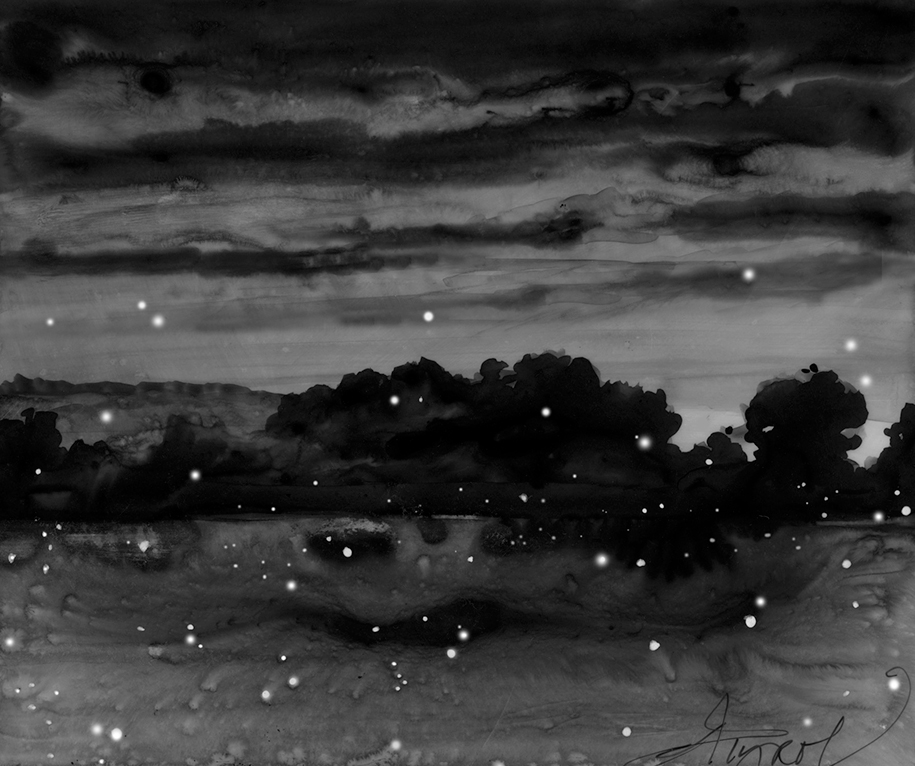
LOWELL, Mass. – In the deepening twilight, the pines edging my backyard merge into a wall of shadow. I hold my breath, staring hard into the darkness. Will they come? No matter how many times I repeat this ritual, I’m never sure. But then the magic happens. A little greenish pulse of light, floating somewhere in the middle distance. Then another. And another. Ten-year-old me readies his empty peanut-butter jar and sets out to catch some stars. Those memories are decades old, but the magic of encountering fireflies remains undimmed.
Bringing them into my well-lit kitchen revealed their true nature. Not living motes of light but long, oval-shaped beetles with soft bodies and hardened outer wings that shield their back and head. Mine were dark brownish-black with red accents.
But “firefly” refers to more than one species in the beetle family Lampyridae. Some of the many include the Chiricahua glow-worm, twilight bush baby, Florida fishhook, double cousin, creekside tree blinker, Bill’s hitch, heebie-jeebie, quick one-two and superb ghost. There are roughly 2,400 described species found around the world, many of which lack common names altogether. A 2021 review tallied 167 species in the United States and Canada, with 44 found in Vermont, New Hampshire, Maine, Massachusetts and New York. (As a point of comparison, there are only around 6,600 species of mammals globally.)
Despite their family name, many do not produce light at all. Biologists think the glow originated as a “do not eat” signal. Most fireflies are poisonous and unpalatable but being toxic is most useful as a survival tool if you can warn off predators before they have you in their mouths , hence the dramatic coloration found of many toxic, venomous or otherwise unpleasant-to-eat animals. But even better than being brightly colored is being literally bright. Once the glow had originated as a warning, it was co-opted by sexual selection and eventually evolved into the displays that have made fireflies famous across the globe.
Fireflies that glow have a specialized organ called a photophore, usually at the tip of the abdomen, which is a translucent chamber where chemicals produced by the insect react to produce light without heat. By controlling the amount of oxygen available in the chamber, fireflies can turn their glow on and off. In fact, the pattern of flashing is one of the best ways to identify an individual species and is used by fireflies to make sure they’re pairing with their own kind. In some species, thousands of fireflies will flash in sync, creating scintillating waves of light. The phenomenon is so spectacular that Great Smoky Mountains National Park runs a lottery each year just to control crowds eager to see the Smokies’ synchronous firefly (Photinus carolinus) during its brief window of activity.
Like all beetles, fireflies undergo complete metamorphosis, hatching from eggs, going through several molts as larvae, then pupating and finally emerging as adults. Time spent in each life stage varies, but adulthood is usually brief, and the complete cycle only takes a few years at most. The majority of their lives are spent as larvae. When they first hatch, they are grublike, but they soon grow and molt into armored, segmented creatures that rove through the soil and leaf litter like predatory tanks, eating anything smaller and softer than themselves. In many species, females remain flightless, even as adults. As a rule, adult fireflies do not eat, although some have been observed sipping nectar or mouthing leaves.
Of course, rules exist to be broken, and females of the genus Photuris, like our own Fairchild’s predator (Photuris fairchildi), have evolved to use their signal in a sinister way. Instead of using their glow to find mates, they flash in patterns mimicking those used by the Photinus genus, luring in males hoping to find a mate, only to be caught and devoured.
For a group of creatures with global cultural and scientific relevance, shockingly little is known about the health of firefly populations. What we do know is worrisome: habitat loss, light pollution and pesticides are all major threats. The Xerces Society, which is dedicated to invertebrate conservation, is attempting to leverage fireflies’ enduring popularity to develop better data about them with their Firefly Atlas project. If you see any fireflies this summer, consider filing a report on the project’s “Record a Sighting” page. With luck, we’ll give many more kids the chance to be enchanted by the eerie glimmer of these remarkable insects.
Kenrick Vezina is a freelance writer, naturalist and raconteur based in Lowell., Mass. Illustration by Adelaide Murphy Tyrol.

Kenrick Vezina
Kenrick Vezina is a freelance writer, naturalist, and raconteur based in the Greater Boston area.
