
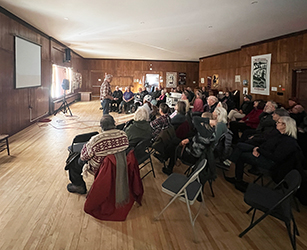



GREENSBORO – George Woodard of Waterbury Center gave a fascinating talk about his life as a dairy farmer, an actor and filmmaker in the Fellowship Hall of the United Church of Christ in Greensboro on Saturday afternoon, Feb. 21, sponsored by the Greensboro Free Library. He described it as a kind of pot luck of personal history combined with film clips and stills.
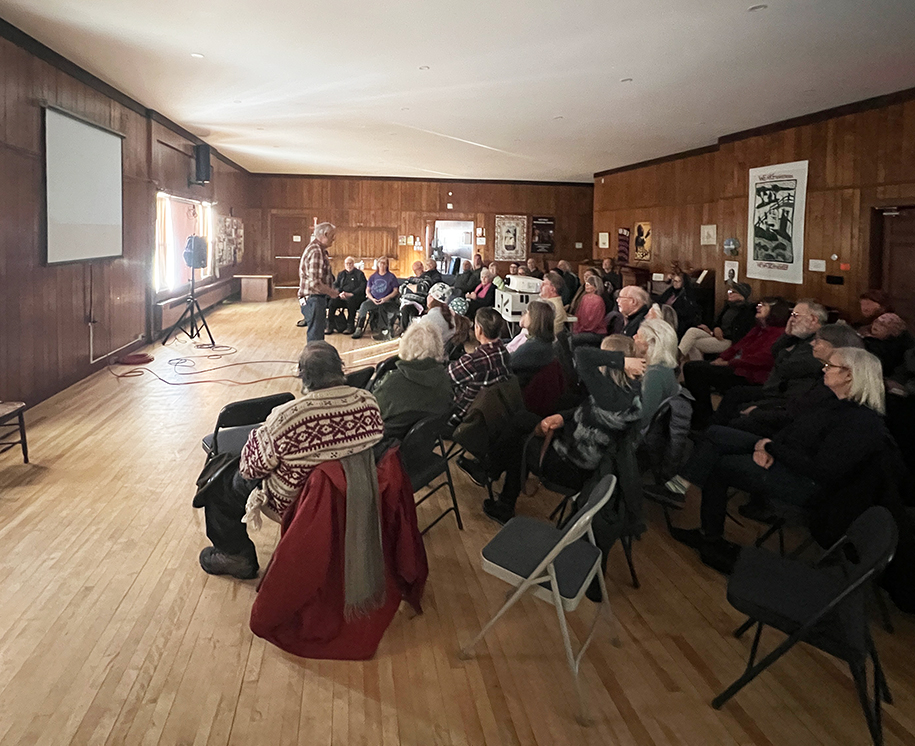
photo by Bianca Caputo
His grandfather was born in 1888; with his parents he came to Vermont from New Hampshire and acquired the present farm where George now lives in 1912. George’s father, Walt, inherited the farm and milked cows until 1961. George had two brothers and a sister. His brother Steve becoming a veterinarian. George himself started up the farm again in 1975 and had a small herd of about 25 cows for roughly forty-five years until recently.
He got interested in films from watching one picture in particular, entitled “The Miracle of Paradise Valley” and then became entranced by cowboy movies on television, especially “Gunsmoke” with Marshall Matt Dylan (James Arness), at the same time, when he was in high school he became attracted to live theatre and acting with the Lamoille County Players at the Hyde Park Opera House, under the inspired mentorship of Steve Hall, who was director for decades, taking roles in numerous productions. He went to Vermont Technical College in Randolph and spent three years in Los Angeles as an actor in low budget films before returning to Vermont.
There was a musical background in his family, his father playing the guitar. With his brothers, he had a band that in 1974 won a contest in Barre against forty other Vermont bands. Later, for a number of years, he had his own entertaining variety show, “The Ground Hog Opry.” He also began making short films, some humorous skits, utilizing young relatives and actors, as well as documenting the daily work of a typical dairy farm, like haying and milking the cows.
He got his son, Henry, used to being in front of the camera from as early as age four, later teaching him to be a camera man and write his own plots. Henry himself became an excellent fiddle player. By the time he was 10 or 11, George felt Henry was ready to star in his first full-length feature film, “The Summer of Walter Hacks,” as he had simultaneously developed acting skills.
A major part of George’s talk gave deep insights into his creative process of making a film, with many clips of how he shot different scenes in “The Summer of Walter Hacks” that gives it the beautiful and powerful flow of montage that is the essence of great films. In the chase episode of the later part of the movie, there is tremendous tension as Henry on his bicycle is trying to escape the villain in his truck. George had to use a number of various supports for his camera in addition to the regular tripod, such as rolling dollies, hand-held manipulation, platforms attached to moving vehicles or even laying on the hood and running boards of a truck, involving some danger.
All of these camera angles and sequences had to be worked out beforehand through his creative imagination, to dovetail with the plot and enhance the drama, an impressive amount of improvisation and problem solving to achieve his original vision.
Finding appropriate vintage sites (“The Summer of Walter Hacks” was set in the early 1950s) for background, building special rooms for certain scenes, matting out certain features and adding others, changing the camera light filter to simulate the passing of the day and playing with special lighting effects all required a command of detail in technology and experience, Add to this the writing of the script with meaningful dialogue and engaging in momentum, assembling a cast of competent actors and actresses who are totally convincing in their roles and being a cameraman who can frame the shots with a sense of proportion and composition and celebrate the richness of black-gray-white tones, all this is quite astonishing for one person to accomplish and result in a unified work of art.
George’s second feature film, “The Farm Boy,” released in 2023, is set in the mid 1940s, first in Vermont and then at the Battle of the Bulge in the Ardenne Forest towards the German border, also starring his son Henry. It will be shown in the Fellowship Hall of the United Church of Christ in Greensboro this coming Sunday afternoon, March 1, at 2 p.m., sponsored by the Greensboro Historical Society as a prelude to their exhibition, The Homefront in Vermont During World War II, to be held this coming summer. Don’t miss this terrific film.
George is currently working on another major film based on rum-running in Vermont during prohibition in the 1920s. He had also written and illustrated a children’s book on mysterious happenings in a cow barn on Christmas Eve, and is finishing up another book on a boy haying and encountering various animals.
For more information, go to HangingMudFlapsProductions.com

David K. Rodgers
David K. Rodgers is a writer, mason and card carrying dilettante, who dabbles and babbles in art. He has lived in East Craftsbury for the past 40 years.


