
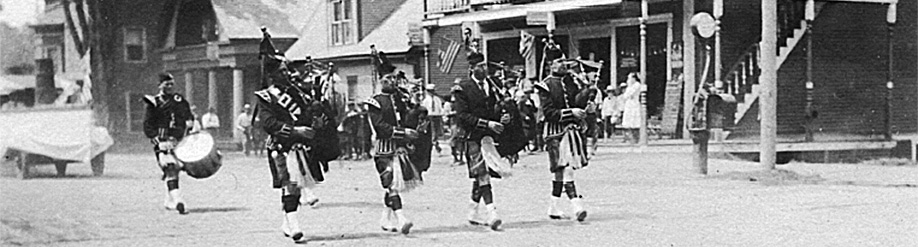

CABOT – When I was growing up, the Fourth of July was not especially significant for me. I lived on a farm on Cabot Plains and looked forward to my city cousins arriving each summer, and if they arrived around the Fourth, they’d have colorful boxes of firecrackers and sparklers with them.
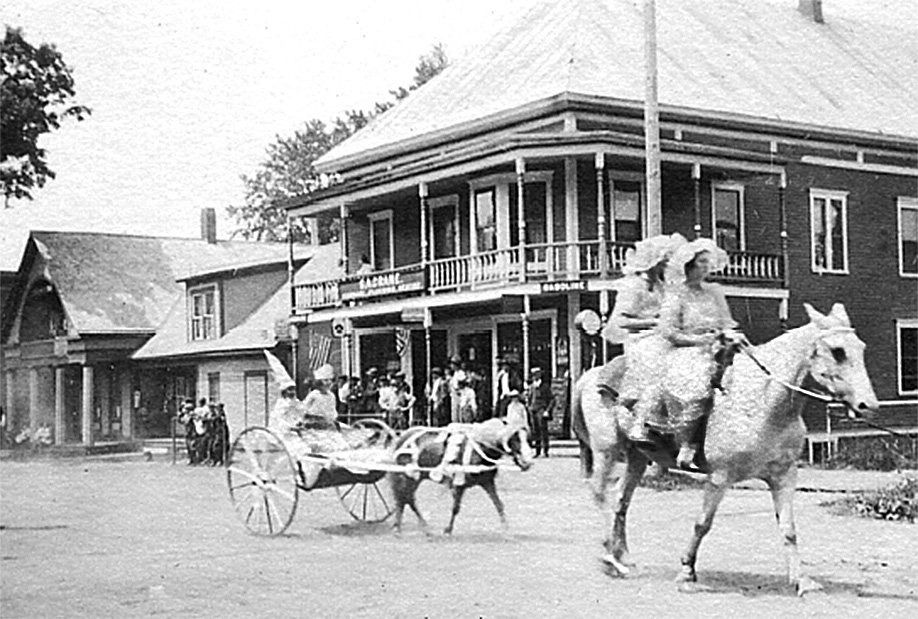
horse. Photo from Cabot Oral History collection.
The youngest of us were allowed to wave a sparkler around in the semi-darkness, always with lots of adult supervision, while the older boy cousins and my uncles had access to firecrackers that they set off under tin cans to see whose flew highest into the night air. Sometimes they set off more powerful blasts or a rocket that zoomed high overhead and exploded with a big boom, and that would send my grandfather abruptly into the house.
He was not a fan. He not only feared for the nearby farm buildings and hayfields, but he also didn’t like startling the farm animals. On a personal level, all the noise interrupted his routine which followed the “early to bed, early to rise” rule for bedtime.
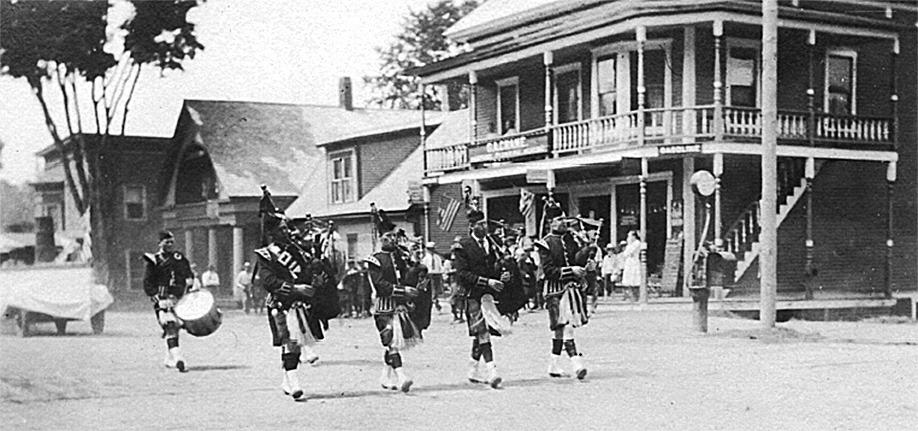
up Main Street in front of what is now Harry’s Hardware.
photo from Cabot Oral History collection.
Most years, we didn’t pay much attention to the Fourth. There were family gatherings if it fell on a weekend, maybe a picnic if it fell on a Sunday, and occasionally someone produced a few firecrackers, but mostly it was just another day. Cows had to be fed and milked, chores done, loads of hay brought in.
However, when my father, who was born in 1906, grew up on that same farm, the Fourth of July was a big event for the Cabot Plains community, at least for a few years. During the weeks prior to the big night, all ten Bolton kids and their neighborhood friends (nearly every family had six or a dozen youngsters in those days) collected scrap wood and hauled it to the highest point around, a pasture hilltop on our farm overlooking Joe’s Pond.
It was our night pasture when I was growing up, a remarkable pinnacle of bare ledges with deep marks left by the iron wheels of military wagons that had struggled northwest to reach Cabot Plain on Bayley’s effort to reach Canada in 1776. It was a fitting place to celebrate those hardy patriots who
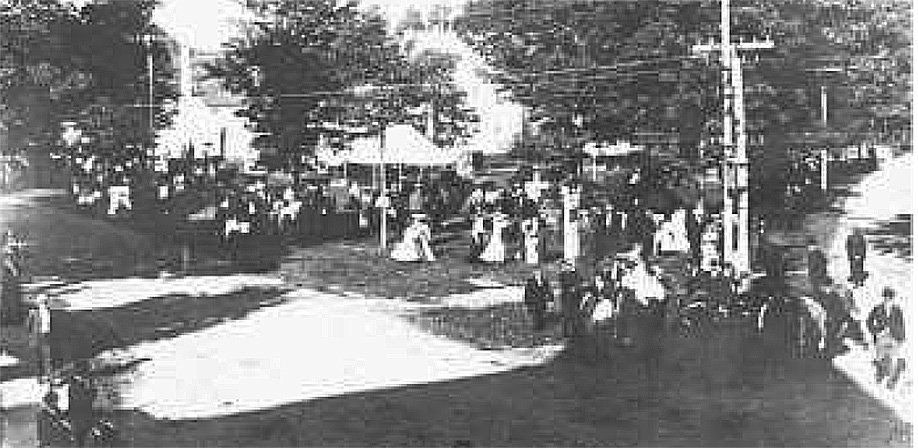
photo from Cabot Oral History collection
served in the Revolution. With much of the route of that old military road on the Bolton property, that was probably my first history lesson, diligently passed on to me and my cousins by our grandfather.
On the night of the Fourth, neighbors arrived on the open knoll in buggies or on foot. Most lived on or
very near the route of the old military road: the Maynards, Gambles, Stones, and Barnetts came from the western end, the Roys, Grays, Macks and Burtnetts trudged up the road from the east.
They came with blankets and sometimes baskets of food to share, and as the last rays of sun disappeared in the west, the pile of wood, sometimes eight or ten feet high, was set ablaze. The adults chatted while watching the roaring blaze, and youngsters frolicked in the flickering shadows of the big fire.
The gathering was probably more about coming together as a community than celebrating the nation’s independence.
Years later I learned that campers on Joe’s Pond, only a few at that time had cottages, but many tented on Flint’s Point on the east shore, looked forward each year to the big fire on top of the hill above the west shore of the pond.
There were celebrations on Flint’s Point in those years, on the west shore where the Joe’s Pond Association pavilion is today. The Flints first opened their farmland for a park in the late 1800s but it wasn’t until the early 1900s that summer cottages began to be built.
There were large gatherings at Flint’s Point for baseball games, band concerts and dancing. The sound of music could easily be heard at the bonfire on the hill across the pond, entertaining Cabot Plains
neighbors as it mingled with the crackling of the big fire.
In the years immediately following the signing of the Declaration of Independence, the Fourth of July was remembered with reverence. There were long speeches by statesmen, hymns, prayers and band concerts.
However, after the Civil War, joyful, noisy “Callithumpian” parades became more common, even reaching some larger communities in Vermont. These boisterous parades featured large puppets designed to poke fun at the so-called elite, politicians or other officials. They were noisy, and bands played a mix of marches and popular tunes of the day.
In Boston, around the end of the Nineteenth Century, some socially-elite men formed a military style group, “The Ancient and Honorables,” and marched in a parade. This very soon became “The Ancient and Horribles” when non-socialites dressed in silly costumes and marched in noisy disarray to mock the “Honorables.”
By the 1870s, Vermont had picked up the practice and today nearly every town has some kind of parade or celebration with good-natured, noisy, often offbeat participants.
Cabot had its own style of celebrating the Fourth. In his memoirs, Rev. Fred Blodgett recalled attending a picnic in the maple grove at the Stone farm on Cabot Plains in about 1885. There was also a baseball game and a band concert.
Other years, there were baseball games on the village common, parades, marching bands and speeches by prominent townspeople or politicians.
During the years of WWI and WWII, Cabot suspended big celebrations on the Fourth, but when Herndon Foster was president of the PTA in the late 1940s and needed to raise money, he revived the parade and Homer Darling, who lived in the lower village, roasted beef in a fire pit, which was served to about 800 people on the common. It was such a success there has been a parade and festivities in
Cabot Village every year since.
Cabot’s Fourth of July celebration is widely known and well attended. This year’s celebration of the 250th anniversary of our nation’s independence will be even bigger. It will begin on Friday, July 3, at 6 p.m. with a softball game, a 3-on-3 basketball tourney, food, magic and fun until 10 in the evening.
On Saturday July 4, the parade moves down Main Street at 11 a.m., and promises to be bigger and better than ever, always with a definite nod to callithumpian ways, and possibly some good-natured spoofing, “Ancient and Horribles” style.

Jane Brown
Jane Brown is a member of the Cabot Oral History Committee.


