



DUXBURY – Imagine you’re a fruit fly by the pond on a sunny day, whirring along in search of food or other flies. Suddenly, you’re scooped up, whisked to a perch, and efficiently devoured by a blue dasher dragonfly. For little flies like you, blue dashers have a 97 percent capture rate. For comparison, great white sharks only catch their prey 50 percent of the time. What makes dragonflies such successful hunters?
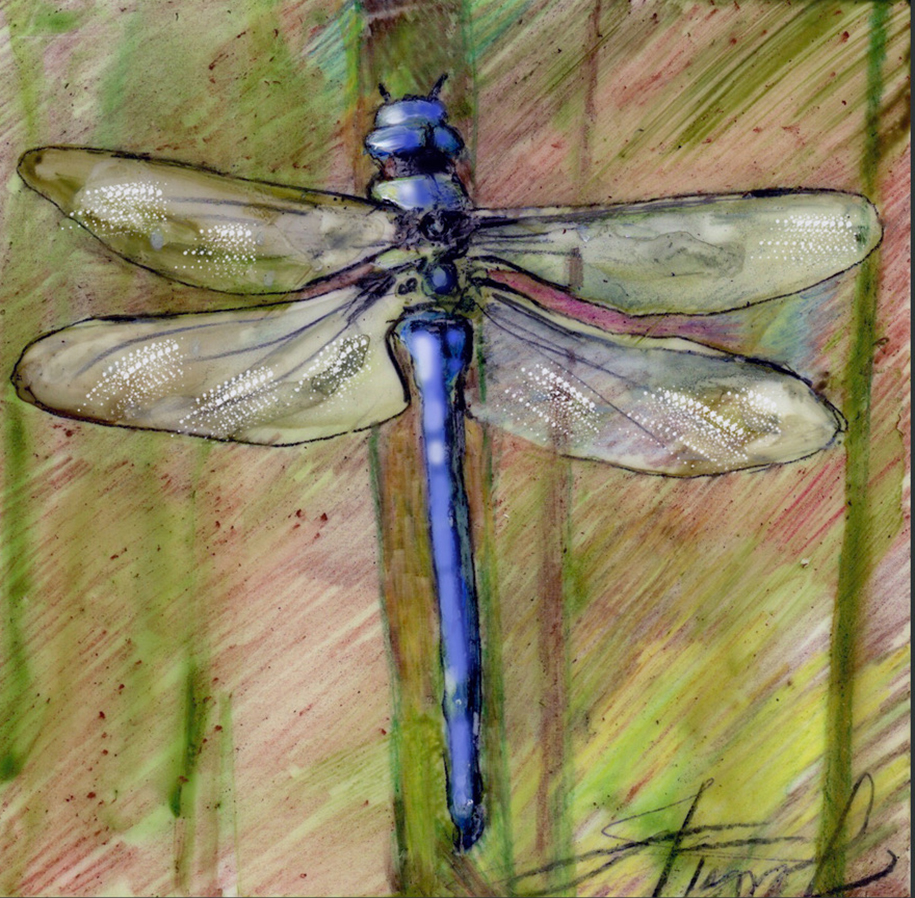
Stacey Combes and graduate student Christofer Brothers film dragonflies hunting inside a greenhouse to learn more about their technique. Combes and Brothers focus on “perchers,” species that wait on perches and take short flights to nab prey. One of their study subjects is the blue dasher dragonfly, a common species that lives across North America. These dragonflies live near bodies of water, preferring those with calm currents, like ponds, wetlands or slow-moving streams. They live as winged adults for the few months of summer. During daylight hours, they hunt insects that are no bigger than their own heads.
Dragonflies are choosy about their hunting grounds, seeking open areas with no obstacles, which allows them to see and chase their prey unimpeded. Blue dashers perch on short reeds and grasses to wait for prey, but each species of perching dragonfly has its own preference for perch height and type.
It’s easy for dragonflies to keep an eye out from their perches; they have the largest eyes of any insect, and their visual systems are tuned to spot and track very tiny objects within their 180-degree visual field. When they spot something, they make an extremely quick head flick to assess the potential prey and decide whether to pursue it.
Once airborne, dragonflies reach their peak speed in one or two wing beats. They feel accelerations of up to 3 g’s. For comparison, the force we feel during take-off as passengers on a commercial flight is unlikely to exceed 0.6 g.
In flight, dragonflies have several handy abilities. The flexible joint between their head and their thorax means they can keep their head locked on target while their body pivots and maneuvers. All four of their wings operate independently, giving them exquisite control in the air, even allowing them to fly sideways.
In general, for flying insects, greater size equals faster top speeds. Since blue dashers are much larger than their hunting targets: a large target might be as big as a horse fly, they always have a speed advantage.
While it’s easy for a dragonfly to exceed the speed of a fly, they also don’t want to overshoot. Many flying insects include evasive maneuvers into their routine flying patterns. Small prey, with smaller bodies, can make abrupt, tight turns. To be prepared, dragonflies automatically adjust their speed so that they are only one meter per second faster than their target. They can overtake prey quickly while not going so fast that they can’t follow if it makes a sudden change in direction.
Dragonflies prefer to attack from below, in the blind spot of a flying insect. Small insects may never see the attack coming. Even when the target insect does spot a dragonfly pursuer, these sneaky hunters use a trick called motion camouflage to make their pursuit less obvious. They maintain the same position in the prey’s visual field, so only their slowly looming size gives away their approach, thus disguising how fast they’re catching up.
When a dragonfly does catch up to its prey, it grabs it with all six legs, cradling it securely in a basket of crisscrossing leg spines, and flies it back to a preferred perch to consume. Environmental factors influence how much a dragonfly hunts, especially temperature and prey availability. Extreme temperatures, both too low and too high, can limit a dragonfly’s ability to take hunting flights.
Combes and Brothers have more questions they hope to answer over the course of their research: What are dragonflies assessing before they choose to pursue a fly? And how do wind conditions affect both dragonfly and prey? Finding answers will be a lot of work: in part because they are such successful hunters, it can be hard to study failed attempts. “Sometimes we have to run hundreds of trials to find the misses, so we can understand why that happens,” Brothers said. Next time you’re watching a dragonfly in pursuit, be thankful you’re not a fruit fly!
Rachel Sargent Mirus is a teaching artist and writer living in Duxbury. Illustration by Adelaide Murphy Tyrol.

Rachel Sargent Mirus is a teaching artist and writer living in Duxbury


