


AREA COUNTIES – People who live in subsidized housing share one thing: incomes low enough to qualify for housing assistance. In 2025, the U.S. Department of Housing and Urban Development (HUD) classified 98% of households in subsidized housing as very low income and 76% as extremely low income.
courtesy USA Facts
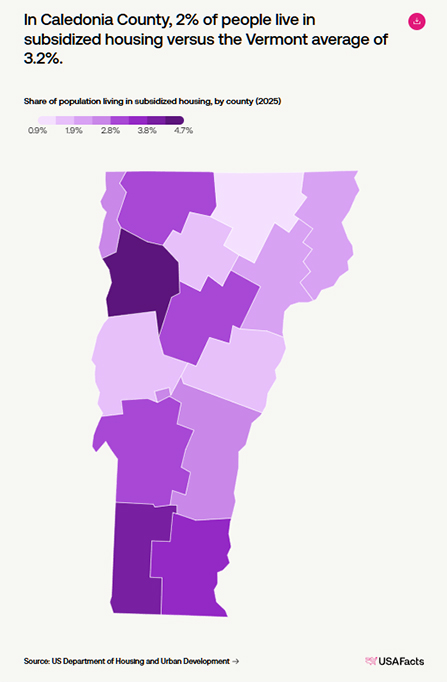
In 2025, about 597 people lived in subsidized housing in Caledonia County. That’s 2% of the population vs. 3.2% in all of Vermont. It is equivalent to about 1.6 people per unit in Caledonia. On average, in 2025 those residents had lived in their units for 6 years and 9 months .
A total of about 20,500 Vermonters lived in subsidized housing in 2025, equivalent to about 1.7 people per unit. On average, residents had lived in their units for 8 years and 6 months, almost two years longer than in Caledonia County.
In Orleans County 248 people (0.9%) lived in subsidized housing for 9 years and 9 months on average
courtesy USA Facts
In Lamoille County it was 368 people (1.4%), averaging 8 years and 5 months.
And it was 1,800 people (3.1%) in Washington County, for 9 years and 3 months on average.
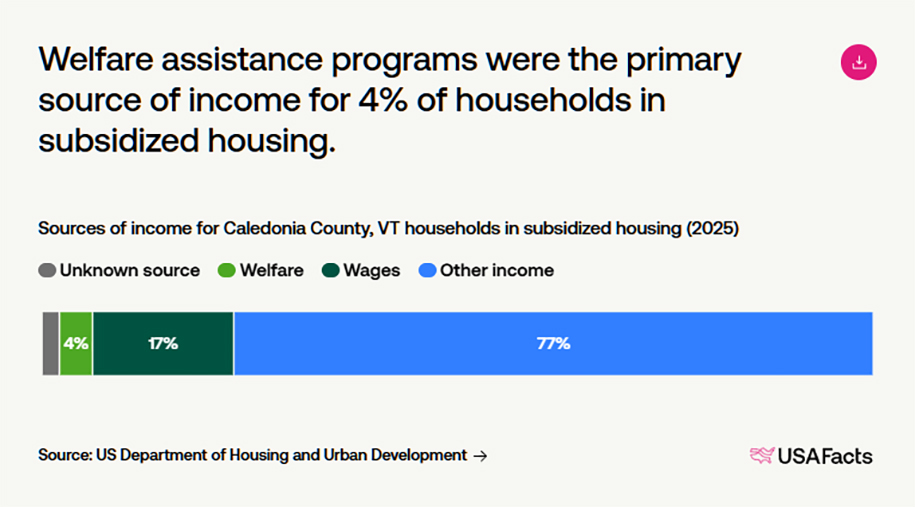
Renters in subsidized housing earn income from different sources. Welfare is the main income source for 6% of households. According to HUD and the Census Bureau, “welfare” includes the Temporary Assistance for Needy Families (TANF) program, general assistance or emergency assistance payments. Another 16% of households earn the majority of their income through wages, salaries and business income. Finally, for 75% of households living in subsidized housing, the majority of income comes from other sources, a broad category that includes Social Security payments; insurance benefits; pensions; interest or dividends; and payments in lieu of salary like worker’s compensation, severance, unemployment or disability. The remaining 3% is unaccounted for in the data.
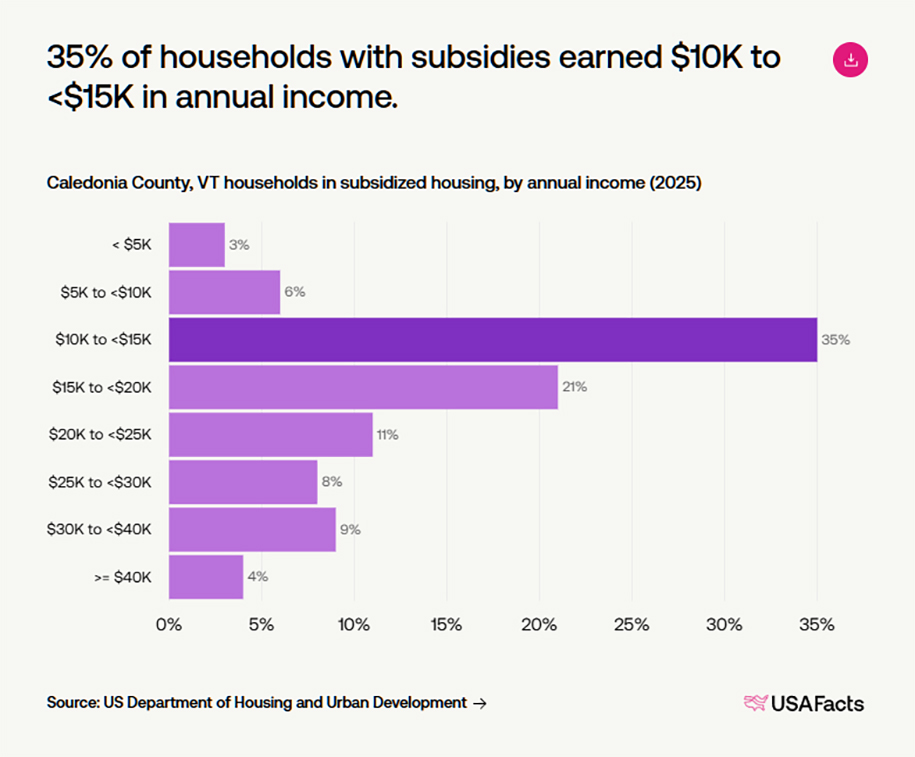
The average Caledonia County household in subsidized housing earned an annual income of $18,370, with 96% earning less than $40,000.
Throughout Vermont, the average annual household income in subsidized housing earned $19,845, with 93% earning less than $40,000.
In Orleans, the average household in subsidized housing was the lowest in 2025, earning $15,361 in annual income, with 99% earning less than $40,000.
In Lamoille, the average household earned $19,457 annually, with 95% of households earning less than $40,000. And In Washington it was $18,689 annually, with 95% of households earning less than $40,000.
Households living in subsidized housing contribute to their rent. In 2025, households living in subsidized housing in Caledonia County, paid average monthly rent of $449, which translates to an average of $5,388 per year, or 29.3% of the average household’s annual income. HUD contributed $935 per household per month, on average.
courtesy USA Facts
Throughout Vermont households paid average monthly rent of $478 in 2025, which translates to an average of $5,736 per year, or 28.9% of the average household’s annual income. HUD contributed $1,007 per household per month, on average.
In neighboring counties average rent paid by households was $385 (30.1%) in Orleans, $465 (29.3%) in Lamoille and $445 (28.6%) in Washington
Households that qualify for subsidies have a variety of family structures. HUD data focuses on homes with children, female-headed households and households that include people with disabilities.
In 2025, 22% of Caledonia households had one or more children under 18, about 77.3% of them were headed by single parents. 66% were headed by women and 19% were headed by women with children. 37% of all people living in subsidized housing had a disability.
Throughout Vermont 25% of households had one or more children under 18, and about 80% of these were headed by single parents. 67% were headed by women and 21% by women with children. 37% of all people living in subsidized Vermont housing had a disability.
Statewide, 11% of households living in subsidized housing were headed by people belonging to minority groups, which the Census Bureau defines as anyone whose race and ethnicity is anything other than “white alone, non-Hispanic.”
In Orleans, 23% of households had one or more children under 18 and about 82.6% were headed by single parents. 72% were headed by women and 20% by women with children. 48% of all people living in Orleans subsidized housing had a disability.
In Lamoille, 19% of households had one or more children under 18 and about 78.9% were headed by single parents. 68% were headed by women, and 17% by women with children. 35% of all people had a disability.
In Washington, 21% of households had one or more children under 18, and about 81% were headed by single parents. 64% of households were headed by women, 18% were headed by women with children and 43% of all people living in subsidized housing had a disability.
Another way of understanding who benefits from housing subsidies is to look at age. People of all ages benefit from housing assistance.
Forty-seven percent (the Vermont average) of Caledonia households living in subsidized housing are headed by people 62 and older, the youngest age when people can qualify for Social Security. People 25 to 50 are considered “prime-age workers.” Households led by this group make up 34% of all households in Caledonia County subsidized housing, while it is 35% in all of Vermont
The same 47% of Orleans households in subsidized housing are headed by people 62 and older, with 29% led by those 25 to 50.
Fifty-seven percent of Lamoille County households living in subsidized housing are headed by people 62 and older, and 27% led by people 25 to 50
Washington County had the lowest percentage of households living in subsidized housing headed by people 62 and older, with 46%. 32% of households in subsidized housing were 25 to 50..
Federally subsidized rental housing began with 1937’s US Housing Act, which created the United States Housing Authority and provided financial assistance to state and local governments for housing low-income people. Since then, the government has provided housing assistance to low-income renters through programs overseen by the US Department of Housing and Urban Development (HUD).
This article is based on information from the U.S. Government provided by USAFacts.

