
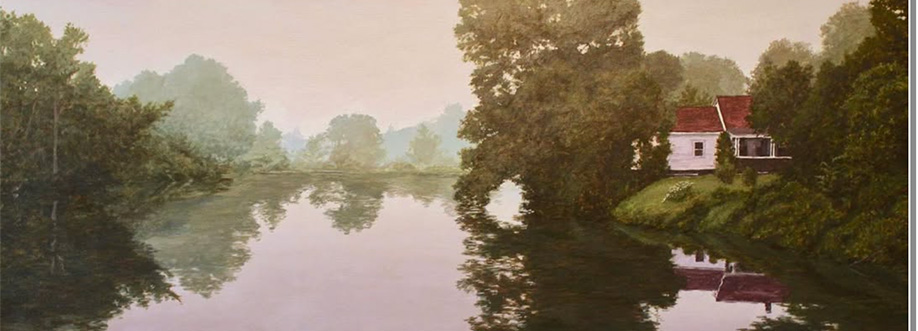


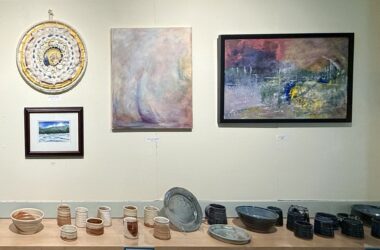
HARDWICK – A painting is like a window into another world and Ben Barnes can certainly create paintings with startling immediacy and great presence. He is currently having an exhibition of three dozen of his works at the Third Floor Gallery in the Hardwick Inn.
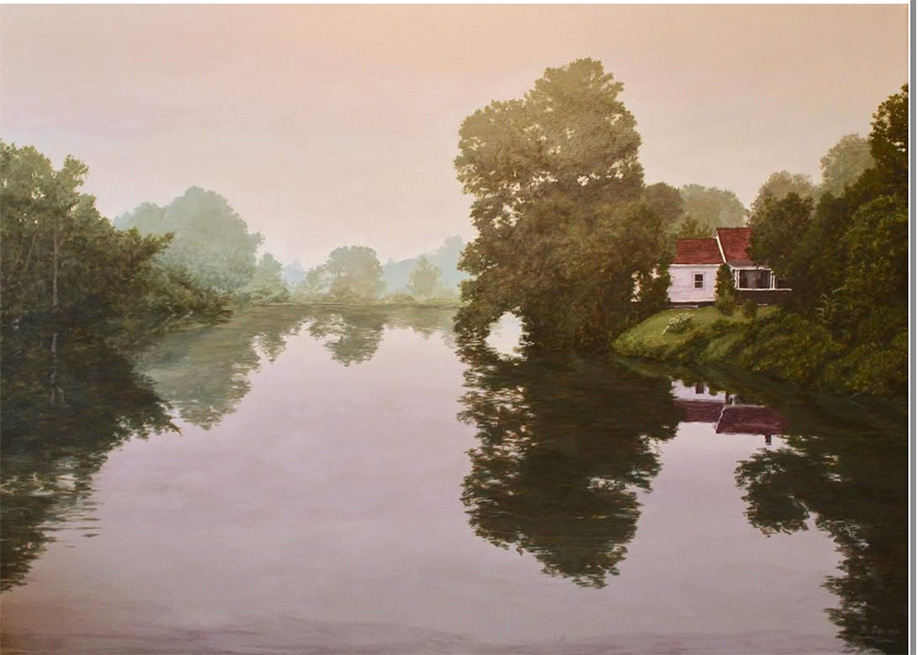
courtesy photo from the artist
“Happy Place” has a simple enough subject: a camping trailer in a broad field, but everything is in exactly the right place in a beautifully proportioned composition. Our eyes go first to the modest blue and white trailer on the middle left but then are drawn to the distant tree line. Two chairs in the field have a welcoming quality and evoke thoughts of where we love being.
“My Dad’s Bear” juxtaposes an old broken down truck in the woods with a stuffed teddy bear sitting inexplicably on the rear bed. The reflected light off the surface of the truck and the filtered light of the forest are very carefully rendered.
“Sunny Ford” shows a tractor that dominates most of the canvas, but Barnes doesn’t include all of it, cutting off the back end on the right and a little of the front on the left so as to play with the edge of the frame and make a bolder, more dynamic composition.
“Rock River” conveys one of the more difficult substances to paint convincingly, namely moving water. Here the dark rounded rocks in the foreground contrast well with the whitish sand area in the upper center and the sky reflected in the water.
While most of Barnes’ works are landscapes and townscapes, he has a number of still life pieces in the show. “Palmolive” is of a kitchen sink with a bottle of dishwashing soap that gives the title, combined with red and white roses in a vase on the left, a pair of knives on a magnetic rack on the right and a glass juicer above, all well balanced.
“Mis Tape,” a bit of a visual pun, assembles several objects on a table with a radio-tape recorder and some loose tapes in their cases in front, carefully constructed.
“Land Line” is another still life with an old black phone, a pair of glasses and flowers on a small table, the focus contained by the surrounding dark areas.
“Green Foyer” depicts multicolored lilies with a chair on one side and a stairway on the other, harmoniously composed.
“Exposed Wiring” refers to open electric lines on the bare wooden walls of a shop, with various tools attached to it in carefully painted detail. “Screwdriver Rack” and “Three Hammers Hanging” continue the tool rack theme with the rhythm of a well ordered composition.
“Pot of Gold” is a painting taken from Barnes’ own home in St. Johnsbury, looking across the street towards the former Family Dollar store right after a rainstorm. A double rainbow arches across the sky, catching a unique fleeting moment with the beautiful effects of natural light.
“A Corner of the Connecticut” has the curve of the river on the right echoed in the curve of a dirt road in the center of the painting, leading our eyes across the deep green growth of fields in July into the background, bathed in the magnificent light of a summer day. “Farmroad” similarly has a dirt road with grass in the middle running up and out of sight through lush hayfields, with lovingly painted grass and the road surface. “Little Barton River” has water flowing over flat pieces of rock, caught in the sunlight, very challenging to paint.
Barnes has long been fascinated by abandoned vehicles such as in “Wheelock Iron,” which has a black truck, a red tractor and a trailer for transporting cows out in an overgrown field, all three forms overlapping in a rhythmic sequence with the play of light upon them and a kind of nostalgic ambiance.
“Hartwell Dapple” gives us a blue and white GMC truck viewed from the front, with mottled sunshine coming down through the trees in balanced areas of light and dark.
“Squarenose” is yet another truck that has seen better days, again only two thirds included within the canvas so as to make it more interesting and less static. “Lowell Three” has actually four abandoned automobiles, including an older Buick-like car, a truck barely visible behind it and another truck and regular car further to the left, all transformed by the alchemy of summer’s light.
“Field Apples” features a bushy tree in the upper right amid a field that flows away to a further tree line and hills, with a blue sky and small clouds all enchantingly bucolic.
“Franklin Phone Company” is a dramatic street scene, a good example of how Barnes takes an ordinary place and makes it extraordinary through his intense seeing, exacting sense of proportion, attention to detail and delight in the ever changing affects of sunlight. He also plays here with a rhythm of repeated reds, starting with the phone booth on the left and continuing in the main diagonal thrust of the overall composition to an American flag on the building, then to a Coca Cola sign on the distant convenience store.
“Masterful! Pink Lady and her Little Green Neighbor” compares two urban houses, a large Victorian on the left and a newer smaller house on the right, with a strong impression.
“Alpha Warner’s Tavern” shows one of the oldest houses on Hardwick Street, formerly the residence of the Baroness von Carlowitz and still in her family. With snow on the ground and roofs, it captures the winter light and blue shadows in an excellent composition. Somewhat saddening is “Settlement,” a striking painting of the old stone foundation of a former house with trees growing up from the basement. The hill farms of Vermont were some of the first to go in the late Nineteenth and early Twentieth Century. All the work of clearing the land and building a home came to nothing, sometimes after hardly a generation or two. This painting is powerful both visually and emotionally.
“Switchboard” is an interior view of an old telephone operator’s station, with light coming in a window and contrasting sharply with the dark areas inside.
“Town Common” has two white steeple churches next to each other and a third building just beyond them to the right, with a Civil War monument and American flag on a pole to the left, all rhythmically positioned.
“Plainfield Village” is a twilight scene looking up towards the bridge over the river and U.S. Route 2, with Positive Pie on the right, catching the light of those furtive moments of dusk perfectly.
“Boulder Beach” is dominated by a large rounded boulder covered with lichen on the left with water flowing around it on the right, a bold juxtaposition of two opposites.
“Old West Road” has a skillful play of diagonals between the road on the right and the farm buildings on the left, with meticulously painted detail of the siding and roofs.
“The Fall of the Andersonville High Drive,” in West Glover, is a large horizontal work having a white house and red barns stretching across the middle of the canvas, with a bright blue sky and billowing white cumulus summer clouds above. The whole composition is held down by a red tractor in the foreground, all the elements stunningly balanced.
“Summer Street” is another urban picture, with a playground and some public building in the background, at that magical time of evening just before darkness falls.
“Project” is again an ordinary scene most people would hardly glance at, a car with its hood up in front of a home garage, but here made special by a shaft of sunlight coming down through the trees on the left.
“Pigeon Hill” has an old Italianate house with an overgrown lawn, all anchored by the vertical shaft of a tree in the right center, coherently structured.
“Cornstalks” is a winter landscape with the stumpy short remains of cut corn in rows with long barns and a house in the distance, a powerful horizontal layout. “Young Corn” is quite the opposite, picturing the bright green of newly planted corn with its first leaves in early summer, and brown earth between the rows.
“Jim’s” was a large work dramatically composed; our eyes are directed first from the corner of a gray clapboard house with a porch on the left (which belongs to someone named Jim), to the right on a diagonal to a white church with a steeple, located in East Albany. Leftover snow by the distant tree line and barren branches indicate it is early spring. Nice touches are a red ladder leaning against the house, high grasses in the foreground painted in careful detail and a car in front of the church altogether a superb work of art.
This exhibition will continue through the end of July into August and September.
Olive Ylin, show organizer. has her office on the third floor of the Hardwick Inn down the hall to the right from the east stairway.

David K. Rodgers
David K. Rodgers is a writer, mason and card carrying dilettante, who dabbles and babbles in art. He has lived in East Craftsbury for the past 40 years.
