




HARDWICK – Historian Allen Davis, was born in 1931, grew up in Hardwick through the Great Depression, World War II and their aftermath, at a time when “American upward mobility did work,” he writes in his new book “The Lucky Generation:Growing up in Depression and War.”
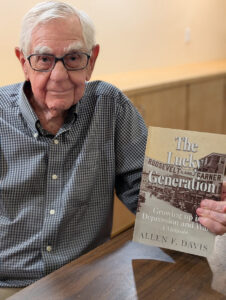
photo by Sandy Scott
“Those of us in the ‘Lucky Generation” who went to college were certainly favored by the odds. I once told my Dartmouth classmates (class of 1953) that they were successful (and most have been very successful), not because they were brilliant and hardworking, but because they were born in 1931,” he writes. “At first they rejected the ‘luck factor’ as a key to their success, but after I sketched the demographic statistics they began to admit that their year of birth had helped the trajectory of their careers in business, law and medicine.”
Davis spoke at a free public book launch co-sponsored by the Hardwick Historical Society, The Galaxy Bookshop and the Jeudevine Memorial Library in the Jeudevine Library’s new Parker Ladd Community Room, Wednesday, Aug. 20
The book ends with Davis entering Dartmouth College. About his journey there and growing up in Hardwick, he recalls baked beans every Saturday night, sneaking into the pool hall, going to movies at the Idle Hour Theater, reading everything within reach at the Jeudevine Library and exploring Buffalo Mountain by himself.
A shy, bookish kid, he became a historian and tells his story with an eye to the historical context that shaped his life and the life of his hometown, which he has returned to every summer of his life, except one.
Davis took questions after introducing the book, recalling Hardwick as “the wettest dry town in the state.” While liquor wasn’t available in town, Al Stratton, who ran the stage to Montpelier took orders, returning with the liquor, Davis said. “Wives often appeared at his door and demanded he take no more orders from their spouses.” Townspeople were resourceful, making liquor from sources that included dandelions.
Much of Allen’s story centered around his father’s South Main Street store, now an apartment building across from the cemetery, and his love-hate relationship with working there as a boy, stocking shelves, sorting ration stamps on Saturday mornings and sometimes filling in for clerks who were ill during the summer.
When he was 16, he wrote letters to 30 boys camps, resulting in a position at Camp Wapanaki that included board and room, allowing him to avoid summer work at his father’s store.
He talked of Hardwick’s characters, including one referred to as the Mountain Queen, and another, May Foot, who lived in a little shack behind his house and ran a shop, but never had much of anything to sell and claimed to be an F.B.I agent.
Asked about travel, Davis said he hadn’t traveled much as a boy, except with his family on Labor Day. He recalled one trip that had an impact on his life, though. In 1944, when he was 12 or 13, he traveled with two Smith boys on the train to Hartford, Conn., then to New York City, where they were met on Brooklyn by the Smith’s aunt. The boys took the subway into the city, alone, where they visited the site of the 1939 World’s Fair and the Empire State Building. He recalled visiting Scribner’s Book Store and eating cheesecake, all of which whetted his appetite for travel, which he’s continued to do ever since.
The book is available at the Galaxy Bookshop and the library has a copy ready for check-out soon.

Paul Fixx is editor of The Hardwick Gazette and lives in Hardwick.
