


MONTPELIER – Back in January, virtually no one imagined that lawmakers responsible for consolidating school districts would go anywhere near last fall’s disparaged recommendations from the school redistricting task force.
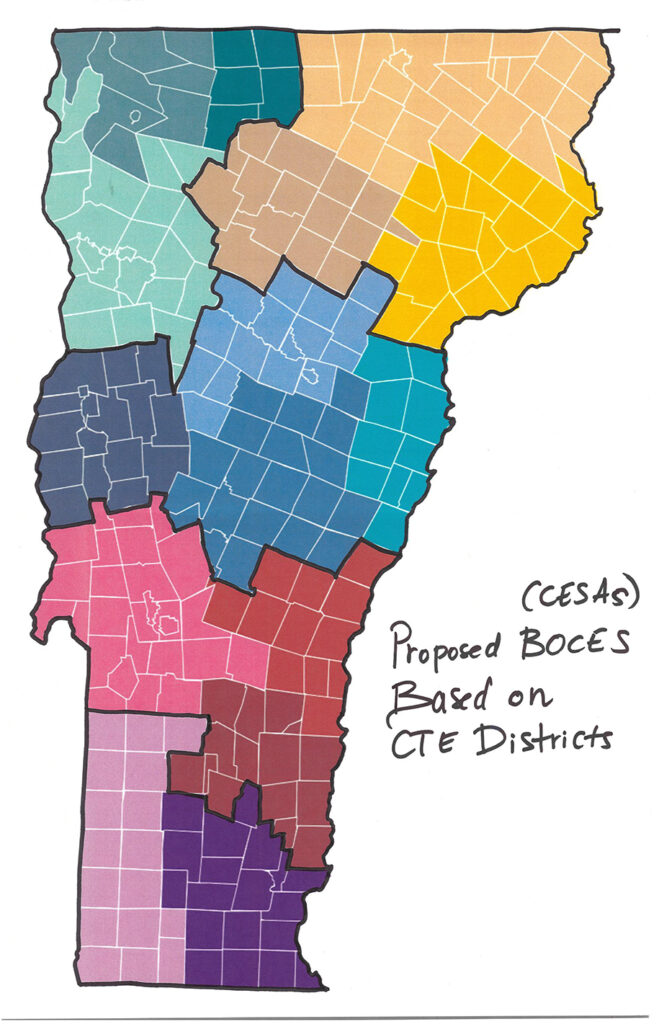
map courtesy VTDigger
Recall that lawmakers last year had punted the responsibility of drawing consolidated school district maps to the task force. But in November, when that body endorsed a proposal that incentivized voluntary rather than mandatory mergers of the state’s 119 school districts, it bucked one of Act 73’s key directives.
At that point, Gov. Phil Scott described the task force’s work as a failure, and lawmakers looked hesitant to consider much of the panel’s proposals.
Now? Well, things have shifted. We’re in the “spitballing” phase of the process, as Rep. Peter Conlon, D-Cornwall, the House Education Committee chair, put it Tuesday.
House lawmakers have put on the back burner Conlon’s more ambitious proposal to merge the state’s 119 districts into 27, and are instead working on a proposal that uses cooperative education service agencies, or CESAs, as the key organizing principle for a consolidation proposal.
Those regional entities, already in use in southeast Vermont, facilitate the sharing of services in special education, professional development, human resources and more and is a key recommendation of the task force.
A map presented by Rep. Leanne Harple, D-Glover, March 18 would overlay five CESAs atop the state’s existing governance units.
The idea would be to save some money in the short term by allowing districts to regionalize, while giving each CESA the power to facilitate mergers of school districts under their umbrella before the proposed new education funding formula kicks in.
Both chambers of the Legislature are considering proposals that would allow for a period of voluntary mergers (another recommendation of the redistricting task force). A proposal in the Senate Education Committee would create a two-year on-ramp period for school districts to voluntarily merge.
“Maybe it’s not the path that folks sort of envisioned when we started this process, but it’s also not nothing,” House Education Committee member Rep. Jana Brown, D-Richmond, said Wednesday. “I think it’s a significant opportunity. It maybe isn’t what we envisioned when we started with Act 73, but I think it is substantive.”
Lawmakers in the House Education Committee have set a rough goal of trying to get the proposal out by next week’s end.
Many details are still being worked out. But it’s a significant pivot for lawmakers in the House Education Committee.
“I’m trying to find something that can generate enough votes to move out of this committee,” Conlon said Thursday morning. “Up until now, I haven’t been able to do that. That’s why we’re on the track that we’re on.”
For some lawmakers, the pivot back to the task force’s recommendations was a frustrating endeavor.
“We called for there to be a redistricting task force. The task force did their job. They came back with recommendations. We basically ignored those recommendations for the first half of the session. And now we’re back to looking at their recommendations,” Rep. Kate McCann, D-Montpelier, said on Wednesday. “I mean, it just floors me. I just want to drop it all and be like, ‘I can’t stand this.’”

