
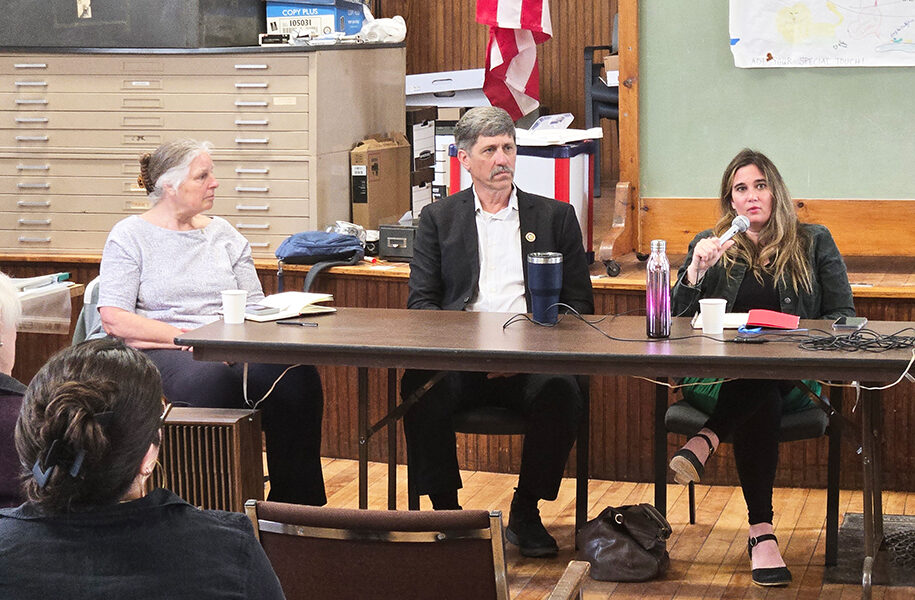


CRAFTSBURY – This past Saturday, June 6, the Craftsbury Town Hall was host to Lt. Governor John Rodgers (R-Glover) and Representative Leanne Harple (D-Glover),Orleans District 4, for a legislative update and discussion.
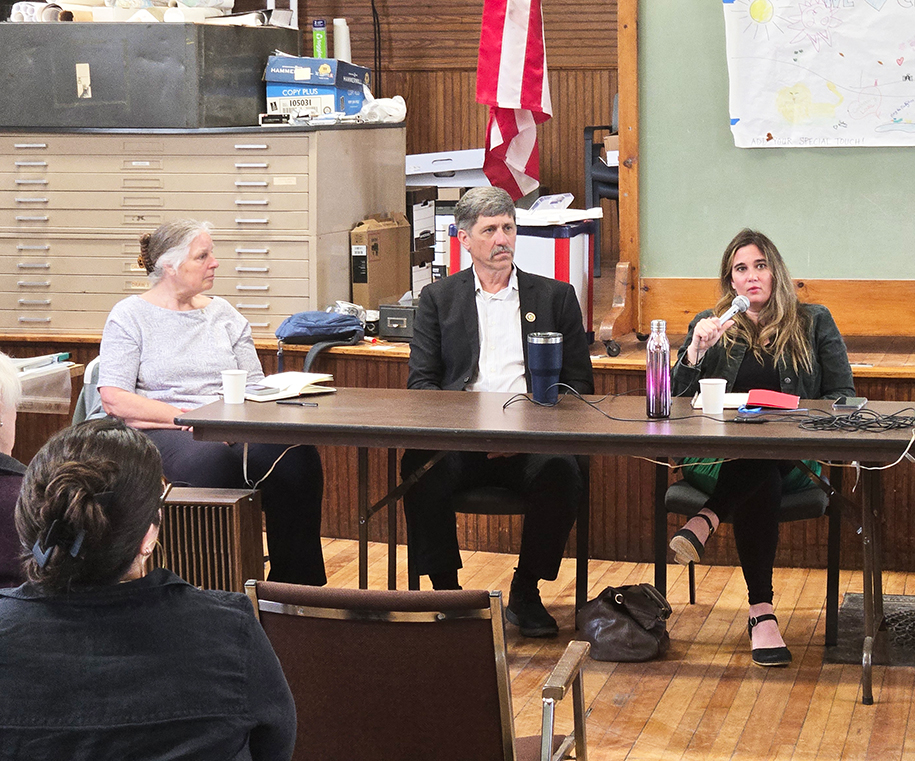
courtesy photo
Senator John Morely, Orleans District, was invited but was unable to attend.
“This is an election year, and Vermont primaries are only two months away. It’s a good time to hear what happened in the legislature, so you can make your decisions on how you want to vote,” Town moderator Jeannine Young said, before handing things off to Deb McKinely, who moderated the event, sponsored by the Craftsbury Freedom and Unity Committee.
The lieutenant governor and Rep. Harple first addressed attendees with remarks on the past legislative session, and other pressing matters.
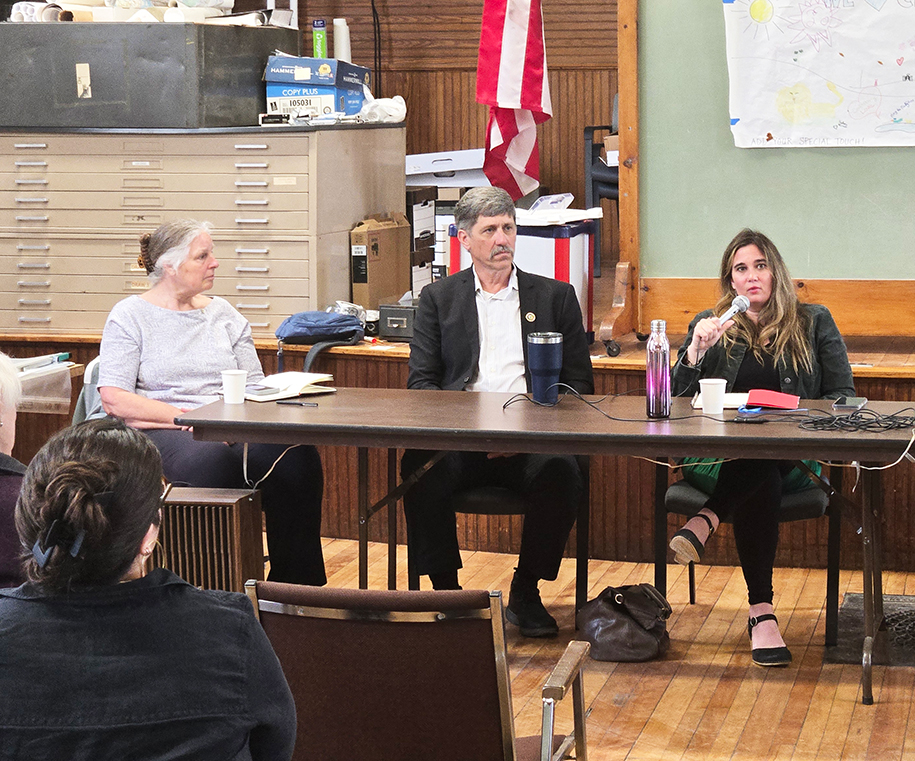
photo by Paul Fixx
“It’s really been an honor to have this position. I thought for years that the lieutenant governor’s position was underutilized, and a lot of people used it just as a stepping stone, trying to get somewhere else. I’m very fortunate to have James Ellers, a person who’s been involved in politics for a long, long time, as my chief of staff, and adviser. Between the two of us, we have touched so many Vermonters’ lives in the past two years. We work with legislators every day.”
Rodgers provided examples of legislative action taken, namely S. 193, an act relating to establishing a forensic facility for certain criminal justice-involved persons.
“Currently we’re the only state in the country that doesn’t have a secure forensic facility of people with mental illness that are violent. So I pulled together a day to allow the victims of these crimes to come into the state house, arranged for the committees of jurisdiction to listen to the stories. The media was there, and the public was welcome, and we got through all that and built enough momentum to finally, after many years of trying, get S.193 over the finish line. The governor signed it, and we will be making progress on establishing a secure facility.”
Rodgers told stories of federal overreach in immigration enforcement, “Early on in my tenure, during the first session, there was a group of migrant workers picked up in Franklin County, off the farm they worked on, and I’ve talked with a lot of my farmers, and one right down in Greensboro. He said, if they come and take my Mexican workers, the cows are going down the road the next day. And I think what a lot of Americans don’t understand is that migrant workers basically feed America. They’re doing the milking, they’re picking the fruit, they’re picking the vegetables.”
He continued, “And unfortunately, our federal government is so broken that they have not fixed the immigration system. We need these people in the system to help get the work done. We need to feed America. And so when those folks got picked up, myself and my chief of staff went to meet with Migrant Justice, and asked how we could help, and they said sometimes when people in powerful positions write a letter of support, the judge will be more lenient.”
Rodgers drafted a letter, with 29 out of 30 Senators signing the support letter. Rodgers says they were able to keep some of those workers in the country, and they were able to go back to the farm. “So that’s the kind of work that you can do from this office,” he concluded.
Rodgers says he thinks although they’ve made some progress on healthcare and education, there’s a lot left to do. He also voiced his support for keeping small schools open.
In concluding his opening comments, Rodgers talked about the aging population of the state, “One of the things that’s really troubling to me is the fact that we have the most expensive healthcare insurance in the whole country, and we’re not the highest earning state in the country by far . . . We’ve got to bend that curve because what we really need to do in this state is change our demographics. We’re the second oldest state in the country, and if we don’t make it, so kids can afford to be here, we’re going to be in serious trouble . . . we’ve got to get to a point where we can do that.”
Representative Leanne Harple then spoke. She sits on the House Education Committee, with a large part of her work this year helping to write H.955, an act relating to next steps in transforming Vermont’s education system.
Harple explained the summer before this one, one of the study committees for Act 73, (an act relating to transforming Vermont’s education governance, quality and finance systems), concluded that forced consolidation of school districts will not save much money. Instead, what would save money is to move the system towards Cooperative Educational Service Areas, (CESA’s). “If you thought of education cost as stores, it would be like the Costco model, where a whole bunch of different districts get together and purchase a lot of things, special education, transportation, cyber security, central administration services, and by doing it together, the cost goes down,” Harple explained.
H.955 will combine school districts into CESAs, also creating merger study committees. “By and large, Vermonters kind of shouted down the idea of forced mergers. It doesn’t necessarily mean that they were against all mergers, but to do so without the local voice and without consideration of which districts were going to merge, didn’t really fly with people.”
“We kept having to stop because no legislator on our committee could get past their own region and know what was best for another region. So we felt kind of lost. Late into the spring, it kind of shifted towards voluntary mergers.” she continued.
“So yes, this does open up the possibility that there are school districts that won’t merge at all. But I think that from my own conversations with superintendents and principals, that these mergers are already being planned in a lot of areas.”
She pointed out that it’s difficult to pinpoint when small becomes too small, as well as the outsized impacts on rural communities, “Because the other part is, that if we didn’t do voluntary mergers versus mandated mergers in this conversation, and this sort of rural and urban divide, because it will come down to closing rural schools.”
Harple further explained what a foundation formula is, and what it means for the future of education funding and spending; “We’re going to now have a centrally decided budget that will go out by number of students to all schools. And that will be weighted on what kind of population the school has. So there are more weights for certain kinds of segments of student populations, such as English language learners, or students living in high poverty. What that looks like in the real world is that a small school that maybe had 200 students, but a third of them were living in poverty, would get a foundation formula for 250 students, or 300 students, and we would count extra students because it takes more resources to educate certain kinds of students.”
Moving on from H.955, Harple discussed some of her other legislative work, namely S.227. Referred to as the “Safe Schools bill” by Harple, the act prohibits schools from collecting immigration documentation on students, nor can immigration come into schools to talk to students or teachers.
“We want to make sure that everyone has access to education. This law does not actually violate any federal laws. It just creates a safe place. Schools are not going to be part of this ICE conversation.”
She also discussed H.930, the state’s first chronic absenteeism bill, “ Absenteeism has spiked since COVID and we’re looking at dealing with the root causes now, rather than just being punitive. Schools are going to either create a policy or adopt a model policy for how we can try to lower absenteeism.”
Harple co-sponsored a couple of bills that are not in her own committee, including bills to help get PFAS out of Lake Memphramagog, as well H.723, an act related to the posting of land.
“You can post your land now for a year from any date rather than from January 1 to January 1, which was going to be really hard on, especially older people or people that might have some mobility issues that couldn’t do it then . . . if it’s like two feet past, it used to be that you could assume it’s not legally posted, and now that kind of thing is not going to matter.”
The question and answer portion of the meeting began, with residents asking about property taxes, school vouchers, details about the foundation formula and more.
Both Rodgers and Harple voiced concerns when asked about school vouchers, each citing a potential drain effect as a chief cause for concern.
“I think we need to preserve the towns that are allowed to send [for school choice] and I think they should be able to choose where their kids go. I know that’s been a big part of the conversation in education.” said Rodgers.
“Some communities have school choice and the kids don’t necessarily all choose the same school. So I know the folks that live in those communities really want to preserve that school choice, but I don’t think you will ever see, or probably in the near future anyway, vouchers, because of the worry that it’s going to drain a lot of the kids off some schools.”
Harple was in agreement, “I think the school vouchers and school choice sound really wonderful. Like as a parent, I’d love for someone else to pay for my own kids to go to St. Johnsbury Academy. Sure, I would.”
She said it’s not as simple as looking at the number of pupils times the foundation formula price per pupil to run that school, “All of this money is pulled together to be able to make a school exist . . . what we’re going to end up seeing, if we have complete school choices, the kids who are the highest buyers academically, leaving behind the kids who are the most vulnerable, and we’re gonna have schools that are really struggling. They can’t pass their test scores that are then going to be labeled failing schools while all of our other students have left. That’s not going to be good for our communities and it’s not going to be good for the schools that are left behind.”
She continued, “But as far as school vouchers go, I think that we need to support our public schools with public dollars, and I’m also a big proponent of same dollars, same rules, so that if you are sending your public dollars to any school independent or public, that they need to follow the same standards.”
One resident asked about non-educational price drivers, such as heating, health insurance and transportation, and whether they are factored into the foundation formula.
Both Harple and Lt. Gov. Rodgers cited health insurance as a large cost driver, with the lieutenant governor reiterating his support for universal healthcare, “What we really need is universal healthcare. If we want to see our school costs go down, that is what it’s going to take,” Rodgers ended.
Harple pointed out longevity as a concern as well, “The foundation formula is not perfect, and the concerns that you name are the concerns that go with the foundation formula, and I don’t disagree with that. I think another point that I’ve been trying to make over the past two years too, is also that like it or not, as we close our small schools and our small communities, we also have to think not just of the immediate cost savings, but of the futures of those communities for the next 20, 30, 50 years.”
She continued, “Who is going to settle in those communities? Who’s going to stay in those communities that don’t have a school to send their children to? My husband and I seriously would think twice about settling in a community where we had to bus our children 30 miles or away. I imagine other people would too, so what is that going to look like for future businesses in our community and community itself, right? Nobody also wants to move to a desert community where people don’t have relationships. So, we need to actually be thinking about not just the short game, but the long game.”

Raymonda Parchment is a Hardwick Gazette reporter. She recently graduated from Vermont State University - Castleton with a Bachelor’s Degree in English. She is a strong supporter of freedom of speech, and the right to publish information, opinions, and ideas without censorship or restraint. She is a lifelong lover of the written word, and is excited to join the team as a staff member.

Paul Fixx is editor of The Hardwick Gazette and lives in Hardwick.
