


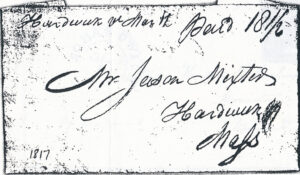
Before mechanical devices, a postmaster had to “stamp” the post office name on mail by hand. This hand stamp from Hardwick dates from 1816.
HARDWICK – In 1781, the Republic of Vermont granted a charter for a town named Hardwick to a group of 67 people known as proprietors. Most of them had some connection to Hardwick Massachusetts. The name Hardwick first appeared in a newspaper when, on January 22, 1787, Bennington’s Vermont Gazette announced the proprietors’ organizing meeting for March 13.
We don’t know when early settlers started using names for various settlements, but old newspapers can tell us when names became popular enough for an editor or an advertiser to assume that people would know them. Newspapers also reveal the role of the U.S. Postal Service (USPS) in the naming process.
Hardwick Street
In 1810, the USPS established the post office for the town of Hardwick in the store run by Elnathan Strong on what we now call Hardwick Street, the area of densest population at the time. An 1832 ad for boots made by C. Stevens described his location as “Hardwick Street,” meaning the street in Hardwick. It was formerly known as the Bayley-Hazen Road.
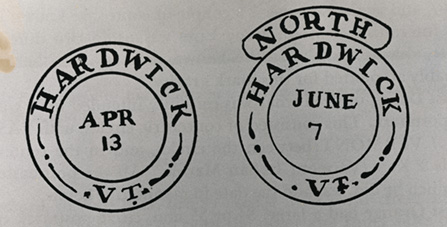
The stamp dates from about 1843, when the Postmaster Delano purchased a device for stamping letters. He simply added North to it when Hardwick’s main post office moved to East Hardwick.
East Hardwick
The term Stevens’ Mill appeared in the town records when the voters at town meeting in 1798 approved building a bridge there. It’s not clear, and it may not have been clear to the voters, whether the name represented the mills Samuel Stevens had established at the falls on the river or the small community growing up around them. In 1844, an ad for Dr. Sherman’s Poor Man’s Plaster pointed out that L.H. Delano and Son, in Hardwick (Hardwick Street), and M.R. Cheever, in Stevensville, both sold it.
Papers don’t tell us when the USPS opened a post office in Stevensville, but in 1846 it renamed that post office the Hardwick Post Office and renamed the post office on Hardwick Street as the North Hardwick Post Office. With that, people distinguished between North Hardwick or Hardwick Street, East Hardwick, and South Hardwick or Lamoilleville. The name “Stevensville” disappeared.
East Hardwick became the official name of that community in 1867 when the USPS changed the name of South Hardwick Post Office to Hardwick, and the Hardwick Office to East Hardwick. Alden Judevine (the way he spelled his name) served as the postmaster in South Hardwick, and I suspect he masterminded the changes. South Hardwick had more people than East Hardwick, and Judevine liked to be the top dog, so he would want to preside over the main post office in town.
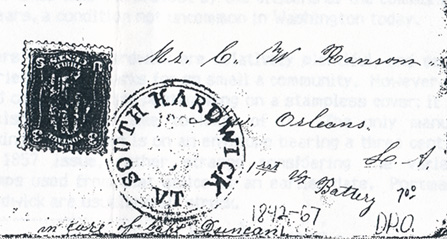
By the time LaMoille Ville became South Hardwick, mechanical stamps prevailed.
South Hardwick
In a 1914 speech to celebrate the renovation and reopening of the Hardwick Inn, Judge W. H. Taylor, mentioned that the area around Hardwick village had once been called Bugbee Hollow, named for Amos Bugbee who, around 1804 built a mill just up river from where Hay’s Service station now stands. Bugbee Hollow does not appear anywhere else in the newspapers.
The name South Hardwick appeared in an advice column in “The Ladies’ Department” of a Montpelier newspaper in 1812 and 1813, signed by a Miss H.J. Stone from South Hardwick. The name then disappeared for 30 years.
Lamoille Village came into popular use in the 1820s. It first appeared in the newspapers when, in 1827, G.P. Fish ran a “For Sale” ad for his mills and house in Lamoille village. Also that year, the USPS established a post office there and called it the Lamoilleville P.O. However, popular use of Lamoilleville never caught on, and it appeared mostly in “Proposals for Carrying the Mails of the United States….from Montpelier, by Calais, Woodbury, Lamoilleville, Hardwick (Hardwick Street), Greensboro and Glover to Barton” into the early1840s.
Hardwick Hollow appeared in the papers in 1827 in ads for a stallion available for service, then in 1835 and 1836 for itinerant ministers holding revivals in the area. In 1835, the Danville paper ran an announcement of a meeting at the Stone House Tavern in Hardwick to discuss a new road to run from “Hardwick Hollow to Danville Green,” now Route 15. The last use of the name Hardwick Hollow appeared in an 1853 ad for Dr. Upham’s Vegetable Electuary.
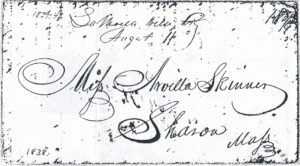
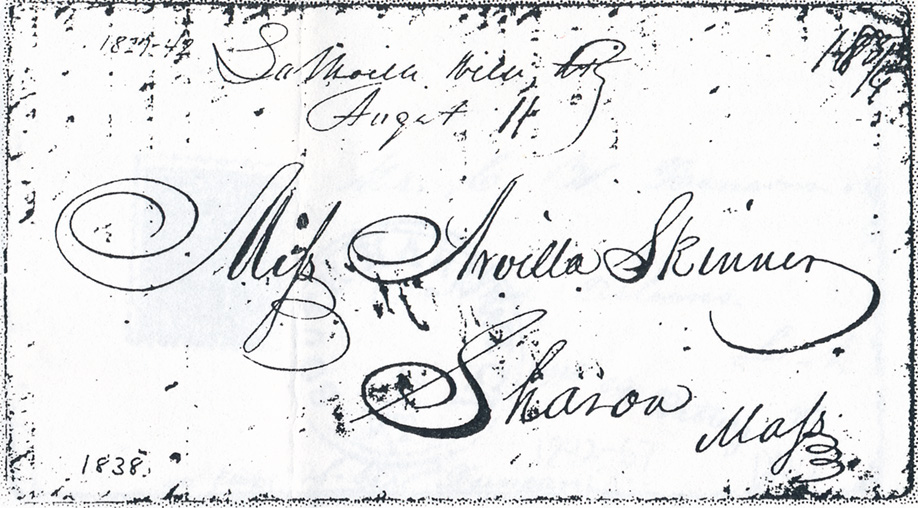
This 1838 letter has a hand stamp from
LaMoille Ville, Vermont.
In 1842, the Vermont Department of Education required towns to number their school districts according to population, and the district serving South Hardwick (Hardwick village today) became District No. 1, meaning it had the largest population.
In 1842, the USPS changed the Lamoilleville Post Office to the South Hardwick Post Office. Twenty-five years later, in 1867 it changed the name of the South Hardwick Post Office to the Hardwick Post Office, but residents continued to use South Hardwick as the name for their community. When the village of South Hardwick incorporated in 1891 and took Hardwick as its name, South Hardwick still remained popular; it last appeared in 1920, when the Barre Daily Times announced that Mr. and Mrs. Mayon Jameson of South Hardwick had visited Mr. and Mrs. H.O. Heath.
Mackville
Between 1812 and 1855, when people referred to the Hardwick village area as South Hardwick, Hardwick Hollow, Lamoilleville, and Lamoille Village they expected others to know where they meant. Mackville never had that problem. Mackville first appeared in the newspapers in March 1861 in the death notice of Resolved Mack. The notice described the village as “. . . in So. Hardwick . . .” The residents may have used that name among themselves, but seeing it in the paper made it feel official. Five months later, an announcement of a meeting in Mackville described it as, “a small, flourishing village in the town of Hardwick, situated one mile south of South Hardwick village.” And so it remains today.
An earlier version of this article appeared in Volume 11 Issue 2 (Fall 2021) of the Hardwick Historical Society Journal.
Dow is executive director and board secretary of NEK Public Journalism, publisher of The Hardwick Gazette.


