

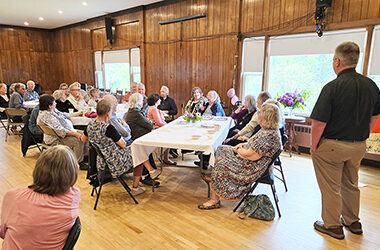

GREENSBORO – A Breezy Avenue scoping study informational meeting took place at the Fellowship Hall, May 5, with town staffer Joshua Karp emphasizing the importance of public input for the project.
The meeting included consultants from BHP, Evan Haugh and Brandon Roberts, who will guide the scoping study.
Haugh began with an introduction for both himself and the project, “I work with VHB on road and sidewalk design, and scoping studies. The purpose of Greensboro’s scoping study is to rule out what is not feasible, explore a few project alternatives that are feasible and develop cost estimates. This will prepare the town to apply for a future construction grant.”
The focus of the meeting was primarily on creating options for Breezy Avenue, considering a sidewalk or a wider shared-use path for bikes. The consultants shared they aim to provide cost estimates, timelines and assessments for the proposed options.
Following community input, the town expects to choose the preferred option, which will facilitate grant applications for construction.
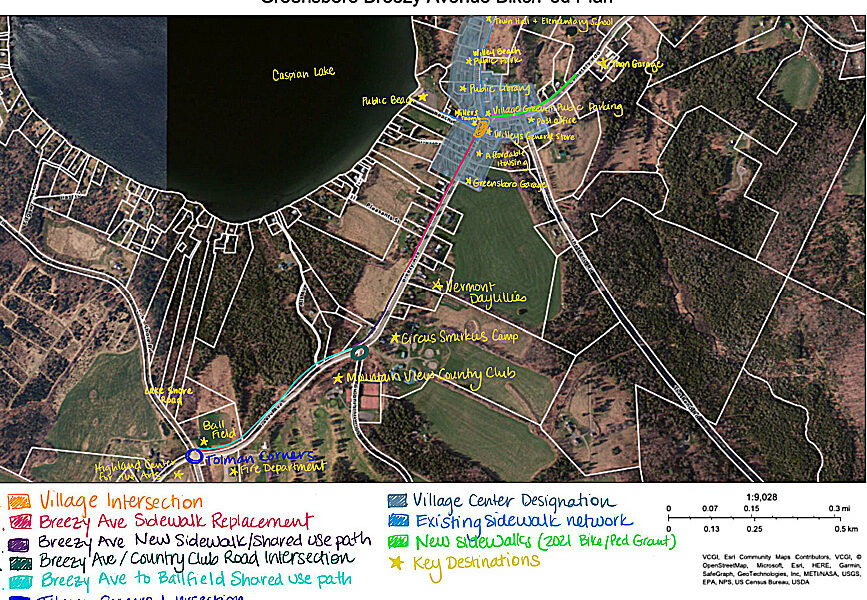
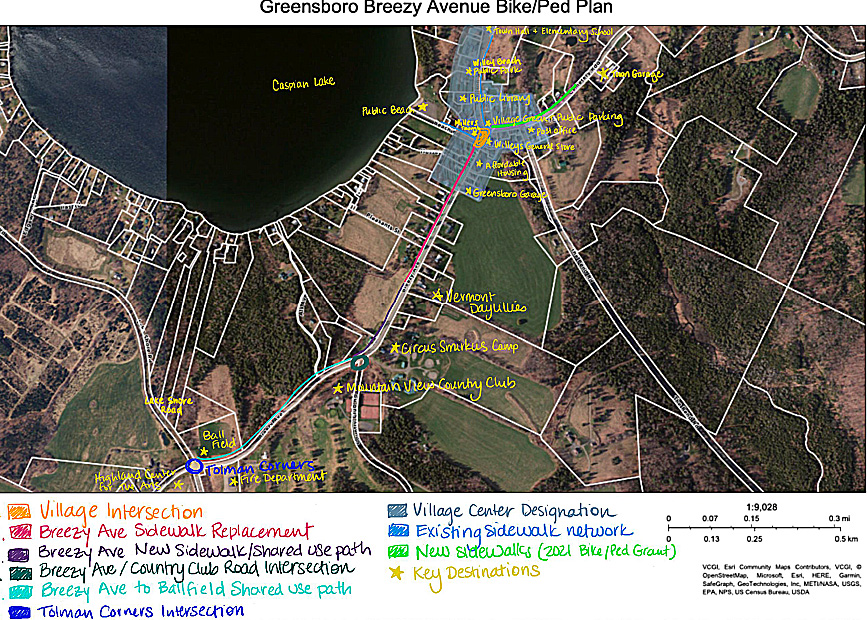
Haugh clarified the grant that the town has is to look at the area encompassing Willey’s Store, over to Tolman’s Corner, the intersections and the sidewalk between them. Some areas would require sidewalk replacement, some could have new sidewalks.
The consultants affirmed that the conditions of the sidewalk on Breezy Avenue have been deteriorating for some time, with areas having sunken lower than the road, pooling water. Reviewing the crash history of the area, they reported 17 crashes going back fifteen years, with Haugh saying more minor crashes often don’t get reported and filed.
Attendees ranged from residents to committee representatives, with public comments placing emphasis on pedestrian safety and accessibility, as well as potential uses. Some residents voiced concern over skate-skiers, who roll without brakes, coming down the hill towards Willey’s. Others noted specific areas that are in need of repairs, like the Lakeshore Road.
Haugh outlined the different types of sidewalk construction and widths, “The most basic ones are that you’ve just got your asphalt for the road, and you make it a little wider, and you paint something, but usually people want a little more protection than that. So usually, like, a default minimum would be you do a curb and a five-foot concrete sidewalk; the five feet being sized for a wheelchair to pass . . . You’re allowed to go down to four to get through a narrow spot, but really, five feet is the minimum. And it goes up from there, there has to be maybe just a six-foot sidewalk, maybe it’s an eight-foot path, which is the minimum where you can have bikes and pedestrians.”
Residents asked about the costs between a gravel sidewalk and a cement sidewalk, with Roberts responding, “I don’t think gravel is going to work on Breezy Avenue, because every time it rains they’re going to lose some of that gravel.”
Haugh elaborated, “When people do a path that isn’t paved, it’s usually either a crushed limestone instead of a true big rock gravel, or sometimes it’s a grass path. It is not a big savings to do crushed limestone, and even on permitting, it still counts as an impervious surface.”
Discussions continued, with the consultants taking down residents’ suggestions and observations.
Before the end of the year, VHB is scheduled to come up with a final report. Sometime in the next few months, Haugh says, they will return and present a list of alternatives, including potential costs and the requisite permits.

Raymonda Parchment is a Hardwick Gazette reporter. She recently graduated from Vermont State University - Castleton with a Bachelor’s Degree in English. She is a strong supporter of freedom of speech, and the right to publish information, opinions, and ideas without censorship or restraint. She is a lifelong lover of the written word, and is excited to join the team as a staff member.


