


EAST HARDWICK – Spring has sprung, with several new faces arriving to the Green Mountain Merino farmstead. Located in East Hardwick, Kevin and Karen Broderick have been cultivating a symbiotic relationship among the sheep and hops for some time. This year introduces a new line of Saxon-Merino ram genetics, acquired from Tasmania. The first Saxon-Merino babies arrived last week.
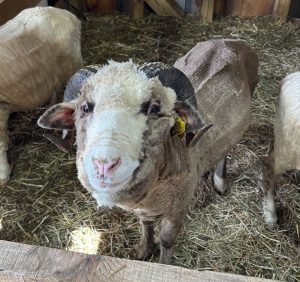
photo by Raymonda Parchment
The Easter season was action packed for the Broderick’s, with many new faces joining the flock around Holy Week. The first ram lamb arrived on Good Friday, April 18. Hera lambed twin ewes the following day. Persephone lambed a single ram on Easter Sunday. Ewe 0015 lambed twin ewes on April 21, with Demeter’s single ram arriving the next day. Athena also lambed a single ram. Ten lambs total have thus far joined the flock, which now amounts to 28 sheep.
Kristin Gallager of Aurora Spinnery was present, to help skirt wool using Broderick’s new skirting table. “I think it’s called skirting because you take the edge away,” she explained. The harvested wool is laid out in one piece, spread on the skirting table to inspect the wool. Generally speaking, there are two stripes on the side that are the best wool, Gallager said. “Often behind the neck and along the back is where vegetable matter is, so that’s what we’re going to look for. A lot of farms have a hard time with grazing animals, so there could be burdock in the fleece.” Gallager also checks for length, ideally three inches, and tests the strength of the fibers. Color variations in the wool can signify a stress or change in minerals in the diet. “Often having a baby is a stress, there could be a break in the wool. Anywhere that’s not on the very tips, that can be a problem for processing because it will break.” Breakage in the wool can result in pilling, which is less than desirable in finished products.
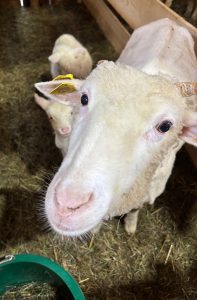
photo by Raymonda Parchment
The flock is shorn once a year, preventing a myriad of potential health complications such as urinary tract infections and mobility issues. Timing is key. The Brodericks book Mary Lake of Can-Do Shearing, located in Tunbridge, a year in advance. The ewes must be shorn prior to the lambkin’s arrival, again for both comfort, hygiene, and quality control.
“They have to get shorn, because they’ve been bred to grow the wool at the rate that they do,” Broderick added.
“You want to shear them before they lamb, it prevents the fleece from getting dirtier, and it’s more comfortable for the lambs too because they can find the udder. We don’t want to do it too early because they’re cold,” said Karen.
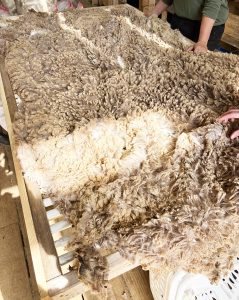
photo by Raymonda Parchment
The Brodericks highlighted Hera, a ewe with a colorful character and some notable quirks. This year is Hera’s last year lambing. “She’s difficult,” he said with a laugh. “She might go, because she’s so difficult.” Reviewing her highlights, Hera has proved herself an escape artist, refuses to nurse her young, and will not follow Broderick himself but will follow the other sheep. “If she gets loose, it takes us a day to find her, get her and get her back.”
Summing up her character, “If anybody was going be a serial killer in our flock, it would be this one,” said Broderick. But in spite of her quirks, she reportedly always has really healthy twins. “Their wool is so good, they never have any problems. Other than that she won’t take care of them.”
Athena, however, is more of a pet. “I would definitely sell Hera,” he said with a laugh, “I wouldn’t ever sell Athena. She is like a dog, if you go over and put your hand in she’ll let you sort of scratch her.”
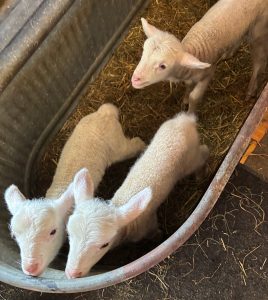
photo by Raymonda Parchment
This year, Hera’s twins are housed in the Broderick’s kitchen alongside a ram from a first-time mother. “Hera, always rejects. She’s really good, she makes really good healthy lambs with wool that’s really good, which is why I’ve kept her. She will not let them nurse, she cleans them up, and once that’s finished, she’s done. She’s like, “okay, your job,” and she acts like she doesn’t even know who they are.”
Inside the Broderick’s home, in the middle of the kitchen, rests a large metal tub. The tub belonged to Karen’s parents, from when they first got married and started their own farmstead.
The tub serves a temporary home to three lambs, Lucky, Victory, and Curio. Karen explained the story behind the unique monikers and more. “Our first born was this guy, we call him the lucky one. Lucky, because the mom was actually rejecting him, and was kicking him.” Atop Lucky’s head was a small bruise, evidence of his rough introduction. “Kevin scooped him up, and had to warm him up before he could start feeding him.” Otherwise, the temperature difference can send lambkins into shock.
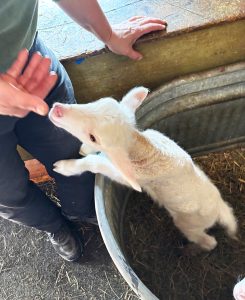
photo by Raymonda Parchment
The lambs are bottle fed every four hours. Victory is named for Karen’s mother, a nod to her middle name. Curio was named for her persistent curiosity, made evident by her attempts to leap out of the tub numerous times. The trio will be moving into a pen in the barn shortly, as they’ll be large enough to leap out of the tub soon. The Brodericks are in the process of completing their new home, along with other additions to the barn.

Raymonda Parchment is a Hardwick Gazette reporter. She recently graduated from Vermont State University - Castleton with a Bachelor’s Degree in English. She is a strong supporter of freedom of speech, and the right to publish information, opinions, and ideas without censorship or restraint. She is a lifelong lover of the written word, and is excited to join the team as a staff member.


