



WHITE RIVER JUNCTION – Native plants are great and all, but what if all they have at the garden center is a closely related, non-native species imported from Asia or Europe? Will it matter to our insect friends if you fudge the sourcing just a little bit?
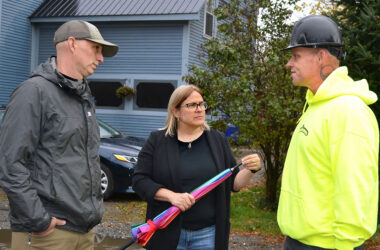
For a research paper published in May in the open-access journal Ecosphere, Vermont Center for Ecostudies (VCE) staff biologist Desirée Narango and her co-author Katherine Straley decided to find out.
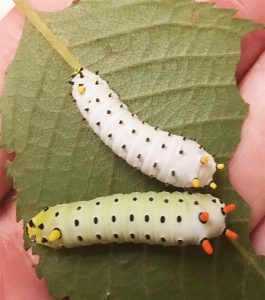
Together they reared more than 950 Promethea Silkmoth (Callosamia promethea) caterpillar larvae, which specialize on Prunus trees and shrubs (cherries, plums, peaches, nectarines, apricots and almonds) in the Northeastern United States. They raised caterpillars on leaf material from 14 different Prunus tree species commonly found in Massachusetts, from both trees growing wild (whenever possible) and cultivated landscaping trees (like street trees). They also included Prunus species native to Western Massachusetts, species native to other North American ecoregions, and species native to Europe and Asia, plus two non-Prunus plants as controls. They put this material into little aerated containers with the larvae and watched what happened.
The results were clear: tree species identity does make a difference.
The larvae grew slower, were smaller, and had higher mortality on non-native species such as Okame Cherry (P. incisa), Red-leaf Plum (P. cerasifera) and Sweet Cherry (P. avium). The larvae had the highest performance on their preferred host, Black Cherry (P. serotina), a native species commonly found in Western Massachusetts. That held true even if the tree was planted and not wild. Encouragingly, the caterpillars also fared similarly on other local Western Massachusetts and non-local (i.e. Canadian or coastal) native cherries like Fire Cherry (P. pensylvnica), Chokecherry (P. virginiana), Sand Cherry (P. pumila) and Maritime Plum (P. martima).
Narango and Straley believe the high performance on Black Cherry is due to its more ideal foliar nutrition, such as higher foliar water and nitrogen content, or lower defensive compounds. The non-native species commonly used in the Northeast might also be a poor substitute for native caterpillars because they have a foliar chemistry that our native species are not adapted to feed on. In addition, gardeners have selected for tree species that are pest-resistant and actively deter insect feeding, inadvertently reducing resources for beneficial native insects.
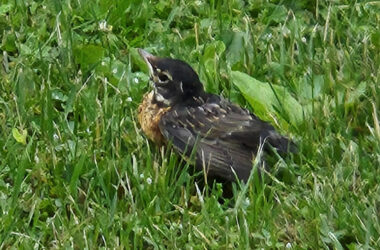
These results are not just relevant to Promethea moth populations, but also bird species, since caterpillars are a critically important food resource for insect-eating birds. Moreover, while the Promethea Silkmoth doesn’t feed as an adult, and so isn’t a pollinator, Narango believes these results have implications for other specialized caterpillar species that grow up to be pollinating butterflies and moth species. In their paper, Narango and Straley call for more studies that compare insect performance on native, near-native, and non-native species, to help inform what species we select in landscaping and restoration to support biodiversity conservation.
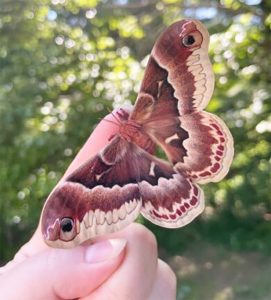
What does that mean for your garden or urban planning? First, if you want to see one of these beautiful moths around try planting native Black Cherry. Second, if you want to support insects and birds more generally, stick with your local native plant species whenever possible, and never buy “pest-resistant” plants from nurseries that use systemic pesticides. Finally, the data so far suggests that it’s okay to experiment with species from nearby regions, especially as we see warming average temperatures and altered soil conditions in our cities and suburbs.
Narango did this research as a David H. Smith Conservation Research Fellow at the University of Massachusetts, Amherst. She wrote the paper as a staff biologist at VCE, and continues to do similar research on how you can manage and restore gardens, parks, forests, and farms that serve as vibrant habitats for insects, birds and other wildlife.


